Xero Plus HR Apps Still Fragmented? Why All-in-One Wins
October 4, 2026 | By Gopareto Marketing

If you run an Australian small business, there is a good chance Xero is the centre of your finances. Your accountant works in it, your bank feeds land in it, and your invoices go out from it.
The people side is usually a different story. Over time, most Xero-centred businesses add an app for rostering, another for timesheets, perhaps a third for onboarding documents or HR records, and a spreadsheet for whatever falls between them. Each app connects to Xero. Very few of them connect properly to each other.
This article is not about replacing Xero—our Xero vs GoPareto comparison already explains why the two usually work best side by side. It is about the layer of HR apps around Xero: where that stack fragments, what it costs you, and how to tell when an all-in-one HR platform is the better shape.
What Xero Covers for Employers
It’s worth being accurate here, because Xero does more for employers than people often assume. For Australian businesses, Xero includes payroll on its plans (employee numbers and features vary by plan, so check current terms).
Xero handles well
- Accounting, bank reconciliation and BAS
- Customer invoicing and payment tracking
- Australian payroll with Single Touch Payroll reporting
- Basic leave requests and simple timesheets through its employee app
- A very large marketplace of connected apps
Usually added from elsewhere
- Attendance capture and clock-in/clock-out
- Rostering and shift planning
- Employee records, contracts and document expiry
- Onboarding and approval workflows
- Task and project time tracking for billable work
- Payroll for staff outside Australia, New Zealand or the UK
None of this is a criticism of Xero. It is an accounting platform with payroll attached, and its design assumes specialist apps will plug in around it. The question is what happens when you have plugged in three or four.
Where the Xero App Stack Fragments
Fragmentation rarely shows up as a single failure. It shows up at the seams—the places where one app hands data to the next. Map your own stack against these five.
| Seam | What should happen | What often happens instead |
|---|---|---|
| Roster → attendance | Actual hours are compared with rostered hours | Variances are checked by eye, or not at all |
| Attendance → payroll | Approved hours, overtime and penalties reach the pay run | Timesheets are exported, re-mapped to pay items and imported |
| Leave app → payroll | Approved leave reduces balances and is paid correctly | Two different balances, and employees ask which one is right |
| HR records → payroll | New starters, pay rises and exits flow through once | The same change is keyed into two or three apps |
| Project time → invoices | Billable hours become client invoices | Hours worked and hours billed never get reconciled |
Each seam might work most of the time. The problem is that you are now responsible for all of them, and a broken connector usually announces itself on payday or at month end, not when it breaks.
Why It Matters More in 2026
Two changes have made loose seams more expensive for Australian employers.
Payday Super from 1 July 2026
Super is now due in the employee’s fund within 7 days of each payday instead of quarterly. Late hours or leave data from an HR app means late or wrong super, with far less time to fix it.
12% Superannuation Guarantee
The SG rate reached 12% of ordinary time earnings on 1 July 2025. Correctly classifying earnings as ordinary time or not depends on clean data about hours, overtime and allowances.
Fair Work wage scrutiny
Underpayment enforcement continues to tighten. Proving compliance means showing hours worked, the award rate applied and the amount paid—often stored in three separate apps.
STP Phase 2 detail
STP Phase 2 reports pay in disaggregated categories. Pay items mapped inconsistently between apps produce reports that are technically lodged but wrong.
For the super side specifically, see our guide to the super contribution deadlines for 2027.
The Costs That Don’t Show on an Invoice
Subscription fees for a Xero app stack are easy to add up. The costs that decide whether the stack is worth it are the ones nobody invoices you for.
Time costs
- Re-keying the same employee change into several apps
- Exporting, mapping and importing timesheets each pay run
- Chasing down why two leave balances disagree
- Learning, training and supporting several interfaces
Risk costs
- Underpayments discovered months after the fact
- Late super under the new 7-day rule
- No single audit trail across hours, rates and pay
- Key-person dependency on whoever built the connections
A quick way to measure it: time one full pay run from “timesheets closed” to “payslips sent”, and count how many apps you touched. If the answer is more than two, the seams are where your time goes.
We have looked at the general maths of bundled versus multiple HR tools before; the Xero case is a specific version of the same trade-off.
What “True All-in-One” Actually Means
Plenty of products call themselves all-in-one because they connect to many things. That is not the same as being one system. A genuine all-in-one HR platform has these properties:
The all-in-one test
- One employee record used by HR, attendance, leave and payroll
- Approved hours and leave reach payroll without an export step
- Employees see their leave balance and payslip in the same portal
- Billable time can become an invoice without re-keying
- One audit trail from clock-in to payslip
- One vendor to call when something is wrong
If a product fails two or more of these, you are still assembling a stack—just with fewer logos.
Keep Xero for the Ledger, Consolidate the Rest
For most Australian SMBs with an accountant, the sensible end state is not “Xero or an HR platform”. It is a clear division of ownership:
| Area | Owned by | Why |
|---|---|---|
| General ledger, BAS, reconciliation | Xero | Your accountant already works there |
| Employee records, attendance, leave | All-in-one HR platform | These feed pay, so they belong next to it |
| Payroll calculation and payslips | All-in-one HR platform | Removes the attendance-to-payroll seam |
| Payroll journals and summaries | Passed to Xero | The ledger still needs the totals |
| Billable time and service invoices | Either, but only one | Pick one home so hours and billing reconcile |
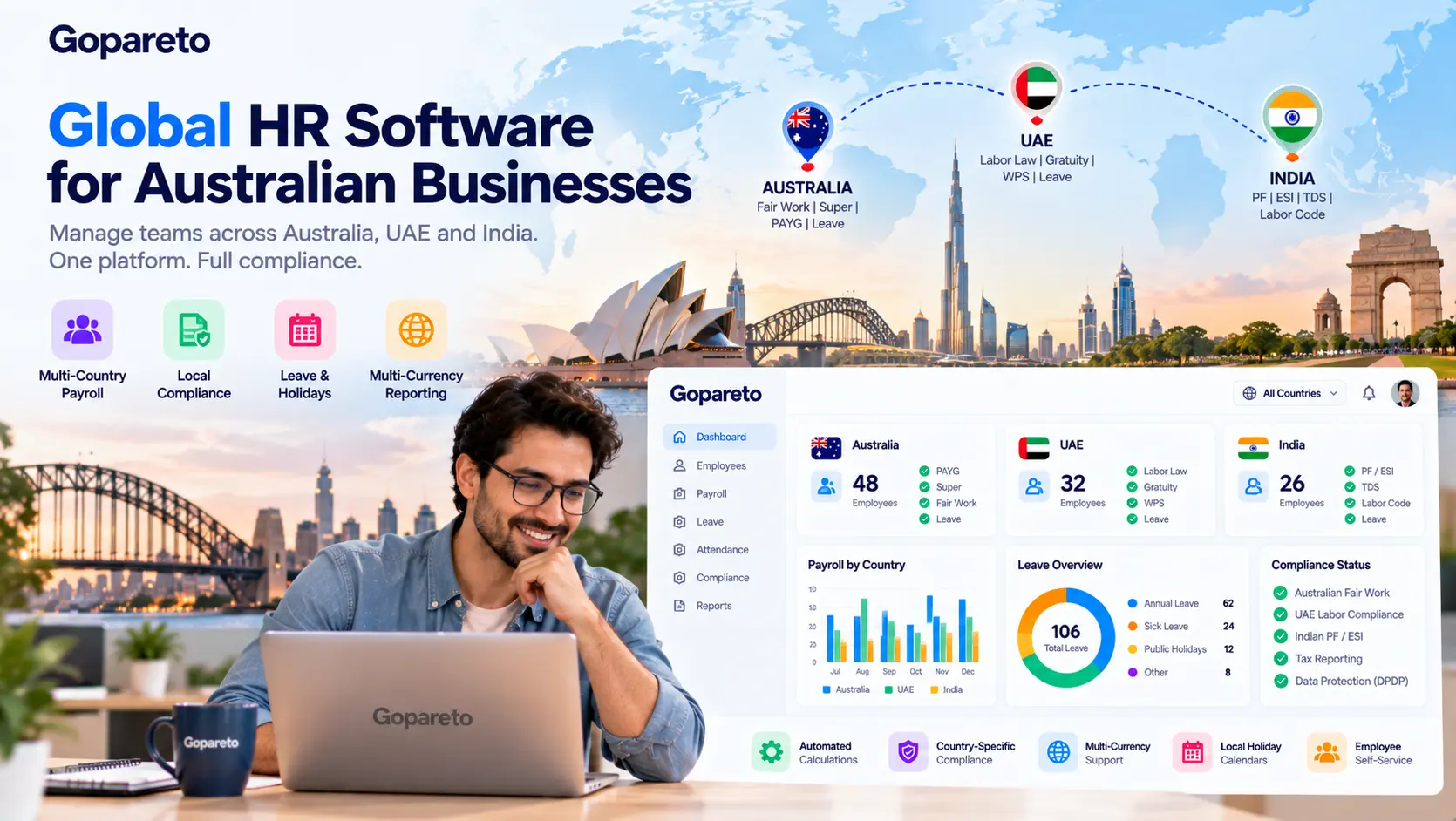
This keeps your accountant happy and collapses most of the seams into one system. If you also employ people in India or the UAE, the case is stronger again; our guide to global HR software for Australian businesses covers multi-country teams.
When Xero Plus Apps Is Still the Right Call
- Very small teams: one to four employees on simple salaries, where Xero’s own payroll and leave are enough.
- One add-on that works: if you have a single rostering app with a stable connection and nobody touches a spreadsheet, the stack isn’t fragmented.
- Accountant-run payroll: if your accountant runs pay in Xero from clean data you provide, adding a platform may not save much.
- Specialist needs: complex rostering for large shift-based workforces may justify a dedicated scheduling tool.
Switching Without Disrupting Pay
Map your seams
List every app, what data it holds and where that data goes. This becomes your migration scope.
Choose the cut-over point
Start of a pay period at minimum. Many businesses prefer 1 July, so the new system holds a full financial year for STP finalisation.
Reconcile balances and YTD
Agree leave balances, year-to-date earnings, tax and super for every employee before import.
Run in parallel, then retire apps
Process at least one pay in both setups, compare line by line, then cancel the apps you no longer need.
Frequently Asked Questions
Yes, for Australian businesses. The fragmentation usually comes from the attendance, rostering and HR apps added around it, not from Xero itself.
No. Most businesses keep Xero as the accounting ledger and move HR, attendance, leave and payroll into one platform alongside it.
They keep working in Xero. Payroll totals still reach the ledger; your accountant just stops receiving them from several directions.
Xero’s payroll covers a limited set of countries, which do not currently include India or the UAE. Check current coverage with Xero.
Conclusion
Xero is not the problem. The problem is the growing ring of HR apps around it, each connected to the centre and loosely connected to each other. With Payday Super shortening the window to fix mistakes, the seams between those apps are now a real cost.
Keep Xero for what it does best. Put the employee-facing work—records, attendance, leave and payroll—on one record, and let the totals flow to your ledger.
Ready to stop managing the seams?
How GoPareto Helps
- Attendance, leave, HR records and payroll on one employee record
- Approved hours and leave reach the pay run without exports
- Timesheets, tasks and invoicing for service businesses that bill time
- Payroll summaries your accountant can bring into Xero
Visit Us
GoPareto - Simple & Complete Business Management solution, Omkar Nandan Apartment, A1 201, near Navale Bridge, Kudale Baug, Narhe, Pune, Maharashtra 411041.
Related Blogs