Global HR Software for Australian Businesses Expanding Overseas
October 11, 2026 | By Gopareto Marketing
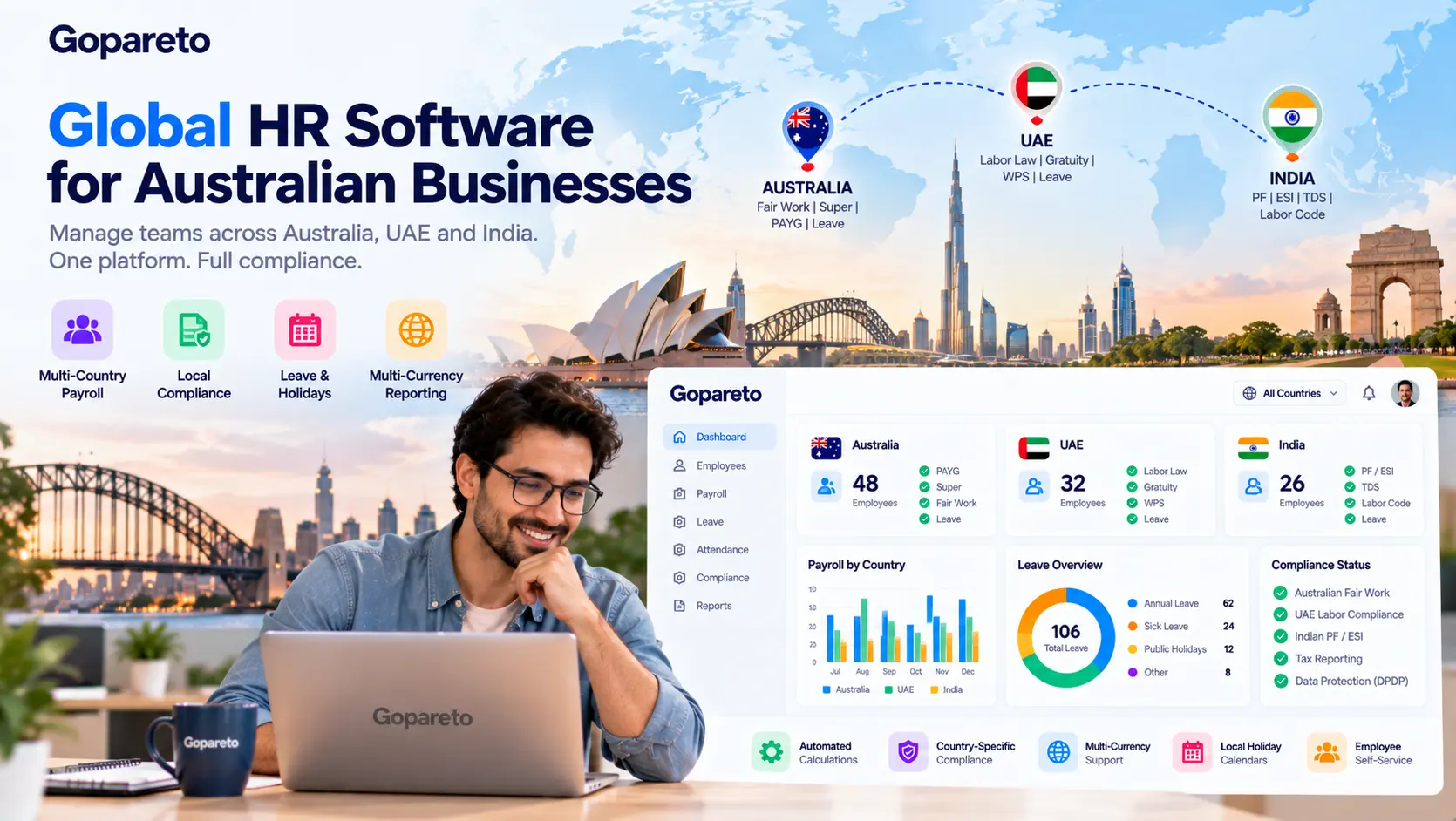
You built the business in Australia, on Australian rules: Fair Work, modern awards, PAYG withholding, Single Touch Payroll and super. Then growth takes you offshore—a development team in India, a sales office in Dubai, a few remote specialists elsewhere in Asia.
At that point the HR stack that worked at home starts to strain. Your Australian payroll software does not know what a Provident Fund is, has never heard of the UAE Wage Protection System, and assumes a financial year that starts on 1 July. Teams end up running the overseas staff on spreadsheets and a local bureau, and nobody has a single view of headcount, cost or compliance.
This guide is for Australian businesses at that stage. It covers how to structure overseas employment, what actually changes in India and the UAE, what global HR software needs to do, and how to move without disrupting payroll.
Step One: Decide How You Will Employ Overseas
Software comes second. First decide the legal model for each country, because it determines who runs payroll and which obligations sit with you.
Your own local entity
- An Indian private company, or a UAE mainland or free-zone company
- You register as the local employer and run local payroll
- In the UAE, a licensed entity is needed to sponsor employment visas
- Most control; most local administration
Employer of Record (EOR)
- A local provider employs staff on your behalf
- They handle local payroll filings and contracts
- Faster to start; a fee per employee
- You still manage the day-to-day work, leave and performance
Independent contractors
- Simple to set up, but only appropriate for genuinely independent work
- If a “contractor” works like an employee, local law may treat them as one
- In the UAE, anyone working needs the right permit for their work model
- Can create tax exposure for your business in that country
Secondment from Australia
- An Australian employee works overseas for a period
- Raises tax residency, super and local permit questions
- Needs advice before the move, not after
Many businesses mix models: an EOR in India while headcount is small, then an entity once the team grows. Your HR system should cope with that change without losing employee history.
What Changes When You Hire Outside Australia
The table below compares the obligations an Australian HR team already knows with their Indian and UAE equivalents.
| Area | Australia | India | UAE |
|---|---|---|---|
| Main law and regulator | Fair Work Act 2009; Fair Work Ombudsman; modern awards are federal | The four Labour Codes, in effect from 21 November 2025, plus state Shops and Establishments rules | Federal Decree-Law No. 33 of 2021; MoHRE (DIFC and ADGM have their own laws) |
| Income tax on wages | PAYG withholding, reported each pay run via STP Phase 2 | TDS on salary, deposited monthly and reported quarterly | No personal income tax on salaries |
| Retirement and social security | Super guarantee at 12% of ordinary time earnings; Payday Super from 1 July 2026 | PF at 12% employee + 12% employer; ESI at 0.75% + 3.25% for wages up to ₹21,000 a month | End-of-service gratuity for expatriates; pension contributions apply to UAE nationals |
| End-of-employment benefit | Accrued annual leave and long service leave (state-based) | Gratuity at 15/26 of last wage per year of service, generally after five years | Gratuity at 21 days’ basic wage per year for five years, then 30 days, capped at two years’ wage |
| Annual leave | 4 weeks a year under the NES (5 for some shift workers), accruing progressively | Set by state law and the Labour Codes; earned, casual and sick leave are common | 30 days a year after one year’s service |
| Typical pay cycle | Weekly, fortnightly or monthly | Monthly | Monthly, through WPS |
| Year end for payroll | 1 July – 30 June | 1 April – 31 March | No personal tax year; plan on the calendar year and your company’s accounting year |
| Privacy law | Privacy Act 1988 | Digital Personal Data Protection Act 2023 | Federal Decree-Law No. 45 of 2021 (PDPL); DIFC and ADGM have their own regimes |
| Currency | AUD | INR | AED |
Watch for borrowed rules
Guides on this topic often mix countries up: Australian annual leave quoted as 30 days, super at an out-of-date 11.5%, India’s DPDP Act applied to Australian staff, or UAE gratuity described as a percentage of salary. Each country’s rules should be configured from that country’s law. For the UAE detail, see our guide to UAE employment law for HR in 2027; for India, our India labour law compliance guide.
What Global HR Software Must Do
“Supports multiple countries” can mean anything from a translated interface to genuine local compliance. These are the capabilities that matter for an Australian business with staff in India and the UAE.
Rules by work location
Leave, holidays, overtime and end-of-service rules attached to where each employee works, not one company-wide policy.
Country-specific payroll outputs
STP and super for Australia, PF, ESI and TDS for India, and WPS-ready salary data for the UAE, from the same employee records.
Local currency pay, consolidated view
Employees paid in AUD, INR or AED, with headcount and cost reports you can read in AUD for the board.
Holiday calendars per country and state
Australian state holidays, Indian national and state holidays, and UAE holidays that move with moon-sighting announcements.
End-of-service calculations
UAE and Indian gratuity, plus Australian leave payouts on termination, calculated from the record rather than by hand.
Attendance that feeds payroll
Hours, overtime and leave captured once, in each time zone, and flowing into each country’s pay run.
Self-service for every location
Employees in Dubai or Bangalore check payslips and leave balances without emailing Sydney.
One audit trail
Every approval and change logged, so you can answer the Fair Work Ombudsman, EPFO or MoHRE from the same system.
Red Flags When Evaluating “Global” HR Software
Localisation in name only
- Country listed on the website, but no local leave or end-of-service rules
- “Enter your own tax rates” as the answer to statutory calculations
- One payroll engine with currency conversion bolted on
Fragmented behind the scenes
- Each country run by a separate partner system you can’t see into
- No consolidated reporting across countries
- Employee history lost when someone moves country or entity
Vague answers on data
- No clear statement of where data is stored and who can access it
- No support for cross-border transfer requirements under the Privacy Act, DPDP Act or UAE PDPL
- Blanket claims that a country “requires local data residency” for all HR data are an oversimplification; ask the vendor to explain their position for each law
Example: A 20-Person Team Across Three Countries
Take a business with 8 staff in Sydney, 7 in Dubai and 5 in Bangalore. With one HR system, the monthly cycle looks like this:
| Stage | Sydney | Dubai | Bangalore |
|---|---|---|---|
| Time and leave | Timesheets and leave against the relevant award and NES | Attendance, overtime premiums and UAE leave tiers | Attendance, earned and casual leave under state rules |
| Pay run | PAYG withheld, STP report lodged, super paid with wages under Payday Super | Salaries paid via WPS by the due date; gratuity liability updated | PF, ESI and TDS calculated; challans and returns prepared |
| Payslips | Award-compliant payslips in AUD | Payslips in AED showing overtime and deductions | Payslips in INR showing statutory deductions |
| Reporting | One headcount, leave liability and payroll cost report, viewable by country or consolidated in AUD | ||
Without a shared system, the same cycle typically means three payroll tools, a spreadsheet to merge them, and month-end reconciliations that depend on one person remembering every country’s rules. The risk is less about time than about errors no one notices until an employee leaves or a regulator asks.
Australian deadlines don’t pause while you expand. Keep an eye on the 2027 super contribution deadlines and the Fair Work compliance calendar alongside your new obligations.
Accounting, Currency and Board Reporting
- Choose a reporting rate policy: either convert overseas payroll at the actual rate on each pay date, or use a fixed budget rate and report variances. Agree this with your accountant before the first overseas pay run.
- Separate entity ledgers: if you have local entities, each keeps its own books in local currency; consolidation happens in AUD.
- Check the export path: confirm how payroll journals will reach your accounting system, whether that is Xero or MYOB in Australia or Tally in India, and test it with a real pay run.
- Mind the year ends: India’s tax year ends on 31 March and Australia’s on 30 June, so year-end processing lands in different quarters.
If you are weighing an accounting-led HR approach, our comparison of Xero and GoPareto for Australian businesses explains where each fits.
Moving to a Single System
Map every employee
Record country, entity or EOR, work model, currency and the rule set that applies to each person.
Migrate balances, not just names
Bring across leave balances, service start dates for gratuity and long service leave, and year-to-date payroll figures.
Run a parallel payroll
Run at least one pay cycle in both systems for each country and reconcile every difference before switching.
Time the switch
Avoid cutting over in a country’s year-end month: June for Australia, March for India.
On cost, compare the total, not just subscription fees: separate tools, bureau charges, EOR fees and the hours spent reconciling. Pricing models differ widely between vendors, so get quotes for your actual headcount in each country.
Frequently Asked Questions
Usually you need either an Indian entity or an Employer of Record to register for PF, ESI and TDS. Engaging people as contractors only works for genuinely independent work.
No. Expatriate employees in the UAE receive end-of-service gratuity instead, and UAE nationals are covered by pension contributions.
It should. Look for leave policies attached to each employee’s work location, with separate holiday calendars per country and state.
Payroll tax, public holidays and long service leave all vary by state. Our guide to HR software for multi-state and multi-country compliance covers the mechanics.
Conclusion
Expanding from Australia into India and the UAE means taking on three sets of employment law, three payroll calendars and three currencies. Settle the employment model in each country first, then choose HR software that applies each country’s rules by work location while giving you one record, one audit trail and one consolidated view in AUD. Get local advice for the legal set-up; let the system carry the everyday compliance.
Ready to manage your global team from one place?
How GoPareto Helps
- HR, attendance, leave and payroll for Australia, India and the UAE in one platform
- Leave, gratuity and end-of-service rules built in for each country
- Multi-region holiday calendars and payslips for every location
- An employee self-service portal and a single audit trail across countries
Visit Us
GoPareto - Simple & Complete Business Management solution, Omkar Nandan Apartment, A1 201, near Navale Bridge, Kudale Baug, Narhe, Pune, Maharashtra 411041.
Related Blogs