How to Handle Employee Records Correctly: Legal Requirements by Jurisdiction
September 28, 2026 | By Gopareto Marketing
Employee records are the legal foundation of the employment relationship. They document hiring decisions, compensation changes, performance evaluations, disciplinary actions and separations. Handling them properly protects both employees and employers—and getting it wrong creates significant legal liability.
Yet many organisations misunderstand employee records legal requirements. They store documents inconsistently, delete records too early, fail to maintain audit trails, or aren’t sure what must be documented in the first place.
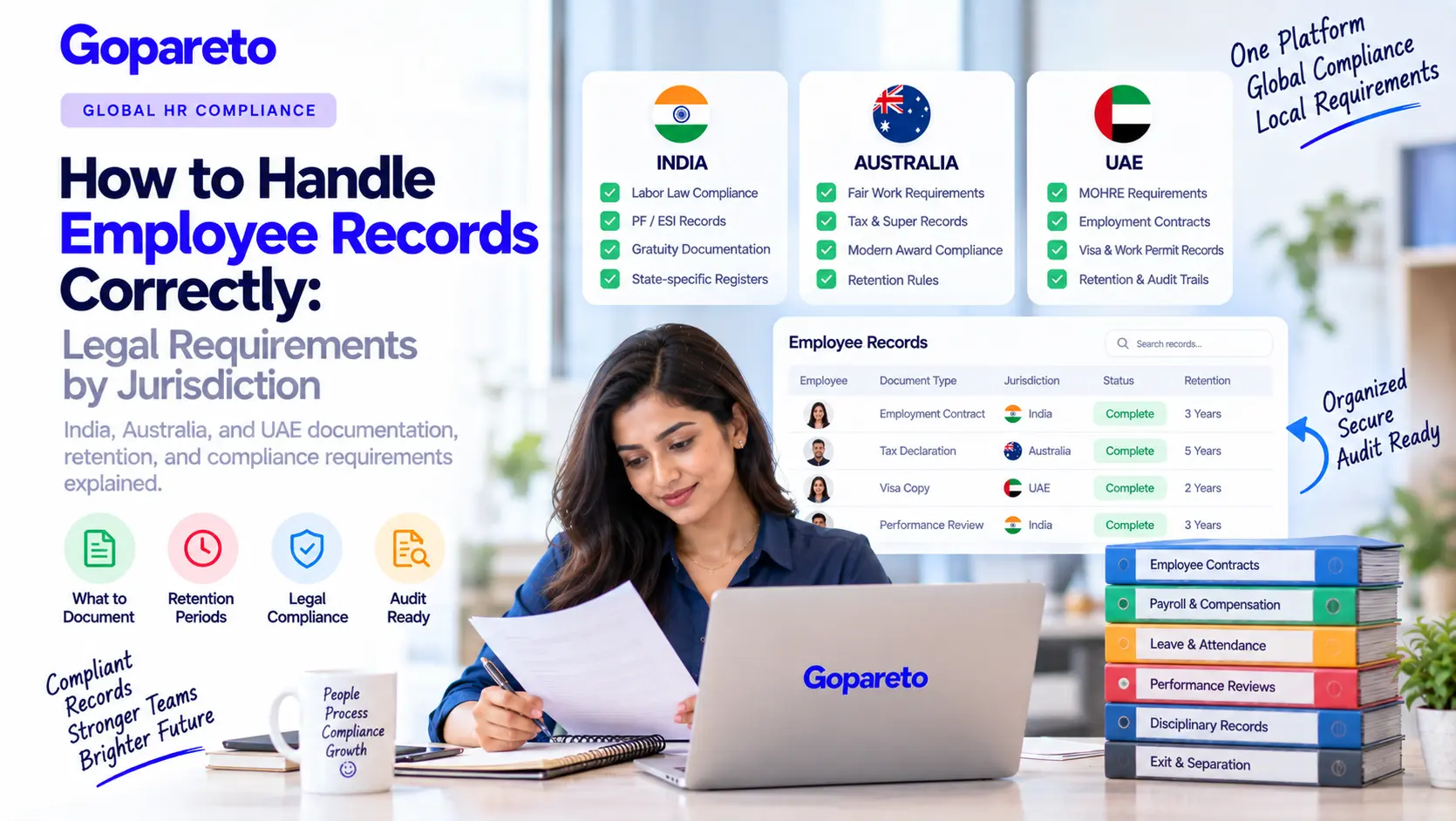
This guide explains how to handle employee records correctly across India, Australia and the UAE: what to document, how long to retain it, and which audit trails prove compliance.
Why Employee Records Matter
Employee records serve four distinct legal purposes. Without them you cannot prove compliance, even if you followed every procedure.
1. Proof of compliance
- Background checks completed before hiring
- Offer letter and acceptance documented
- Tax withholding forms signed and filed
- Leave approval workflows followed
- Termination procedures documented
2. Dispute resolution
- Performance evaluations showing issues were documented
- Disciplinary warnings showing progressive discipline
- Leave balances supporting final settlement calculations
- Time cards showing hours worked
- Termination documentation showing proper process
3. Regulatory audit
- India: labour authorities, EPFO and ESIC inspect gratuity, PF and ESI compliance
- Australia: the Fair Work Ombudsman investigates wage and entitlement complaints
- UAE: the Ministry of Human Resources and Emiratisation (MoHRE) inspects and enforces labour law compliance
4. Evidence in litigation
- Discrimination claims: records proving non-discriminatory treatment
- Wrongful termination: records showing the reasons for termination
- Wage disputes: time cards, payroll records and salary agreements
The bottom line: audit-ready records prevent penalties and reputational damage, and organisations without records typically settle disputes at a higher cost.
India: Employee Records Legal Requirements
Indian employment law requires comprehensive employee records under multiple statutes, each with its own registers and retention expectations.
Core Legislation
| Law | What it requires | Retention |
|---|---|---|
| Shops and Establishments Act (state-specific) | Registers and records of employment, wages, attendance and leave | Commonly 3 years minimum; varies by state |
| Payment of Gratuity Act, 1972 | Gratuity records and continuous service calculations | Keep permanently (long-term reference) |
| Employees’ Provident Fund Act, 1952 | PF eligibility records and contribution documentation (monthly ECR filings) | 5 years after PF closure |
| Employees’ State Insurance Act, 1948 | ESI eligibility and contribution records | 5 years after coverage ceases |
| Digital Personal Data Protection Act, 2023 | Lawful basis for processing, security safeguards, retention and erasure practices | Only as long as the purpose requires |
Labour codes
India’s four labour codes consolidate many of the statutes above, including PF, ESI and gratuity. As they are implemented, check whether your registers and returns have moved to code-prescribed formats. Our guide to PF, gratuity and leave compliance in an HRMS covers the calculations these records must support.
Mandatory Employee Records in India
1. Permanent employee file
- Name, address, date of birth, father’s or spouse’s name
- Passport or ID copy; Aadhaar where applicable
- PAN (income tax number)
- Emergency contact
- Educational qualifications with certificates
- Previous employment details
- Medical fitness certificate (for certain roles)
2. Appointment records
- Offer letter and acceptance
- Signed employment agreement
- Terms and conditions, signed by the employee
- Joining date and initial salary
3. Compensation records
- Salary structure (basic, DA, HRA, other allowances)
- Salary changes with effective date and reason
- Bonus and incentive calculation basis
- TDS documentation
4. Leave records
- Leave policy acknowledged by the employee
- Leave accrual schedule
- Leave approvals, including approver
- Monthly or annual leave balance statements
- Leave without pay (LWP) dates and reasons
- Leave encashment calculation at separation
5. PF and ESI records
- PF eligibility and enrolment (UAN) details
- Employee and employer contributions (ECR filings or equivalent digital record)
- PF withdrawal or transfer forms, if any
- ESI enrolment and claim documentation, if applicable
6. Gratuity records
- Gratuity eligibility confirmation
- Continuous service calculation, including breaks and LWP
- Calculation: last drawn salary, years of service, formula
- Payment record and receipt
7. Performance and discipline
- Annual reviews (date, rating, supervisor sign-off)
- Promotion and increment approval letters
- Disciplinary warning letters, if any
- Suspension or termination documentation
- Separation settlement letters
8. Tax and compliance
- Form 16 (salary TDS certificate) copies
- Form 16A, where non-salary TDS applies
- Statutory compliance certificates
- Court orders, if any
- Employee compensation records if an injury occurred
9. Resignation and termination
- Resignation letter signed by the employee
- Acceptance of resignation
- Last salary and settlement details
- Full and final settlement calculation
- Gratuity payment proof
- Leave encashment proof
- Any severance or compensation
- Exit interview, if conducted
- Relieving letter issued to the employee
Retention Requirements in India
| Document type | Retention period | Reason |
|---|---|---|
| Permanent employee details | Permanent | Legal reference |
| Salary and compensation records | 3 years minimum; 5+ years better | Audit compliance |
| Leave records | 5 years minimum after separation | Gratuity and settlement disputes |
| PF records | 5 years after PF closure | EPFO audit |
| ESI records | 5 years after coverage ceases | ESI audit |
| Gratuity records | Permanent | Legal reference |
| Performance reviews | 5 years minimum | Dispute resolution |
| Discipline records | 5 years minimum | Litigation evidence |
| Tax compliance (TDS, Form 16) | 5 years minimum | Income tax assessment |
| Resignation and termination | 7 years minimum | Dispute resolution |
Best practice for India: retain all employee records for 7 years after separation. Some regulated sectors may require longer.
State-Specific Registers
Shops and Establishments rules differ from state to state, so multi-state employers need a register set for each location.
Maharashtra
- Time and attendance records (muster roll)
- Wages register
- Leave register
- Gratuity records kept permanently; other registers typically 3 years
Delhi
- Muster roll (attendance)
- Wages register
- Leave register
- Retention: 3 years minimum
Tamil Nadu
- Registers broadly similar to Maharashtra
- State-specific holiday calendar per Tamil Nadu regulations
Audit Trails and DPDP Compliance in India
The Digital Personal Data Protection Act, 2023 and its Rules change how employee data must be handled. Employers can process personal data for employment purposes as a legitimate use, but they still need clear notices, reasonable security safeguards and defined retention and deletion practices. The records below are how you demonstrate that.
Consent and notice records
- Consent or notice for data collected beyond core employment purposes
- A clear purpose statement for each data category
- Records of any consent withdrawals
Access logs
- Who accessed employee data, and when
- What data was accessed
- Why it was accessed (purpose)
Modification logs
- Who modified employee data, and when
- What changed
- The reason for the change
Data security records
- Encryption status of employee data
- Access control documentation
- Data breach incident reports and notification records
Keep access and modification logs for at least the period the DPDP Rules prescribe, and many employers choose 3 years for internal consistency. For a full walkthrough, read our guide to employee data protection under the DPDP Act, and see how to check that your HR software is DPDP compliant.
Australia: Employee Records Legal Requirements
Australian employers must keep employee records under the Fair Work Act 2009 and the Fair Work Regulations, alongside tax, superannuation and work health and safety obligations.
Core Legislation
| Law | What it requires | Retention |
|---|---|---|
| Fair Work Act 2009 | Records proving minimum wages, entitlements, leave (annual, personal, long service), hours of work and award conditions | 7 years |
| Privacy Act 1988 | Protection of personal information under the Australian Privacy Principles; data held for its stated purpose only | As long as needed for that purpose |
| State and territory WHS laws | Incident reporting and investigation records, health and safety registers | Until resolved, plus the statutory period |
Record-keeping breaches are penalised
- Failing to keep or produce required records is a civil penalty contravention under the Fair Work Act
- Penalties are assessed per contravention and can reach tens of thousands of A$ for a company
- Where records are missing, the burden can shift to the employer to disprove an employee’s wage claim
Note that the Privacy Act contains an exemption for private-sector employee records directly related to the employment relationship, but it does not cover every HR record or every contractor, so treat personal data carefully regardless.
Mandatory Employee Records in Australia
1. Permanent employee file
- Full name, date of birth, address
- Tax file number (TFN)
- Superannuation fund name and member number
- Banking details for salary deposit
- Emergency contact
- Qualifications and licences relevant to the role
- Health and safety information
2. Appointment records
- Offer letter and acceptance
- Signed employment agreement
- Position title and employment type (permanent, fixed-term, casual)
- Start date
- Remuneration details
3. Compensation and superannuation
- Salary or wage rate, payment method and frequency
- Remuneration changes (date, amount, reason)
- Superannuation contribution records and fund details
- Payslips, electronic or paper
- Tax withholding declarations
4. Leave records
- Entitlements under the award or agreement
- Annual leave accrual and usage
- Personal (sick and carer’s) leave usage
- Long service leave accrual (state-specific)
- Paid parental leave records
- Applications, approvals and balance statements
- Any leave disputes and their resolution
5. Time and work records
- Timesheets, especially for award-covered employees
- Start and end times, and breaks taken
- Overtime and shifts worked
- Any unpaid work performed
6. Award compliance
- A copy of the applicable award or agreement
- Award rates in effect, by date
- Allowances and penalty rates paid
- Documentation showing award requirements were met
- Agreed variations or flexibility arrangements
7. Performance and discipline
- Performance reviews and improvement plans
- Promotion and increment letters, with conditions
- Disciplinary warnings and suspension records
- Termination documentation
8. Health and safety
- Incident reports, including near-misses
- Investigation documentation
- Medical reports for workers’ compensation claims
- Return-to-work documentation
- Health and safety training records
9. Payroll records
- Payroll schedule and cycle
- Gross and net pay details
- Deductions: tax, superannuation, voluntary
- Payslip copies
- Single Touch Payroll reports and end-of-year income statements
10. Termination records
- Resignation letter or termination notice, dated
- Reasons for termination
- Final pay calculation: accrued annual leave, long service leave, notice pay, redundancy
- Final payment records and payroll reconciliation
- Tax and superannuation documentation
Retention Requirements in Australia
| Document type | Retention period | Reason |
|---|---|---|
| Employment contract and variations | 7 years minimum after termination | Fair Work Act requirement |
| Payroll and superannuation records | 7 years minimum | Tax and Fair Work compliance |
| Leave records | 7 years minimum after termination | Leave entitlement disputes |
| Time and wages records | 7 years minimum | Award compliance proof |
| Discipline and termination | 7 years minimum after termination | Litigation evidence |
| Performance reviews | 5 years minimum | Discrimination defence |
| Health and safety records | 5+ years (longer for serious incidents) | WHS compliance |
| Training records | Duration of employment + 3–5 years | WHS and competency proof |
Best practice for Australia: retain all employee records for 7 years after termination.
Award Compliance Proof
Australian employers must be able to prove they comply with award conditions. Non-compliance is a Fair Work contravention and can lead to back-pay claims.
What your records must show
- A current, dated copy of the applicable award
- Correct minimum wages paid
- Shift, weekend and other allowances paid per the award
- Casual loading and penalty rates applied correctly
- Leave accrued per the award and the NES (at least 4 weeks’ annual leave for full-time employees)
- Leave paid at the correct rates, with no unauthorised deductions
- Hours worked that align with award conditions
- Any variation from award terms documented and agreed
For the dates these records feed into, see the Fair Work Australia compliance calendar for 2027.
UAE: Employee Records Legal Requirements
In the UAE, private-sector employment is governed by Federal Decree-Law No. 33 of 2021 (the UAE Labour Law) and its Executive Regulations, with the Ministry of Human Resources and Emiratisation (MoHRE) as the regulator. Free zones such as DIFC and ADGM have their own employment laws.
Core Requirements
UAE Labour Law
- Comprehensive employee records and an employee file for each worker
- Registered employment contracts and variations
- Payroll records (via the Wage Protection System) and leave records
- Plan to retain records for at least 5 years after termination
MoHRE oversight
- Issues work permits and registers contracts
- Conducts inspections and audits
- Requires records to be available for verification
- Tracks Emiratisation targets for applicable employers
Mandatory Employee Records in the UAE
1. Government registration
- Employee name and Emirates ID number
- Date of hire, job title and position
- Salary
- Employment type (full-time, part-time, temporary)
- Work permit and contract registered with MoHRE
2. Permanent employee file
- Full name, nationality, date of birth
- Emirates ID and passport copies
- UAE address and emergency contact
- Qualifications and licences
- Previous UAE employment
- Visa and sponsorship documentation
3. Employment contract
- Written contract in Arabic, with a translation in the employee’s language where relevant
- Signed by both parties
- Job title and duties, salary and payment frequency
- Benefits, leave entitlements and working hours
- Terms of termination
- Every variation documented
4. Compensation and benefits
- Salary structure (basic and allowances)
- Payment schedule and method
- Bonus structure, if applicable
- Allowances and deductions
- End-of-service gratuity calculation basis
- Health and life insurance details
- Payslips for each payment
5. Leave records
- Annual leave entitlement (30 days a year after one year’s service)
- Leave applications and approvals
- Leave taken and balance statements
- Sick leave, with medical certificates where required
- Maternity, parental and bereavement leave
- Unpaid leave, if any
6. Attendance and time records
- Timesheet or attendance register
- Start and end times
- Attendance pattern for pay and leave calculations
- Absences, including unauthorised absences
7. Salary and payroll
- Payment records and salary slips
- Deductions, if any
- Benefits paid
- Overtime, if applicable
- Salary changes
8. Performance and discipline
- Documented performance concerns
- Disciplinary warnings, if issued
- The employee’s opportunity to respond to allegations
- Investigation documentation
- Termination decision and reasons
9. End-of-service gratuity
- Continuous service calculation
- 21 days’ basic wage per year for the first 5 years
- 30 days’ basic wage for each year beyond 5
- Pro-rata calculation for partial years
- Payment proof and employee clearance
10. Visa and sponsorship
- Sponsorship documents and employment visa
- Visa cancellation on separation
- Attested certificates
- Any NOC or transfer documentation
End-of-service example: an employee with 7 years’ service and a basic wage of AED 10,000 a month (about AED 333 a day) earns 5 × 21 = 105 days plus 2 × 30 = 60 days, so 165 days, or roughly AED 55,000. Your records must show the basic wage, service dates and any unpaid absences behind that figure.
Retention Requirements in the UAE
| Document type | Retention period | Reason |
|---|---|---|
| Employment contract and variations | Permanent, or 5 years after termination | Legal reference |
| Payroll and salary records | 5 years | Labour law compliance |
| Leave records | 5 years | End-of-service calculation disputes |
| Attendance records | 3 years | Wage and leave calculation |
| Discipline and termination | 5 years | Dispute resolution |
| End-of-service documentation | Permanent | Permanent record |
| Visa and sponsorship | During employment + 3 years | Government requirement |
Best practice for the UAE: retain all employee records for 5+ years after termination.
Government Registration Requirements
Maintain an employee register
Keep an up-to-date register and file for every employee, covering the records listed above.
Register with MoHRE
Obtain the work permit and register each employee’s contract with MoHRE within the required timeframe.
Give the employee a copy
Provide every employee with a copy of their signed contract and any variations.
Stay inspection-ready
Keep records accessible for government inspection. Non-compliance results in fines and can restrict new work permits.
Audit Trails: Documentation That Proves Compliance
Beyond storing records, you need audit trails that prove how records were handled. In every jurisdiction, they are what turns a file into evidence.
Access logs
- Who accessed employee records
- When access occurred
- What records were accessed
- Why access was needed
Modification logs
- Who modified the record, and when
- What changed (old value → new value)
- Reason for the modification
- Approval, where required
Approval workflows
- Leave approval chain: who approved, and when
- Termination decisions: who decided, when, and why
- Salary change approvals
- Expense and reimbursement approvals
Retention compliance
- When records were deleted
- Reason for deletion
- Who authorised it
- Proof of destruction for sensitive documents
Why Audit Trails Matter
- Data integrity: records weren’t altered
- Authorisation: proper procedures were followed
- Retention: policies were applied consistently
- Transparency: no hidden or secret records
The audit trail shows when leave was approved, by whom, and under which policy.
The audit trail shows who made the hiring decision, which records were reviewed, and when.
The audit trail shows the payroll record, who created it and who modified it.
Leave is where most disputes start; our guide to avoiding leave-related legal disputes covers the documentation in more depth.
How to Handle Employee Records Correctly: Best Practices
Create a record retention policy
Document what records are kept, for how long by type, where they are stored, who has access, how they are destroyed, and exceptions such as litigation holds.
Implement secure storage
Physical files in locked cabinets with HR-only access and off-site backups. Digital records encrypted, with role-based access, logged access, regular backups and a disaster recovery plan.
Establish clear audit trails
Log every access (who, what, when, why) and every modification (old value, new value, who, when, reason). Keep audit logs for at least 3–5 years.
Document approval workflows
Record who approved leave and salary changes, when and under which policy. For discipline, record the incident, investigation, decision and the employee’s chance to respond.
Comply with data protection laws
DPDP in India: notice, security safeguards, employee data access. Privacy Act in Australia: respect privacy principles. GDPR where it applies: access, deletion and portability rights.
Audit regularly
Quarterly, check every mandatory document is present. Annually, test that expired records are properly destroyed. After any dispute, review records for accuracy.
Train HR and managers
Cover required documents, confidentiality, retention and audit trail requirements, and DPDP and Privacy Act obligations. Our framework for making sure employees understand company policies applies equally here.
Technology Support: HRMS for Employee Records
A modern HRMS takes most of this burden off HR by building the requirements into everyday workflows.
- Centralised employee file: all records in one secure location
- Audit trails: automatic logging of access, changes and approvals
- Retention management: alerts for retention periods and secure deletion
- Access control: role-based, with limited manager views
- Document management: records organised by type and searchable
- Compliance reporting: export audit trails and records for audits
- Multi-region templates: compliance checklists by jurisdiction
- Data security: encryption, backup and disaster recovery
- Employee portal: self-service access to their own records, supporting DPDP rights
Summary: Employee Records Compliance Checklist
India
- Mandatory records by statute: employee details, leave, PF, gratuity, discipline
- Retention: 7 years after separation as best practice
- DPDP compliance: notices, security safeguards, access logs, deletion capability
- Gratuity records in the prescribed format
- State-specific Shops and Establishments registers
- Audit trails: access logs, modification logs, approvals
Australia
- Fair Work compliant records for every employee
- Retention: 7 years after termination
- Award compliance proof: applicable award, wages, allowances, penalty rates
- Payroll and superannuation records
- Time and wages records
- Incident and WHS records
- Privacy Act compliance for employee data
UAE
- MoHRE registration: work permits and registered contracts
- Employment contract in Arabic, with the employee’s language where relevant
- Payroll and salary records
- Leave records
- End-of-service gratuity documentation
- Visa and sponsorship documentation
- Retention: 5+ years after termination
Ready to implement compliant records?
How GoPareto Helps
- A centralised, secure employee file for every worker in India, Australia and the UAE
- Mandatory record checklists and retention schedules by jurisdiction
- Automatic audit trails of every access, change and approval
- Role-based access and an employee self-service portal
Visit Us
GoPareto - Simple & Complete Business Management solution, Omkar Nandan Apartment, A1 201, near Navale Bridge, Kudale Baug, Narhe, Pune, Maharashtra 411041.
Related Blogs