Alternative to Asana for SMB Operations: Unified HR and Task Management
September 26, 2026 | By Gopareto Marketing
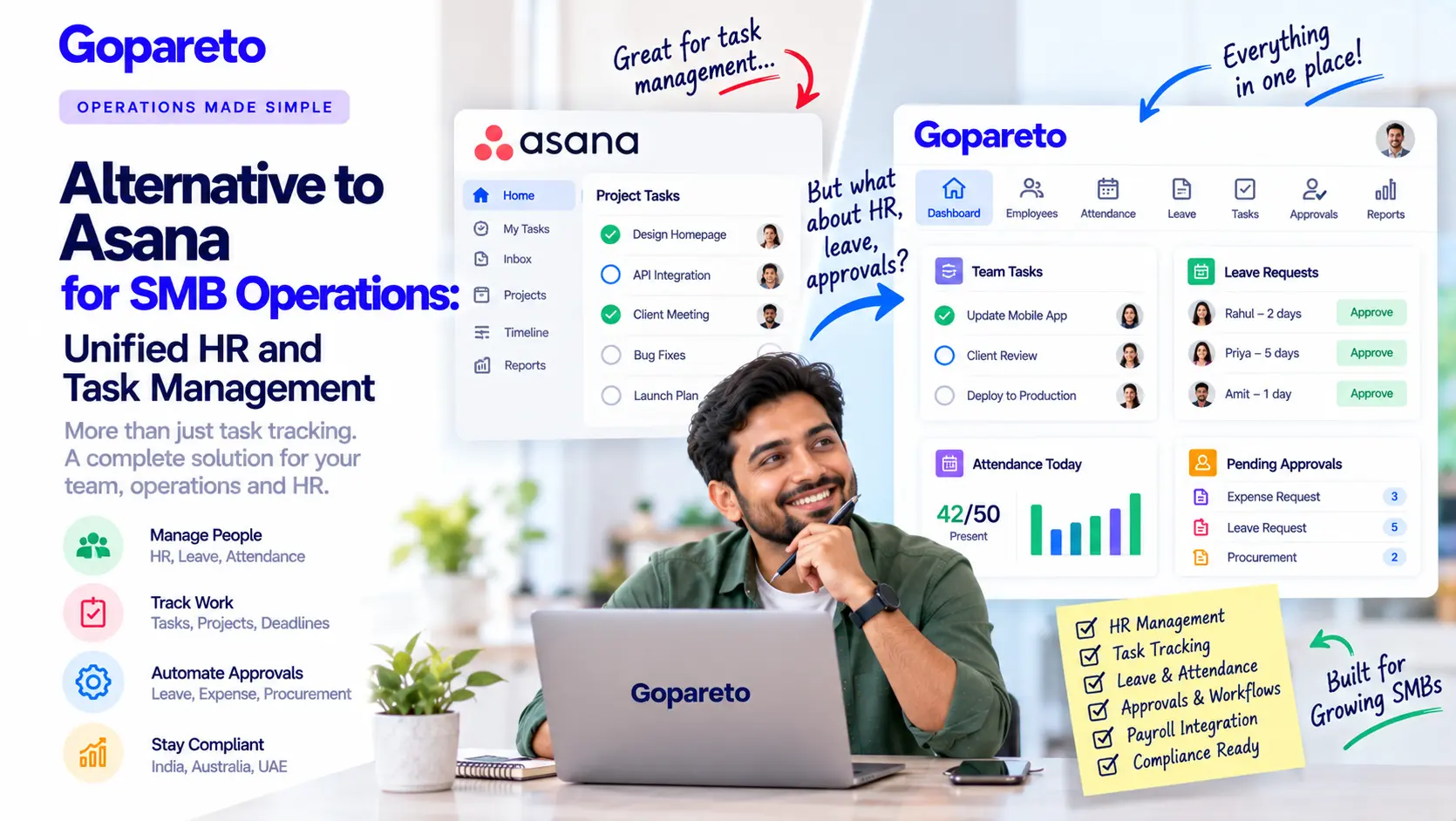
Asana is excellent for project management, but many small and medium businesses discover it solves only part of their operational challenge. It excels at task tracking and project timelines—but what about leave requests, approval workflows, employee records and the HR compliance that intersects with operations?
That gap is why most SMBs start looking for an alternative to Asana. They need a platform that unifies HR management, operations and task coordination without adopting several disconnected systems.
This guide compares Asana with alternatives that offer integrated operations management, particularly for SMBs operating across multiple regions such as India, Australia and the UAE.
Why SMBs Look for Alternatives to Asana
Before evaluating alternatives, it helps to understand where SMBs outgrow Asana.
Task-focused, not process-focused
Operational processes involve more than tasks: leave request → manager approval → payroll; expense submission → finance approval → reimbursement; procurement → approval chain → vendor. Asana can model these, but it isn’t designed for them.
No leave or HR integration
Asana doesn’t natively understand leave, approvals tied to HR status or payroll. If you need to see “who’s out this week” alongside project capacity, it can’t connect those data points.
No compliance automation
In regulated environments such as India, Australia and the UAE, compliance isn’t optional. Asana has no statutory leave rules, no payroll link so leave affects salary correctly, and no compliance-driven approval policies.
Cost at scale
Per-user pricing of roughly $10–30 per user per month adds up as you grow, and bolting on HR, leave and payroll tools multiplies the bill.
Without HR integration, SMBs end up running parallel systems:
- Asana for project management
- Google Sheets for leave tracking
- Email threads for expense approvals
- A payroll tool handling leave implications
That fragmentation creates errors and duplicate work—the same problem we cover in why bundled HR, attendance and payroll solutions win.
Illustrative stack for a 50-person SMB: Asana on a higher tier ($30 × 50 = $1,500) + leave management ($500) + payroll ($1,000) + time tracking ($300) = $3,300 a month, or $39,600 a year.
Asana Feature Analysis
Before choosing an alternative to Asana, clarify what you actually use today.
What Asana does well
- Task creation and assignment
- Timeline and Gantt chart visualisation
- Dependency tracking
- Progress and status updates
- File attachments, comments and collaboration
- Custom fields and calendar view
- Reporting and dashboards
- Integrations with Slack, Google Workspace and more
What Asana doesn’t do
- HR and leave management
- Approval workflows with compliance logic
- Payroll integration and employee records
- Compliance audit trails and multi-region rules
- Operations scheduling with resource constraints
- Time tracking tied to employees and payroll
- Expense management with approval chains
- Procurement and vendor management
Alternative to Asana: Defining Your Needs
| If you need… | Best fit |
|---|---|
| Pure project management (tasks, timelines, dependencies) | Asana is still excellent; Monday.com, Jira or Notion are like-for-like alternatives |
| Project management + leave/HR integration | A unified HR + operations platform such as GoPareto, rather than Asana plus a separate leave tool |
| Project management + operations + HR compliance | A unified operations/HR platform (GoPareto or Lattice), or a BambooHR + Asana combination |
This guide focuses on the second and third cases: organisations seeking an alternative to Asana that brings operations and HR together.
Top Alternatives to Asana for SMB Operations
1. Monday.com
Visual project management with customisable workflows.
Strengths
- Highly visual interface and dashboards
- Powerful automation workflows
- Flexible task templates
- Built-in time tracking and budget tracking
- Good for marketing and operations teams
Weaknesses
- No native HR or leave management
- No payroll integration
- Automation is powerful but not compliance-focused
- Per-user pricing ($10–30/user/month) similar to Asana
Verdict: choose it for better workflow automation and time tracking in one tool. It still doesn’t close the HR integration gap.
2. Jira (Atlassian)
Developer-focused project and issue tracking.
Strengths
- Excellent for software development teams
- Strong agile workflows: sprints, burndowns, retrospectives
- Customisable issue types and workflows
- Integrates with GitHub and GitLab
Weaknesses
- Steep learning curve for non-technical teams
- No HR or leave management
- Built for engineering, not general operations
- Per-user pricing ($7–20/user/month) plus high complexity
Verdict: not a general alternative to Asana—a specialist tool for software teams.
3. Notion
A document and database platform you shape into your own workflows.
Strengths
- Highly customisable—build your own project management
- Natural fit if your team already documents in Notion
- Low-cost plans for small teams
- Basic HR workflows can be built inside it
Weaknesses
- Significant set-up and customisation effort
- No built-in compliance automation
- Limited reporting compared with Asana
- Weaker mobile experience; learning curve for end users
Verdict: a budget alternative for early-stage teams with technical staff to configure it, but it doesn’t solve compliance gaps.
4. Lattice
A people platform that began with performance management and goals, and has since expanded into HR tools.
Strengths
- Goal and OKR management integrated with HR
- Performance and feedback workflows
- Employee records and HR data in one place
- Approval workflows tied to HR data
- Suits SMBs whose priority is HR plus some operations
Weaknesses
- More expensive ($25–50/user/month)
- Much weaker task and project management than Asana
- Requires an HR-first approach; overkill for operations-only teams
- Check India-specific leave and gratuity support before committing
Verdict: a strong option for HR-plus-goals focused SMBs that can justify the higher per-user cost.
5. BambooHR (with task management add-ons)
An HR-first platform with basic task and workflow capabilities.
Strengths
- Mature HR management and employee self-service
- Leave management and compliance tracking
- Audit trails
- Can run alongside Asana
Weaknesses
- Limited task and project management—can’t replace Asana
- Usually deployed with Asana, not instead of it
- Per-user pricing plus the cost of a separate task tool
- US-centric; check Indian statutory support carefully
Verdict: a complementary system rather than a direct alternative to Asana. For a closer look, read our BambooHR vs GoPareto comparison.
6. GoPareto (Unified HR + Operations)
Integrated HR management, leave compliance, operations management and task and approval workflows in one platform.
Strengths
- Native HR and leave management, especially for India
- One platform for operations and HR, not two systems
- Approval workflows for leave, expenses and procurement
- Payroll integration with leave accounting
- Multi-region compliance: India, Australia, UAE
- Task and project assignment with resource context
- Audit trails, employee records and document management
- Time tracking tied to projects and employees
Weaknesses
- Not as strong at pure Gantt charts as Asana
- Smaller user community and ecosystem
- Fewer third-party integrations
- Needs organisation-wide adoption and change management
Verdict: the best fit for SMBs seeking unified HR and operations. It isn’t a like-for-like Asana replacement, but it solves the broader operational need—including Indian leave and gratuity rules covered in our HRMS India compliance guide.
Detailed Comparison: Asana vs Alternatives
Ratings are out of 5; “—” means the capability isn’t offered natively.
| Feature | Asana | Monday.com | Jira | Notion | Lattice | GoPareto |
|---|---|---|---|---|---|---|
| Project management | ||||||
| Task creation & assignment | 5 | 4 | 5 | 3 | 2 | 3 |
| Timeline/Gantt charts | 5 | 4 | 3 | 2 | 1 | 2 |
| Dependency tracking | 5 | 4 | 5 | 2 | 2 | 3 |
| Progress reporting | 5 | 4 | 4 | 2 | 2 | 3 |
| HR & leave management | ||||||
| Leave request/approval | — | — | — | 2 | 4 | 5 |
| Leave compliance (India) | — | — | — | — | 3 | 5 |
| Gratuity management | — | — | — | — | 3 | 5 |
| Employee records | — | — | — | 2 | 5 | 5 |
| Payroll integration | — | — | — | — | 3 | 4 |
| Operations & approvals | ||||||
| Approval workflows | 2 | 3 | 3 | 2 | 3 | 4 |
| Expense management | — | 1 | — | 2 | 3 | 4 |
| Procurement workflows | — | 1 | — | 1 | 2 | 4 |
| Document management | 2 | 2 | 3 | 4 | 3 | 4 |
| Compliance & audit | ||||||
| Audit trails | 3 | 3 | 3 | 2 | 4 | 5 |
| Multi-region compliance | — | — | — | — | 3 | 5 |
| Compliance automation | — | 1 | — | 2 | 4 | 5 |
| Indicative pricing, 50-person SMB per month | ||||||
| Base cost | $1,500 | $1,200 | $700 | $600–800 | $2,500+ | $600–800 |
| Additional tools needed | $1,500+ | $500+ | $500+ | $1,500+ | $0 | $0 |
| Total | ~$3,000 | ~$1,700 | ~$1,200 | ~$2,100 | ~$2,500 | ~$600–800 |
Vendor pricing changes often and varies by plan and region, so treat these figures as indicative and confirm current rates before deciding.
Making the Choice: Decision Framework
Choose Asana if…
- You need best-in-class project and task management
- You have no HR or leave management needs
- You operate in a simpler regulatory environment
- You want the largest ecosystem and Gantt/dependency tools
Choose Monday.com if…
- You like Asana but want better workflow automation
- You need time tracking in the same platform
- You prefer a highly visual, customisable interface
- You’re willing to add a separate HR tool for leave
Choose Jira if…
- Your team is primarily software developers
- You need agile workflows such as sprints and standups
- GitHub or GitLab integration is critical
Choose Notion if…
- You already use Notion heavily
- Budget is your primary constraint
- You have technical staff to configure workflows
- You’re early-stage and can customise as you grow
Choose Lattice if…
- Your primary focus is HR and performance
- You need OKRs integrated with HR
- You can justify a higher per-user cost
- You want a modern HRIS with some operations features
Choose GoPareto if…
- You operate across India, Australia or the UAE
- You need integrated leave management and compliance
- You want approvals beyond tasks: leave, expenses, procurement
- You want audit trails and one system instead of several
Leave visibility matters most when capacity is tight—see our guide to managing leave during peak business seasons.
The Hybrid Option: Asana + GoPareto
Many SMBs don’t need to choose. A hybrid approach keeps what Asana does best and adds the HR layer it lacks.
Keep Asana for
- Project management and task tracking
- Gantt charts and timeline visualisation
Add GoPareto for
- HR management and employee records
- Leave compliance and approvals
- Payroll coordination
Connecting the two—so project leads can see who’s on leave while tasks are assigned—requires an integration or API connection, so confirm what your setup supports before planning around it.
Hybrid cost for 50 people: Asana ($1,500) + GoPareto ($600–800) = $2,100–2,300 a month, still less than Asana plus several separate HR tools.
Real-World Scenario: Why SMBs Switch from Asana
Consider a manufacturing SMB with 60 employees and operations in India.
Before: four disconnected tools, ~$4,200/month
- Asana for production scheduling and projects, blind to who’s out
- Google Sheets for leave, regularly conflicting with payroll
- A separate payroll system
- Procurement approvals scattered across email
- Manual gratuity calculations and no compliance proof for audits
After: unified HRMS + operations, ~$900/month
- Leave management integrated with the production schedule
- Approval workflows automated
- Gratuity calculated automatically
- Audit trails proving compliance
- One source of integrated data
Savings: $3,300 a month, or $39,600 a year, plus compliance automation and audit trails. For more on staying inspection-ready, read how to be audit-ready without a compliance officer.
Conclusion
For pure project management, Asana remains excellent. But if your operations intersect with leave, approvals, payroll and compliance, an alternative to Asana like GoPareto offers a lower total cost of ownership and less risk than stitching several tools together.
If you’re an SMB operating in India, Australia or the UAE, see how unified HR and operations management can reduce tool sprawl—and pair it with good employee task management practices.
Ready to evaluate alternatives to Asana?
How GoPareto Helps
- Tasks, projects and approvals alongside leave, attendance and payroll
- Leave approvals that show project capacity before you say yes
- Multi-region compliance for India, Australia and the UAE
- Audit trails and employee records in one place
Visit Us
GoPareto - Simple & Complete Business Management solution, Omkar Nandan Apartment, A1 201, near Navale Bridge, Kudale Baug, Narhe, Pune, Maharashtra 411041.
Related Blogs