How to Avoid Leave-Related Legal Disputes: Documentation & Policy Guide
September 5, 2026 | By Gopareto Marketing
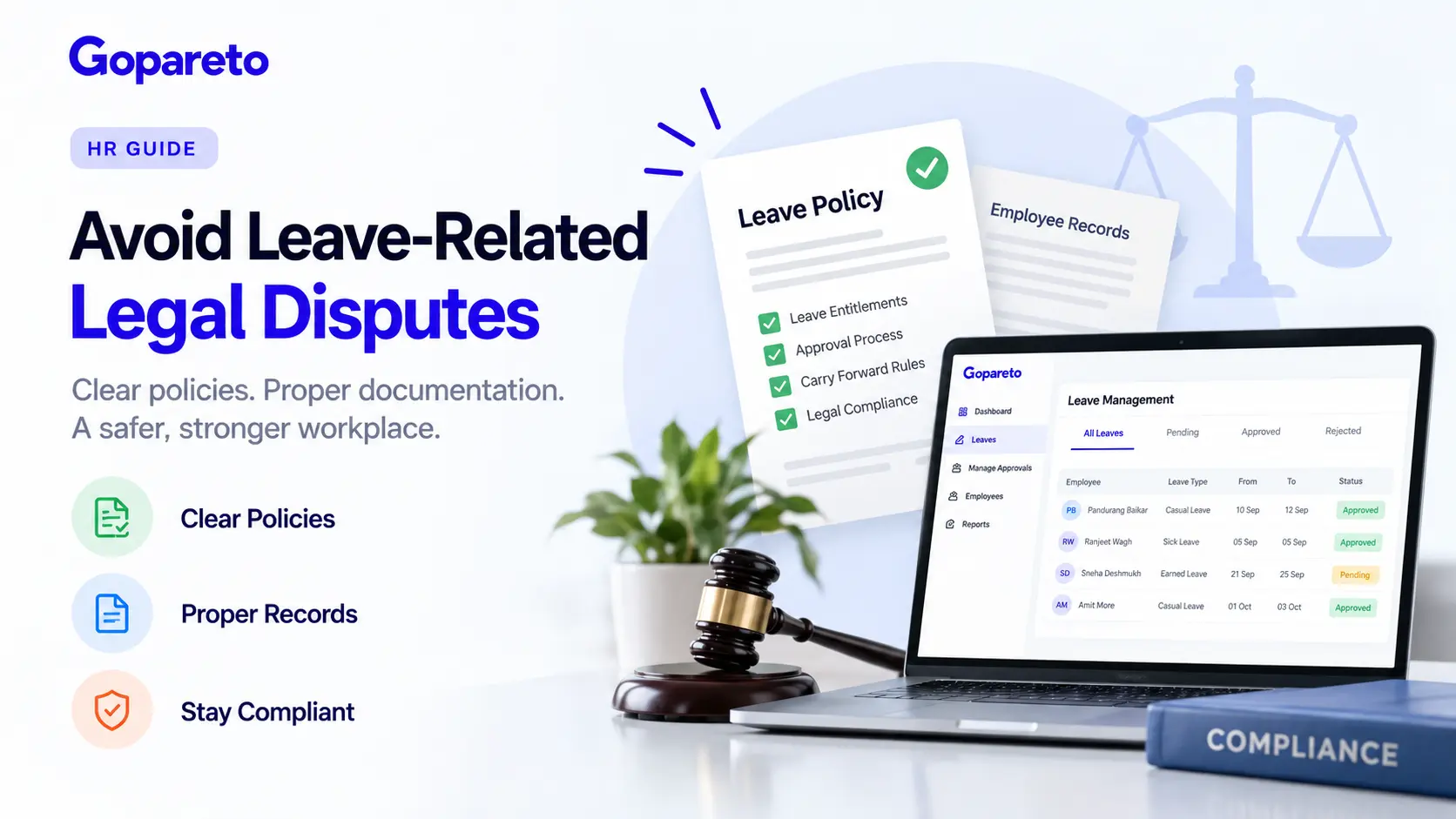
Leave disputes are among the most common employment conflicts. Employees claim they weren’t given their entitled leave. Managers dispute the number of days taken. Records don’t match. The result: damaged relationships, legal costs, and distraction for your entire team.
Yet most of these disputes are entirely preventable. This guide shows you exactly how to avoid leave-related legal disputes through clear policies, proper documentation, and systematic tracking.
Why Leave-Related Legal Disputes Happen
Understanding the root causes helps you prevent them.
If your leave policy isn’t clear, employees interpret it differently than you intend. One thinks they have 25 days of leave, another thinks they have 20. Disputes follow.
Without records, it becomes a he-said-she-said situation. The employee claims they requested leave; you claim they didn’t. With no documentation, courts often side with the employee.
If your leave tracking isn’t centralized, information falls through the cracks. A request made verbally gets forgotten. A day of leave isn’t recorded properly. Discrepancies emerge.
HR tells an employee one thing; the manager tells them another. Approvals aren’t confirmed in writing. When the employee takes leave expecting approval and doesn’t get paid, conflict erupts.
Without digital records, you can’t prove what happened or when. Disputes become unresolvable.
The good news is that all of these are fixable. When you address them systematically, you avoid leave-related legal disputes.
Step-by-Step: How to Avoid Leave-Related Legal Disputes
1. Create a Clear, Written Leave Policy
The foundation of dispute prevention is a clear policy that leaves no room for interpretation.
Your leave policy must specify
- Total annual leave entitlement (in days or hours)
- How leave is accrued (monthly, annually, or on hire date)
- Eligibility rules (probation period, employment type, etc.)
- Different leave types (annual, sick, personal, bereavement, maternity, etc.)
- Rules for each leave type (can sick leave be combined with annual? Can personal leave be taken in hourly increments?)
- Carryover rules (can unused leave be carried to next year? By how much? What’s the deadline?)
- Forfeiture rules (what happens to unused leave that expires?)
- Payment on termination (is unused leave paid out?)
- Notice requirements (how much notice for leave requests?)
- Approval process (who approves, how long does it take?)
- Anti-discrimination statement (assuring fair treatment regardless of status)
Write in plain language, not legal jargon. Employees should understand it without needing a lawyer.
Have a lawyer review it against your jurisdiction’s employment laws. Requirements vary significantly by location.
Don’t just post it once. Include it in employee handbooks, provide it to new hires, and reference it regularly. Employees can’t follow a policy they don’t know about.
Keep records showing that every employee received and understood the policy. Have them sign an acknowledgment.
2. Implement a Centralized Leave Tracking System
Decentralized tracking (sticky notes, emails, spreadsheets) is a recipe for disputes. Implement one central source of truth.
Your system should include
- A single database for all leave requests
- Accessible to employees (to request and view)
- Accessible to managers (to approve)
- Accessible to HR (to oversee and maintain records)
- Automatic balance calculations
- Clear audit trail (who made what change, when, and why)
- Integration with payroll
When leave is tracked centrally:
- Requests don’t get lost
- Balances are calculated consistently
- Records are always available
- Disputes can be resolved quickly by reviewing the system
Avoid scattered records (emails, messages, verbal requests). Everything goes into the system.
3. Establish a Formal Leave Request Process
Create a clear process that everyone follows:
Standard leave request process
- Employee submits request in the system (with dates, reason if required, leave type)
- System checks if employee has sufficient balance (prevents over-requesting)
- Manager receives notification and reviews
- Manager approves or rejects (with reason if rejecting)
- Employee receives notification
- Approved leave is locked in the system
- On leave date, attendance is marked as approved leave (not absence)
- Balance is updated
Important protections
- Requests should be submitted in advance (specify minimum notice, e.g., 2 weeks for annual leave)
- Emergency leave (sick leave, bereavement) has a shorter timeline
- All approvals are documented in the system
- Employees receive written confirmation of approval
Make this process accessible: Employees should be able to request leave online, by email, or through your HRMS. No verbal requests that can’t be documented.
4. Maintain Detailed Records of All Leave
Documentation is your primary defense against disputes. Keep records of:
For each leave request
- Date requested
- Type of leave
- Dates of leave
- Reason (if required by your policy)
- Manager who approved/rejected
- Date of approval/rejection
- Confirmation sent to employee
For each leave taken
- Attendance marked correctly (showing approved leave, not absence)
- Balance deducted from correct leave pool
- Payroll calculation (paid, unpaid, or partially paid)
- Any adjustments or corrections made
Historical records
- Employee’s leave balance at start of year
- Leave accrued during the year
- Leave taken and when
- Leave carried over (if applicable)
- Leave forfeited (if applicable)
- Leave balance at end of year
Communication records
- Policy provided to employee
- Acknowledgment signed by employee
- All notifications about leave
- Any discussions about leave disputes
Keep these records for at least 5-7 years (longer for disputed cases).
5. Communicate Proactively About Entitlements
Many disputes stem from employees not understanding their entitlements. Communicate proactively.
Regular communications
- New hire: Provide leave policy immediately upon joining
- During year: Remind employees of their leave balance periodically
- Near year-end: Notify about expiring leave and carryover rules
- Upon promotion: Confirm if leave entitlements change
- When policy changes: Communicate clearly what’s changing and why
Make it personal: Don’t just post a generic notice. Provide employees with a summary of their specific entitlements:
- "You have 20 days annual leave this year, 3 days sick leave, and 2 days personal leave."
- "You’ve taken 5 days so far; you have 15 days remaining."
- "Your leave year runs January-December."
When employees clearly understand what they’re entitled to, disputes become rare.
6. Document All Approval Decisions
When you approve or reject leave, document why.
For approvals
- Record the dates approved in the system
- Send written confirmation to the employee
- Manager and HR both have records
For rejections
- State the reason (business need, insufficient balance, policy violation, etc.)
- Communicate in writing
- Document that the employee was notified
- Offer alternative dates if possible
When you reject leave, be especially careful about documentation. An employee might later claim they were unfairly denied leave. With proper documentation, you can defend your decision.
7. Handle Special Leave Carefully
Special leave types (maternity, bereavement, disability) have different legal protections. Document these especially carefully.
For maternity/paternity leave
- Document the employee’s notification
- Confirm statutory minimum entitlements
- Provide written leave policy
- Keep records of all communications
- Document any workplace adjustments
For bereavement leave
- Document the request and relationship to deceased
- Confirm dates approved
- Maintain privacy while keeping records
For medical leave
- Request medical documentation if required
- Keep confidential records separate
- Don’t disclose medical information to other employees
- Document any workplace adjustments or leave modifications
Special leave disputes often involve discrimination claims. Careful documentation protects you.
8. Integrate Leave With Payroll
Leave disputes often arise from payroll errors. Keep leave and payroll synchronized.
Integration points
- Payroll run shows which days were leave vs. worked
- Leave balance decreases when leave is taken
- If leave is paid, money is correctly calculated
- Year-end leave payout is accurate based on system records
- Final payment when employee leaves includes correct leave payout
When integrating
- Use one source of truth (the HRMS) rather than separate spreadsheets
- Reconcile payroll and leave records monthly
- Correct discrepancies immediately
- Document any adjustments made
Payroll errors are a leading cause of leave disputes. Prevent them through integration.
9. Handle Disputed Leave Claims Systematically
Despite your best efforts, disputes occasionally happen. Have a process for resolving them.
When an employee disputes their leave balance or a decision
- Listen and understand their claim
- Review all documentation in the system
- Check the leave policy against their claim
- Consult with legal counsel if needed
- Make a decision based on evidence
- Document your decision and reasoning
- Communicate the outcome to the employee
Important
- Don’t be defensive; treat it seriously
- Be transparent about your reasoning
- If you made an error, correct it and apologize
- If the employee is wrong, explain clearly why based on the policy and records
Most disputes can be resolved through honest review of documentation. If disputes can’t be resolved internally, they’re likely to proceed to legal action—and your documentation will be your defense.
10. Train Your Managers on Leave Management
Managers are on the front lines of leave requests. Ensure they understand the policy and process.
Managers should know
- The leave policy inside out
- How to approve/reject requests fairly
- The importance of documenting decisions
- How to handle difficult situations (employee takes undocumented leave, dispute arises)
- Legal protections for employees and business
- Confidentiality obligations (don’t share why someone took leave)
Provide training when
- Onboarding new managers
- Updating the leave policy
- After a dispute (so you don’t repeat mistakes)
- Periodically (annual refresher)
Well-trained managers prevent many leave disputes before they happen.
Common Mistakes That Lead to Leave Disputes
Relying on verbal approval
Verbal approvals lead to disputes. Everything should be documented in writing.
Inconsistent application of policy
If you apply the leave policy differently to different employees, it creates disputes and discrimination claims. Apply consistently.
Changing policy without notice
If you change leave policy, give employees plenty of notice and confirmation. Retroactive changes often trigger disputes.
Losing records
If you can’t prove what happened, you lose disputes. Keep detailed, permanent records.
Not communicating policy to employees
Employees can’t follow a policy they don’t know. Communicate clearly and repeatedly.
Mixing leave types
Don’t combine different leave types (annual + sick + personal) into one pool. They have different rules.
Poor manager training
Untrained managers make inconsistent decisions, create disputes, and violate policy. Train them well.
Not integrating with payroll
When leave balance and payroll don’t match, disputes are inevitable. Keep them synchronized.
How Clear Documentation Protects Your Business
If a leave dispute ever reaches legal proceedings, your documentation is your defense. With clear records showing:
- A clear, legally-compliant leave policy
- Employee acknowledgment of the policy
- Proper leave request and approval process
- Accurate balance tracking
- Documented decisions and reasons
...you can defend your position credibly. Without documentation, you’re vulnerable.
How GoPareto Helps You Avoid Leave Disputes
GoPareto’s leave management system is designed to prevent disputes:
Clear Policy Management
- Store your leave policy in one place
- Customize for your jurisdiction
- Track policy versions and updates
- Document employee acknowledgment
Centralized Tracking
- All leave requests in one system
- Automatic balance calculations
- Complete audit trail
- No lost or forgotten requests
Formal Approval Workflow
- Structured request and approval process
- Written confirmations at each step
- Manager and HR oversight
- Clear documentation of decisions
Employee Transparency
- Employees see their balance anytime
- All their leave requests and approvals visible
- No surprises about their entitlements
- Reduces disputes by reducing uncertainty
Compliance Records
- Digital records with timestamps
- Searchable audit trail
- Export capabilities for legal proceedings
- Integration with payroll
When you manage leave this way, disputes become rare. And if one does occur, you’re prepared to defend your position.
Final Thoughts: Prevention Through Clarity
Leave-related legal disputes are expensive and damaging. But they’re largely preventable through clear policies, good documentation, and systematic processes.
Start today: Review your current leave policy. Is it clear? Is it legally compliant? Do all employees have copies? Have they acknowledged it?
Then implement a centralized leave tracking system. Make sure all leave requests go through it, and maintain detailed records.
When you avoid leave-related legal disputes, you protect your business and improve your relationship with your team. Employees who feel treated fairly are more loyal and productive.
Ready to prevent leave disputes?
How GoPareto Helps
GoPareto’s leave management system provides the documentation, tracking, and compliance tools you need. Learn how GoPareto protects your business.
Request a DemoVisit Us
GoPareto - Simple & Complete Business Management solution, Omkar Nandan Apartment, A1 201, near Navale Bridge, Kudale Baug, Narhe, Pune, Maharashtra 411041.
Related Blogs