HRMS India: Complete Guide to Leave, PF and Gratuity Compliance
September 24, 2026 | By Gopareto Marketing
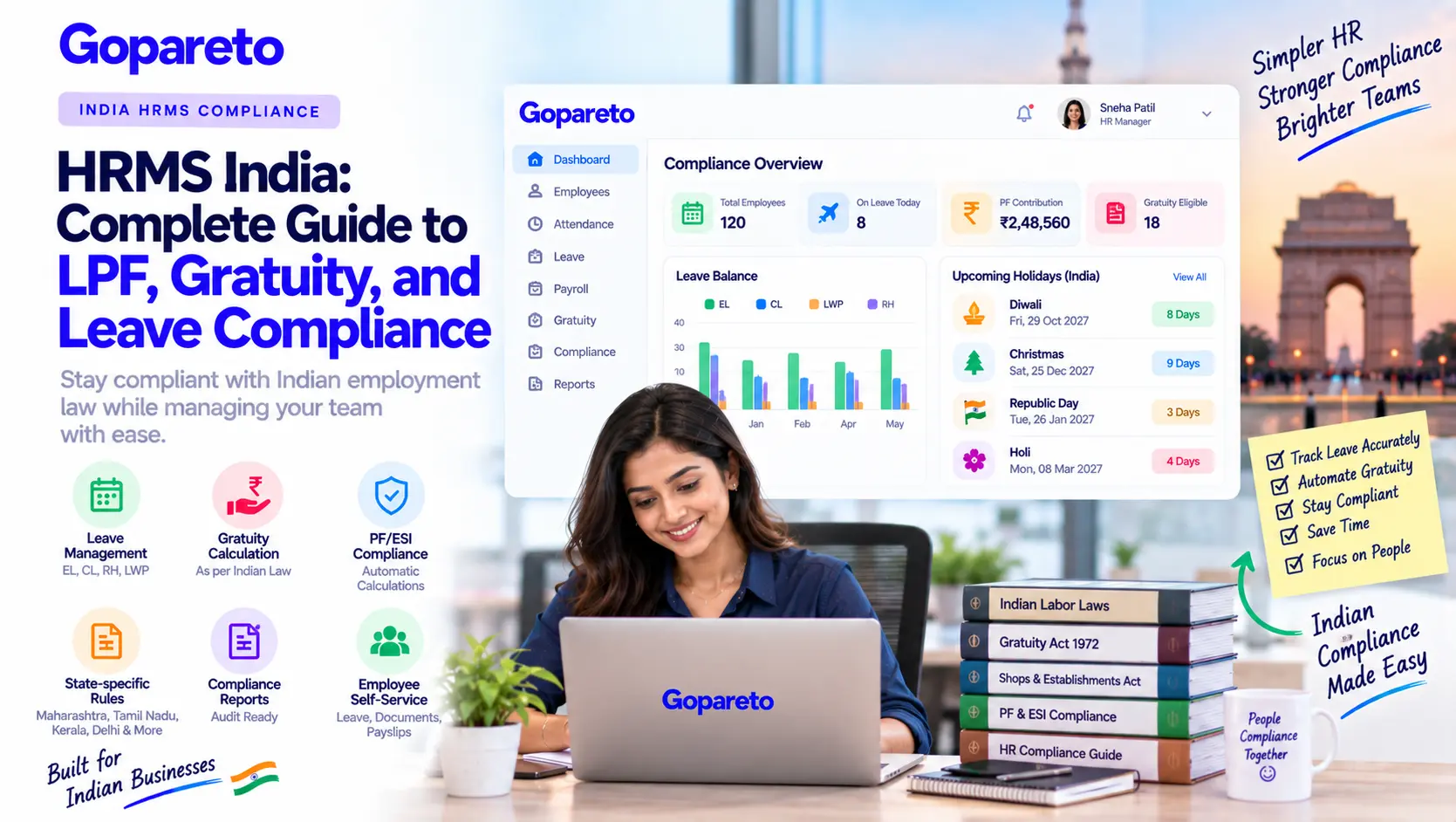
Indian employment law creates complexities that many HR systems struggle to accommodate. The regulatory landscape includes statutory leave requirements, mandatory gratuity calculations, provident fund compliance and income tax implications that differ fundamentally from Western employment law.
For organisations operating in India, an HRMS (Human Resource Management System) must embed Indian employment law at the architecture level. A system built for US payroll and retrofitted with Indian compliance patches will inevitably create gaps, calculation errors and compliance exposure.
This guide walks through the critical leave, gratuity, PF and ESI requirements Indian companies face, and explains how a properly configured HRMS India system handles them.
The Indian Employment Law Framework
Indian employment law combines central statutes with state-level regulations. The key laws affecting leave, gratuity and social security are:
| Statute | What it governs |
|---|---|
| Payment of Gratuity Act, 1972 | Gratuity eligibility, calculation and payment |
| Employees’ Provident Funds Act, 1952 | PF, pension (EPS) and EDLI contributions |
| Employees’ State Insurance Act, 1948 | Health and social security cover for lower-wage employees |
| Shops and Establishments Acts | Working hours and leave; varies by state |
| Industrial Disputes Act, 1947 | Termination and dispute resolution |
| Code on Social Security, 2020 | Consolidates the gratuity, PF and ESI statutes |
The Labour Codes Change Some Rules
The Code on Social Security, 2020 subsumes the Gratuity, EPF and ESI Acts. As the labour codes are brought into force, some rules change—for example the definition of wages used for contributions and gratuity eligibility for fixed-term employees. Confirm which provisions currently apply to your establishment before configuring your system.
State-Level Variations
Leave requirements and shop regulations vary by state:
- Maharashtra has its own Shops and Establishments Act
- Tamil Nadu has separate leave rules
- Kerala provides enhanced statutory leave
- Delhi has specific requirements under the Delhi Shops and Establishments Act
An HRMS India system must accommodate these state variations, not assume uniformity. For a broader overview, see our India labour law compliance guide.
Statutory Leave Categories
One of the most misunderstood aspects of Indian leave administration is the distinction between paid leave types and Leave Without Pay (LWP). Indian employers typically work with four categories:
Earned Leave (EL)
- Statutory annual leave earned through service
- Accrual commonly 1 day per 20 days worked (the Factories Act standard); shop acts vary by state
- Carries forward up to a state-set cap, often 30 days
- Paid at full salary
- Encashable at retirement or resignation
- Eligibility period varies by statute and state
Casual Leave (CL)
- Short-term leave for personal reasons
- Typically 5–10 days a year, depending on company and state
- Usually does not carry forward
- Paid at full salary
- Limited or no encashment at separation
Restricted Holiday (RH)
- Paid days off for religious or regional observances beyond national holidays
- Fixed annually; typically 3–5 days
- Carry-forward and encashment are set by company policy
- Paid at full salary
Leave Without Pay (LWP)
- Unpaid absence allowed without termination
- Used when paid leave is exhausted
- No salary for the days taken
- Employee retains employment status
- Needs to be recorded for service and gratuity calculations
The LWP Compliance Challenge
Many systems treat LWP as just another leave type with a balance. In practice, LWP is the absence of a leave entitlement: when an employee exhausts paid leave and takes additional time off without resigning, that absence is unpaid.
An HRMS India system must:
- Track LWP separately from earned and casual leave
- Exclude LWP days from salary automatically
- Record LWP periods in the employee’s service history for gratuity purposes
- Compute PF and ESI on the wages actually paid for the month
- Calculate leave encashment excluding LWP periods
For policy guidance on unpaid absence, read how to handle unpaid leave fairly.
Gratuity: Statutory Calculation and Compliance
The Payment of Gratuity Act, 1972 applies to establishments with 10 or more employees. Understanding gratuity is central to Indian HR compliance.
Gratuity Eligibility
Gratuity is payable on termination of employment if:
- The employee has completed 5 years of continuous service, or
- The employee dies or becomes disabled due to accident or disease (the 5-year condition does not apply)
“Continuous Service” Has a Legal Meaning
Section 2A of the Act defines continuous service. Authorised leave, sickness, accidents, lay-offs and certain other interruptions do not break continuity, so LWP on its own should not be assumed to reset the clock. Your HRMS should record every break, LWP period and unauthorised absence in the service history and flag cases for HR review, rather than silently deducting them from tenure.
Gratuity Calculation Formula
Gratuity = (Last drawn salary × Years of service × 15) / 26
- Last drawn salary: Basic + DA (dearness allowance)
- Years of service: total completed years of continuous service, not just years beyond the 5-year threshold
- 15: 15 days’ wages per year of service
- 26: working days in a month
Worked example: Basic ₹30,000 + DA ₹10,000 = ₹40,000 last drawn salary. With 10 years of service, gratuity = (40,000 × 10 × 15) / 26 = ₹2,30,769.
Gratuity Ceiling and Payment Timing
- The statutory ceiling is ₹20 lakh (raised from ₹10 lakh in 2018); if the calculated amount exceeds it, the ceiling applies
- Gratuity must be paid within 30 days of becoming payable—on resignation, termination, superannuation, death or disablement
- Late payment attracts simple interest at the rate notified by the government
Leave Encashment and Income Tax
When employees separate, they are paid for unused earned leave. Both this and gratuity carry income tax implications that payroll must handle correctly.
Earned Leave Encashment Calculation
Encashment = unused EL days × daily salary, where daily salary is commonly last drawn salary / 26 (some policies use 30).
Example: last drawn salary ₹40,000 and 20 unused EL days. Daily salary = 40,000 / 26 = ₹1,538.46, so encashment = 20 × 1,538.46 = ₹30,769.
Tax Treatment at Separation
Exemptions
- Gratuity is exempt under section 10(10) of the Income Tax Act, within prescribed limits
- Leave encashment at retirement or resignation is exempt under section 10(10AA), within prescribed limits
- Amounts above the limits are taxable as salary
Section 89(1) relief
- Applies when salary arrears or certain lump-sum payments push income into a higher slab in one year
- Tax is recomputed as if the amount had been received in the relevant years
- The employee claims it by filing Form 10E
An HRMS India system should:
- Calculate gratuity and leave encashment separately in the full and final settlement
- Apply the exempt and taxable portions correctly when computing TDS
- Flag cases where section 89(1) relief may be available
- Provide documentation the employee and employer need for tax filing
Exemption limits and tax rules change through Finance Acts, so confirm current figures with your tax advisor before processing settlements.
Provident Fund (PF) Compliance Integration
The Employees’ Provident Funds Act, 1952 requires both employer and employee contributions. Proper integration of PF with payroll and leave is critical.
PF Coverage
- Applies to establishments with 20 or more employees
- Membership is mandatory from the date of joining for employees whose Basic + DA is up to ₹15,000 a month (previously ₹6,500)
- Employees earning above ₹15,000 who are not already PF members may be excluded, or may join voluntarily
PF Contribution Rates
| Component | Rate | Where it goes |
|---|---|---|
| Employee contribution | 12% of Basic + DA | Employee’s EPF account |
| Employer contribution | 12% of Basic + DA | 8.33% to EPS (on wages up to ₹15,000), balance to EPF |
| EPF administrative charges | 0.5% of PF wages | EPFO |
HRMS Integration Requirements
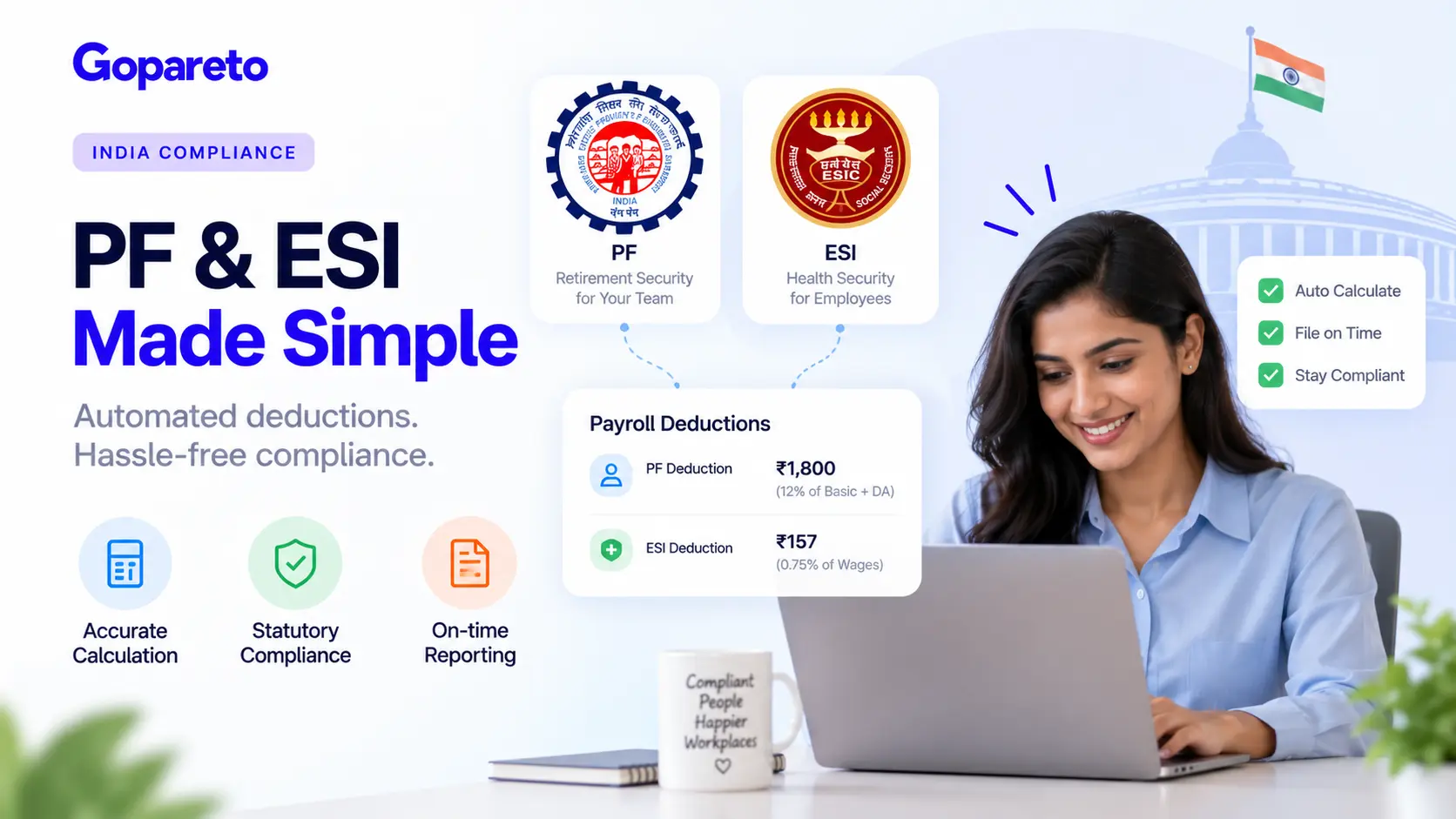
- Calculate PF contributions automatically on every payroll run
- Enrol eligible employees and track UANs from the date of joining
- Generate the monthly ECR (Electronic Challan cum Return)
- Provide monthly and annual PF statements to employees
- Interface with the EPFO portal for online filing
- Compute PF on wages actually paid in months with LWP
- Continue PF correctly through the notice period
Many systems calculate PF correctly but don’t integrate it with leave accounting. If LWP is not reflected in wages paid, PF contributions become incorrect. Our guide to PF and ESI compliance with HRMS covers automated deductions in more depth.
Employees’ State Insurance (ESI) Compliance
The ESI Act, 1948 provides medical and social security cover to lower-wage employees. It is mandatory for covered employees.
Eligibility
- Employees with gross wages up to ₹21,000 a month
- Includes temporary and contract workers below the threshold
- Employees above the threshold are outside the scheme
Contributions
- Employee: 0.75% of gross wages
- Employer: 3.25% of gross wages
A compliant HRMS India system should:
- Determine ESI eligibility from salary automatically
- Calculate contributions each month
- Generate monthly ESI returns
- Track ESI registration and compliance
- Flag eligibility changes as salary changes
Digital Personal Data Protection (DPDP) Act, 2023
The DPDP Act, 2023 introduces compliance requirements for the employee data your HRMS holds.
Key requirements
- Lawful basis: consent, or a permitted “legitimate use” such as employment purposes
- Security: reasonable safeguards to protect personal data
- Purpose limitation: data used only for specified, lawful purposes
- Storage limitation: data not retained longer than necessary
- Individual rights: access, correction and erasure requests
What your HRMS should do
- Maintain data access logs: who accessed what, and when
- Keep audit trails for all data changes
- Give employees self-service access to their data
- Support deletion requests, with holds for statutory retention periods
- Track consent where it is the basis for processing
- Flag when retention periods expire
- Provide encryption and role-based access control
For detail, see DPDP Act compliance for Indian businesses, and our guide to employee records legal requirements for how long statutory records must be kept.
Implementing Compliant Leave Management
A properly configured HRMS India system handles leave compliance through six connected components.
Leave policy configuration
Define policies by state and role: for example 15 days EL (or the state-specific amount), 8 days CL, 3 restricted holidays, 26 weeks of maternity leave, paternity leave per company policy, and LWP allowed once paid leave is exhausted.
Accrual engine
15 days EL / 12 months = 1.25 days a month; 8 days CL / 12 = 0.67 days a month. The system tracks fractional accrual and credits leave on the 1st of each month, or per company policy.
Carry-over rules
EL carries forward up to the state cap (commonly 30 days, lower in some states). CL usually lapses at year-end. Restricted holiday carry-forward follows company policy.
LWP tracking
Track LWP separately from accrual, flag long LWP periods for HR review of service continuity, and exclude LWP from salary automatically rather than as a manual deduction.
Approval workflows
Manager approval for requests, auto-rejection when the balance is insufficient, escalation to HR or a director for LWP, and automatic notification to payroll when LWP is approved.
Reporting
Leave balances by employee, expiring-leave alerts before year-end, service history with continuous service calculation, and leave encashment projections.
Configuration is only half the job: make sure employees actually understand the rules with a clear policy communication framework.
Implementing Gratuity in HRMS India
Configuration
- Eligibility threshold: 5 years of continuous service
- Formula: (Last salary × Service × 15) / 26
- Statutory ceiling: ₹20 lakh
- Payment through the full and final settlement or bank transfer
Automatic triggers
- Monthly review flagging employees approaching the 5-year mark
- Gratuity auto-calculated in the exit workflow
- Gratuity verification step before final salary is processed
- Tax computation generated for the settlement
Compliance tracking
- Payment status: paid, pending or overdue
- Payment date against the 30-day deadline, flagging delays that attract interest
- TDS on any taxable portion calculated and withheld
- Gratuity records kept as an annual compliance register
Payroll Integration
Leave and gratuity compliance depends on seamless payroll integration.
| Leave type | Salary impact |
|---|---|
| Earned Leave | Full salary |
| Casual Leave | Full salary |
| Sick Leave (if separate) | Full salary |
| Leave Without Pay | Day’s salary excluded automatically |
| Half-day LWP | Half a day’s salary deducted |
Statutory deductions
- PF: 12% employee, with employer match
- ESI (if eligible): 0.75% employee, 3.25% employer
- Income tax: as per tax slabs
- Professional tax: varies by state
Year-end calculations
- Leave balances as of 31 March (Indian financial year)
- Encashment of excess EL, if policy allows
- Accrued leave liability for financial reporting
Audit Trails and Compliance Proof
Modern HRMS India systems record the evidence you need during labour department inspections or disputes:
- Leave request history and approval chain
- Leave balance snapshots at each transaction
- Gratuity calculation history: inputs, formula, result
- Leave policy changes: what, when and by whom
- Leave exceptions: LWP periods and manual adjustments
Multi-State Compliance
If your organisation operates across states, your HRMS must handle the variations:
What differs by state
- Leave accrual rates and carry-forward caps
- Shop regulations on working hours and leave rights
- State statutory and festival holidays
- Exemptions some states grant IT/ITES establishments from certain shop act provisions
What your HRMS must support
- Employee assignment by state and location
- State-specific leave policy application
- Multi-state statutory holiday calendars
- State-specific compliance reporting
Deployment: Cloud vs On-Premise
When assessing DPDP obligations, ask where employee data is stored:
- Cloud SaaS with an India data centre: data stored in India, which simplifies security and cross-border questions
- On-premise: data stays on your own servers, for organisations with stricter localisation policies
- Hybrid: primary data in India with global backups
Ensure your HRMS India provider clearly documents data residency and how it supports your DPDP obligations.
Implementation Best Practices
Policy audit
Review existing leave and gratuity policies against Indian law and the state acts you operate under.
System configuration
Configure leave types, accrual, caps and carry-over rules accurately.
Payroll integration
Ensure leave affects salary, PF and ESI calculations correctly.
Training
Train managers and employees on the updated system and workflows.
Testing
Verify leave, gratuity and PF calculations on sample data before launch.
Go-live cutoff
Set a clear transition date and migrate legacy balances and service history.
Audit trail
Preserve historical data and calculations as compliance proof.
Common Implementation Mistakes
1. Treating LWP as a leave balance
- Result: incorrect salary calculations and inflated payroll costs
2. Not recording service history
- Result: gratuity eligibility and tenure disputes, and audit exposure
3. Not integrating PF with leave accounting
- Result: incorrect PF contributions in months with LWP
4. Using the wrong wage base for gratuity
- Result: using gross pay instead of last drawn Basic + DA leads to over- or under-payment and legal liability
5. Ignoring state-level leave variations
- Result: non-compliance in multi-state organisations
India HRMS Compliance Roadmap
Whether you are implementing a new HRMS India system or upgrading an existing one:
| Phase | Timing | Activities |
|---|---|---|
| 1. Policy audit and configuration | Weeks 1–2 | Review policies against Indian law, document state-specific requirements, configure leave types |
| 2. Integration and testing | Weeks 3–4 | Integrate payroll, test accrual, verify gratuity on sample data, validate PF, ESI and tax impacts |
| 3. Training and change management | Week 5 | Train managers on approvals, communicate the system to employees, issue leave balance statements |
| 4. Go-live and monitoring | Week 6+ | Launch, monitor requests and approvals, verify payroll, track compliance metrics |
Ready to Get Leave, PF and Gratuity Right?
How GoPareto Helps
- State-specific leave policies, accrual and carry-forward rules configured once
- LWP tracked separately and excluded from salary, PF and ESI automatically
- Gratuity calculated on exit with the 30-day payment deadline tracked
- PF and ESI contributions computed on every payroll run
- Audit trails and access logs that support DPDP compliance
Visit Us
GoPareto - Simple & Complete Business Management solution, Omkar Nandan Apartment, A1 201, near Navale Bridge, Kudale Baug, Narhe, Pune, Maharashtra 411041.
Related Blogs