How to Improve Team Productivity Without Being Intrusive: Trust-Based Approach
September 9, 2026 | By Gopareto Marketing
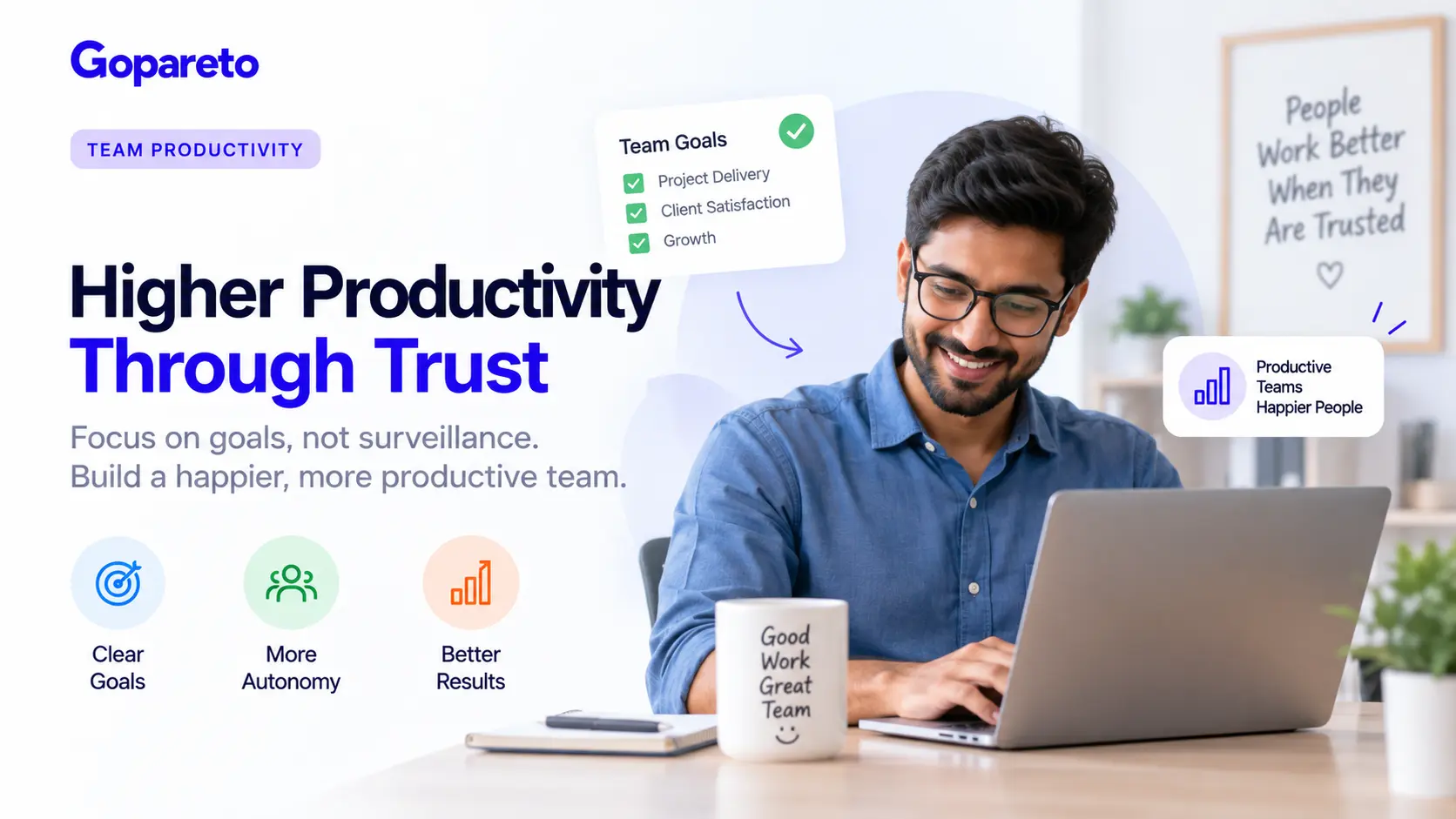
The rise of remote work has created a temptation: install monitoring software that tracks every keystroke, every website visit, every moment the employee is away from their desk. Managers think it will increase productivity.
The opposite happens. Employees feel distrusted, morale drops, and the best people leave. Meanwhile, productivity doesn’t actually improve—it sometimes declines as employees spend energy resenting the monitoring instead of focusing on their work.
This guide shows you how to improve team productivity through a better approach: trust, clear goals, and autonomy.
Why Intrusive Monitoring Doesn’t Work
Before diving into the solution, let’s understand why surveillance backfires.
When employees know they’re being monitored, they feel distrusted. Trust erodes, and with it, commitment and morale.
Monitoring implies you don’t trust employees to manage their time. High-performing employees leave companies where they lack autonomy.
The best employees are often self-motivated. When treated like they can’t be trusted, they resent it.
You’re measuring activity (hours at desk, keystrokes), not outcomes (work completed, quality, impact). Busy doesn’t equal productive.
If some employees are monitored and others aren’t, it creates distrust between teams.
In some jurisdictions, excessive monitoring violates privacy laws. It also opens you to legal liability.
Companies known for surveillance attract people who are less self-motivated and more prone to rule-breaking.
Studies show that trust-based management improves productivity more than surveillance.
The companies that attract and retain top talent don’t monitor intensively. They trust their people and focus on results.
How to Improve Team Productivity Without Being Intrusive
1. Set Clear, Measurable Goals
The foundation of trust-based productivity is clarity. Employees need to know exactly what’s expected.
Effective goals have these qualities:
Not "be more productive," but "complete 3 client proposals by Friday."
You can verify completion objectively. "Increase customer satisfaction" is vague; "achieve 4.5-star rating on surveys" is measurable.
Goals should be challenging but realistic. Impossible goals demoralize people.
Goals should matter to the business and the employee’s role.
Include a deadline. "Complete by end of quarter" is clearer than "eventually."
Individual goals should align with team goals, which align with company goals. Employees should understand how their work contributes.
When goals are clear and measurable, you don’t need to monitor activity. You monitor outcomes instead.
Example of clear goals
- "Process 200 invoices per week with 99% accuracy"
- "Complete 5 customer onboardings on schedule each month"
- "Resolve 90% of support tickets within 24 hours"
- "Launch new feature by October 15 with documented code"
Employees know exactly what success looks like. You measure results, not activity.
2. Establish Clear Expectations About Work Arrangement
Different roles need different arrangements. Be explicit about what you expect.
For office-based roles
- Core hours (e.g., 9 AM-3 PM, everyone should be present)
- Flexibility outside core hours (can they flex hours if needed?)
- Lunch/break policies
- Approved absence procedures
For remote roles
- Availability requirements (must be online during these hours)
- Communication expectations (respond to messages within X hours)
- Location flexibility (can they work from anywhere, or specific locations?)
- Meeting requirements (how many must be in-person or video?)
For hybrid roles
- Days in office vs. remote (e.g., Mondays and Wednesdays in office)
- Flexibility if something comes up
- How to communicate your location to the team
When expectations are clear, employees don’t feel monitored. They know the rules and follow them.
3. Focus on Outcomes, Not Activity
Stop measuring time at desk. Start measuring results.
Don’t measure
- Hours logged in
- Login/logout times
- Keyboard activity
- Website visits
- Email response times
- Time spent in meetings
Do measure
- Tasks completed
- Quality of work (defects, revisions needed)
- Customer satisfaction
- Deadlines met
- Revenue generated or cost saved
- Business impact
Outcome-focused measurement is more aligned with actual productivity. It also respects employee autonomy.
Example of outcome focus: Instead of: "You must be logged in 8 hours per day" Say: "Deliver these 3 deliverables by Friday. How you organize your time is up to you."
The first creates surveillance culture. The second creates accountability and trust.
4. Establish Regular Check-Ins and Feedback
Trust doesn’t mean absence of communication. Regular check-ins build relationship and catch issues early.
Implement regular one-on-ones
- Weekly or bi-weekly (30 minutes)
- Discuss progress toward goals
- Address obstacles
- Provide feedback
- Connect personally
One-on-one best practices
- Focus on the employee, not just task updates
- Ask about obstacles and help remove them
- Provide recognition when goals are met
- Discuss development and growth
- Listen more than you talk
Quarterly or annual reviews
- Review progress toward goals
- Discuss performance and growth
- Adjust goals if needed
- Plan next period
Regular communication, done right, builds trust better than surveillance ever could.
5. Provide Autonomy in How Work Gets Done
Trust means giving employees freedom in how they approach their work.
Where to allow autonomy
- HOW they complete tasks (as long as quality is maintained)
- WHEN they work (core hours, but flexible scheduling)
- WHERE they work (office, home, coffee shop)
- TOOLS they use (within reasonable constraints)
Where to maintain standards
- WHAT they deliver (clearly defined)
- QUALITY expectations (measurable standards)
- DEADLINE (non-negotiable)
- COMMUNICATION (responsiveness requirements)
When employees have autonomy, they’re more motivated and productive. They feel respected, which builds loyalty.
6. Create a Culture of Communication
Transparency works in both directions. Communicate openly with your team.
What to communicate
- Company goals and strategy
- How their role contributes
- Performance feedback (both positive and corrective)
- Challenges the company faces
- Decisions that affect them (and reasoning)
- Recognition of good work
How to communicate
- Regular team meetings (not just status updates; include strategy and culture)
- Company-wide announcements on important news
- One-on-ones for individual feedback
- Public recognition for good work
- Honest conversations about challenges
When employees feel informed and included, they’re more invested in success.
7. Build Psychological Safety
Psychological safety—the belief that it’s safe to take risks and be vulnerable—is essential for high productivity.
How to build it
- When someone makes a mistake, treat it as a learning opportunity, not punishment
- Admit your own mistakes and what you learned
- Encourage questions and ideas
- Don’t punish people for speaking up about problems
- Listen without judgment
- Follow through on commitments
When employees feel safe, they take ownership, innovate, and solve problems. Without safety, they play it safe and hide issues.
8. Recognize and Reward Results
Positive reinforcement works better than surveillance.
Recognize
- When goals are met, acknowledge it
- When quality is excellent, point it out
- When someone goes above and beyond, celebrate
- When someone helps teammates, highlight it
- In public (for most people—some prefer private recognition)
Reward
- Extra flexibility or time off for strong performers
- Bonuses tied to performance
- Growth opportunities
- Public recognition
- Preferred projects or clients
Recognition doesn’t have to be expensive. Sincere acknowledgment of good work is incredibly motivating.
9. Address Performance Issues Directly and Fairly
When someone isn’t meeting goals, address it promptly and fairly.
When performance is below standard
- Have a private conversation
- Share specific examples (not "you’re not productive"; say "your last 3 projects were late")
- Listen to their perspective (maybe there are obstacles you don’t know about)
- Clarify expectations
- Agree on a plan to improve
- Check in regularly to monitor progress
- Document the conversation
- Take action if improvement doesn’t happen (coaching, role change, or termination)
Important: Address issues individually and privately. Don’t shame or embarrass.
When you address performance issues fairly and clearly, it’s better for everyone.
10. Lead by Example
Your behavior sets the tone for the whole team.
Model the culture you want
- Be trusted (show up for commitments)
- Respect boundaries (don’t expect emails late at night)
- Take care of yourself (take your own vacation, maintain work-life balance)
- Admit mistakes
- Ask for help
- Recognize others’ work
- Communicate transparently
When leaders model trust and autonomy, the team follows.
Common Mistakes in Productivity Management
Installing monitoring software
It damages trust more than it improves productivity. Stop.
Vague goals
If employees don’t know what success looks like, they can’t be accountable. Be specific.
Not communicating expectations
If employees don’t know the rules, they’ll violate them. Over-communicate.
No feedback until review time
Employees should hear about their performance regularly, not once a year. Build feedback into regular check-ins.
Inconsistent standards
If you hold some employees accountable and not others, it creates resentment. Apply standards fairly.
Absence of recognition
People work hardest when they feel appreciated. Recognize good work consistently.
Not trusting remote workers
Assuming remote workers are slacking off is self-defeating. Trust them and measure outcomes.
Benefits of Trust-Based Productivity Management
Studies show trust-based cultures are more productive
High performers want to work where they’re trusted
Employees enjoy coming to work when they feel trusted
Employees suggest ideas in psychologically safe environments
Retention is cheaper than replacing people
Less stress leads to healthier, happier employees
Companies known for trusting their people attract better talent
How GoPareto Supports Trust-Based Productivity
GoPareto’s HR tools support trust-based management:
Goal and Performance Tracking
- Set clear, measurable goals
- Track progress regularly
- Link individual goals to company goals
- Regular check-in documentation
Communication Tools
- Facilitates regular one-on-ones
- Stores feedback and recognition
- Supports transparent goal-setting
Attendance and Leave Tracking
- Respects privacy while tracking work-hour attendance
- No constant surveillance
- Focuses on results, not activity
Time Tracking (When Needed)
- Focuses on billable hours for agencies, not on surveillance
- Supports trust-based time management
Final Thoughts: Trust Is the Competitive Advantage
The companies that outcompete others aren’t the ones with the most surveillance. They’re the ones with the most trust, autonomy, and clear goals.
When employees feel trusted, they bring their best selves to work. They’re more creative, more committed, and more productive.
Start by setting clear goals. Then focus on outcomes, not activity. Build a culture of communication and psychological safety. Recognize good work.
When you improve team productivity through trust instead of surveillance, you’ll see better results and happier employees. That’s a culture worth building.
Ready to build a trust-based culture?
How GoPareto Helps
GoPareto’s HR tools support goal-setting, feedback, and transparent communication. Explore how GoPareto helps you build a better culture.
Request a DemoVisit Us
GoPareto - Simple & Complete Business Management solution, Omkar Nandan Apartment, A1 201, near Navale Bridge, Kudale Baug, Narhe, Pune, Maharashtra 411041.
Related Blogs