How to Ensure All Employees Understand Company Policies: A Complete Guide
September 23, 2026 | By Gopareto Marketing
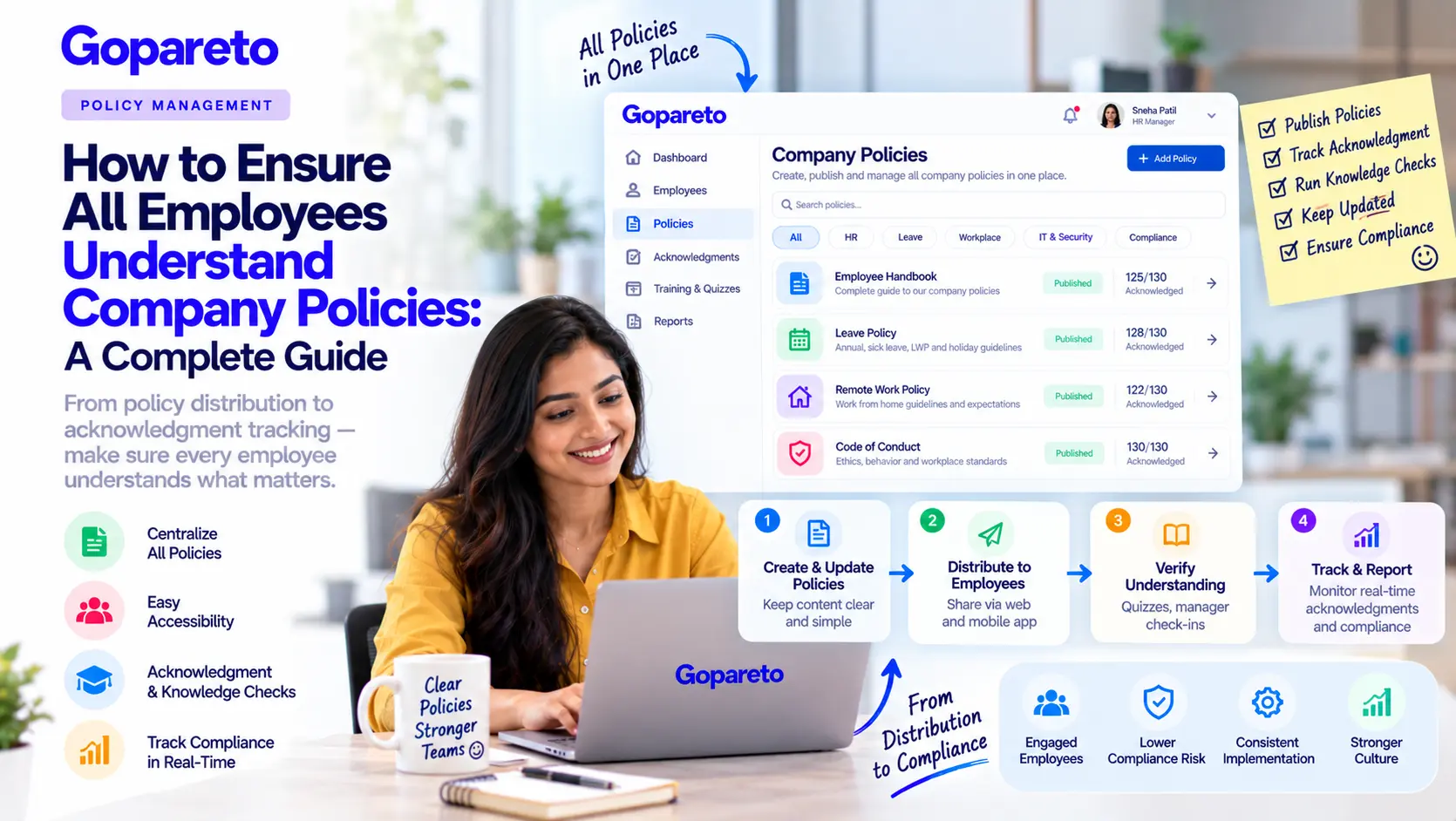
Company policies are the operational foundation of any organisation. They set expectations, support legal compliance, protect the business and create consistency across teams. Yet many companies struggle with one critical challenge: making sure all employees actually understand these policies.
The gap between distributing a policy and genuine understanding creates real risk. Employees say they didn’t know about time-off procedures, managers apply inconsistent discipline because they misread a policy, and compliance audits reveal that critical policies never reached certain groups of employees.
This guide gives you a complete framework for ensuring all employees—regardless of role, location or tenure—understand your company policies.
Why Policy Understanding Fails
Before implementing solutions, understand why comprehension gaps exist in the first place.
Information overload
- Onboarding delivers a 50+ page handbook, compliance documents, benefits guides, technology and travel policies all at once
- Nobody retains everything delivered in a single session—even engaged employees absorb only a fraction
Passive distribution
- Static PDFs emailed out and never looked at again
- Emails get lost, files stay unread, and there’s no way to confirm receipt
No verification
- Distributing a policy is treated as compliance
- Few companies check that employees read a policy, let alone understood it
Outdated policies
- Leave rules, remote work guidelines and compliance requirements change
- Employees who read the handbook at onboarding may be working from obsolete information months later
Contextual disconnection
- Handbooks state rules in abstract terms that are hard to apply to a real situation
- A leave policy says “emergencies require manager approval”, but employees don’t know what counts as an emergency
Step 1: Audit Your Current Policy Landscape
Begin by taking an inventory of the policies you already have.
What policies exist?
- Employment (hiring, probation, notice periods, background checks)
- Leave and time off (annual, sick, casual leave)
- Compensation and benefits (salary reviews, bonuses)
- Performance management (reviews, promotion, termination)
- Code of conduct and ethical guidelines
- Compliance (anti-discrimination, anti-harassment, whistleblower)
- Technology and security (acceptable use, data protection, BYOD)
- Health and safety
- Remote work, if applicable
- Expenses and procurement
- Travel
Which policies matter most?
Not all policies carry equal weight. Identify the top 8–12 that directly affect daily operations or carry significant compliance risk.
| Policy | Why it matters |
|---|---|
| Leave and time off | Affects payroll, compliance and team planning |
| Anti-harassment and discrimination | Legal liability |
| Data protection and confidentiality | Regulatory compliance |
| Health and safety | Worker protection and liability |
| Code of conduct | Sets organisational values and prevents misconduct |
| Leave encashment and gratuity (India) | Statutory compliance and financial impact |
| Remote work and flexibility | Operational impact |
| Performance management | Career development and dispute prevention |
Are existing policies well documented?
- The language is clear and jargon-free
- There are specific examples for common scenarios
- Policies reflect how the organisation actually works today
- Policies are aligned with local employment law
For the anti-harassment policies in particular, see our guide on preventing workplace discrimination and harassment.
Step 2: Rewrite Policies for Understanding
Policies must be written for comprehension, not legal perfection. That usually means restructuring them.
Use plain language
Before
- “In accordance with applicable statutory leave regulations, employees shall be entitled to annual paid leave subject to eligibility criteria outlined in Appendix B.”
After
- “All employees get paid time off. In India, you receive annual leave based on your tenure. Your manager will help you plan time off with the team.”
Provide examples for common scenarios
Add concrete examples to every policy. A leave policy, for instance, should answer:
Fever, injury or a medical appointment—not bad weather or a minor headache.
The manager approval process and how much notice is required.
Who to notify, and what documentation is required.
Yes, up to X days; the remainder is paid out.
Our guide to developing a legally compliant leave policy covers how to structure these rules in the first place.
Structure policies around the questions employees actually ask
- “Can I work from home?”
- “What if I’m sick?”
- “How much leave do I get?”
- “Can I extend my break?”
- “What happens if I quit?”
Create visual guides
Complex policies benefit from flowcharts, decision trees and infographics:
- Leave request flowchart: when to request, the approval path, documentation
- Expense approval decision tree: what qualifies and who approves
- Incident reporting diagram: who to contact in different scenarios
Step 3: Implement Structured Policy Communication
Effective policy understanding needs deliberate communication across multiple touchpoints, in three phases.
Phase 1: Phased initial distribution
During onboarding, release core policies in stages rather than all at once.
Week 1: immediate-need policies
- Code of conduct and ethical standards
- Reporting structure and communication expectations
- Health and safety basics
- How to ask questions or report issues
Weeks 2–3: operational policies
- Leave and time-off procedures
- Expenses and procurement
- Technology access and security
- Remote work arrangements, if applicable
Ongoing: specialised policies as relevant
- Compliance certifications
- Department-specific procedures
- Advanced benefits such as investment options and wellness programmes
This phased approach prevents cognitive overload and makes sure the critical policies land first.
Phase 2: Active learning and verification
Don’t assume reading equals understanding. A policy that was sent but never verified gives you neither real compliance nor real protection.
Manager-led policy discussions
A 15-minute conversation between each manager and new employee: a core policy overview, how policies apply to this role, common questions from the team, and where to get clarification. Managers become policy translators.
Scenario-based quizzes
Brief assessments of 5–10 questions that present realistic workplace scenarios, ask employees to apply the policy, and give immediate feedback with the correct reasoning.
Acknowledgement with verification
Replace the passive “I have read the handbook” checkbox with an attestation that makes employees confirm the specific terms that apply to them.
Sample quiz question: “A client invites you to a conference with potential business value. Your policy says travel over ₹4,00,000 requires executive approval. The estimated cost is ₹5,00,000. What do you do?”
Correct answer: seek executive approval before committing. Feedback: “Yes—while the cost seems reasonable, exceeding the threshold requires approval to maintain budget discipline and consistent decision-making.”
Old approach: vague checkbox
- “I have read and understand the employee handbook.”
- Proves only that a box was ticked
New approach: specific attestation
- “I have read the leave policy. I understand that I receive [X] annual leave days”
- “I must request leave [X] days in advance”
- “Emergency leave requires manager notification within [Y] hours”
- “Unused leave above [X] days is paid out at year-end. I confirm these statements are correct for my role.”
Forcing this kind of specificity prevents vague acknowledgement.
Phase 3: Ongoing reinforcement
Initial communication isn’t enough. Policies fade from memory without reinforcement.
| Cadence | What to do |
|---|---|
| Monthly | Brief, role-specific reminders of 2–3 bullet points. Month 1: expense submission deadlines. Month 2: leave carry-over rules. Month 3: confidentiality and data protection. Month 4: anti-harassment and discrimination. Then repeat. |
| Quarterly | Short team meetings reviewing 2–3 top policies through scenarios, e.g. “Sarah wants to work from home on Fridays. Our remote work policy says [X]. As her manager, how would you respond?” |
| Annually | Every employee re-reads core policy summaries (not the full handbook), completes a brief assessment or attestation, and attends a short training or discussion session. |
Team discussion surfaces misunderstandings and clarifies the grey areas before they become disputes.
Step 4: Create a Self-Service Policy Portal
Technology is what makes policy understanding scalable.
A centralised policy repository
What employees can access
- All company policies in one place
- Keyword search
- Version history: what changed and when
- FAQs and scenario explanations
- Links to relevant external resources
What a good portal provides
- Clear navigation and organisation
- Mobile access, since many employees only use a phone
- Plain-language summaries alongside formal policies
- Video explainers for complex topics
- Search by role, e.g. “remote employee policies”
- Updated timestamps that show policy freshness
Contextual, just-in-time delivery
- When an employee submits a leave request, show the leave policy
- When an employee submits an expense report, show the expense policy
- When an employee joins a remote-first team, show the remote work policy
Delivering a policy at the moment it applies improves comprehension because the context is already there.
Attestation and audit trails
Digital systems create audit trails that prove distribution and understanding:
- Timestamp when each employee accessed a policy
- Completion of assessments
- Documented manager discussions
- Acknowledgements with specific statements
- Flags for employees with missing attestations
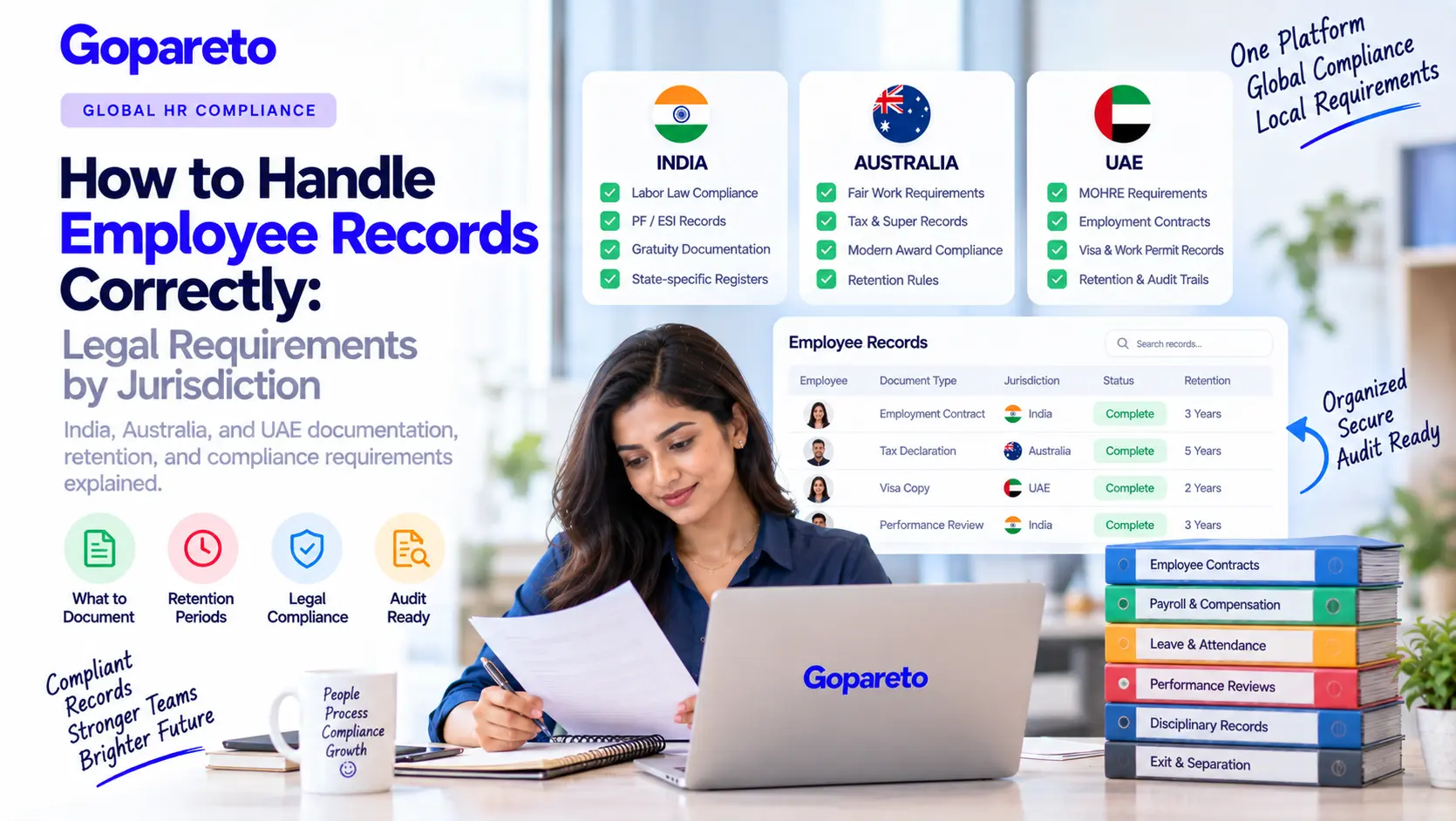
This turns compliance from theoretical into verifiable. Keeping those records well is its own obligation—see our guide to employee records legal requirements in Australia, India and the UAE.
Step 5: Build Manager Accountability
Managers are the policy frontline. Without manager accountability, employee understanding suffers.
Train managers to
- Understand core policies deeply, not just on the surface
- Apply policies consistently within their teams
- Spot when employees misunderstand or misapply a policy
- Coach employees on policy implications
Give managers
- Manager-friendly summaries of 2–3 pages per policy
- Frequently asked questions and answers
- Real scenarios and how to handle them
- Decision frameworks for common policy questions
Accountability metrics for managers
- Track attestation and assessment completion rates within each team
- Monitor consistency: are all managers applying the leave policy identically?
- Include “team policy understanding” in manager performance reviews
- Recognise managers whose teams score highest on policy quizzes
HR and manager policy office hours
Schedule regular sessions where HR presents updated guidance, managers discuss real scenarios and how they handled them, HR clarifies grey areas, and managers share what’s confusing their teams.
Step 6: Handle Policy Changes and Updates
New regulations emerge, business conditions change and operational practices shift. Communicate policy changes deliberately.
Announce the change and why
“We’re updating our remote work policy because [reason]. This affects [roles]. Changes take effect on [date].”
Explain what’s changing
Old rule: remote work needs weekly manager approval. New rule: remote work follows standing schedules approved quarterly. Why: less admin and more predictability for teams.
Provide scenario examples
Show how the new policy applies to different roles and situations.
Give a transition period
Allow a grace period to move from the old policy to the new one, typically 30 days.
Deliver training
Hold short sessions explaining the change, or share a recorded video.
Verify understanding
Use brief assessments or manager discussions to confirm employees understand the new policy.
Use multiple channels
- All-hands meeting or video message from leadership
- Email summarising key changes, linked to the full policy
- Portal view comparing old and new side by side
- Manager summary with FAQs and talking points
- Individual notifications for directly affected employees
Step 7: Create a Culture of Policy Transparency
Beyond distribution, build a culture where policies are visible, questioned and improved.
Make policies visible
- Link to policies from Slack, Teams or your chat platform
- Share policy excerpts in relevant conversations
- Create a discussion channel such as #policy-questions
- Make asking about policies normal and encouraged
Encourage questions
- “Does this scenario fall under our policy?”
- “What if I’m in this situation?”
- “Is this policy still current?”
- Answer quickly and share the Q&A with the team to amplify understanding
Annual policy review
- Which policies generate the most questions?
- Where do employees apply policies inconsistently?
- Are policies aligned with how the business actually operates?
- Are any policies outdated or no longer relevant?
Use this feedback to simplify confusing policies and clarify grey areas.
Step 8: Document and Measure Understanding
Create accountability through documentation and measurement.
| Metric | What it measures | Target |
|---|---|---|
| Policy attestation rate | % of employees who’ve acknowledged core policies | 100% |
| Assessment completion rate | % of employees who’ve completed policy quizzes | 100% |
| Assessment accuracy | % of employees scoring 80%+ | 90%+ |
| Policy access rate | % of employees using the self-service portal | 60%+ |
| Policy question rate | Questions per 100 employees per quarter | Indicator of engagement and confusion areas |
| Manager training completion | % of managers trained on core policies | 100% |
| Consistency of application | Variance in how managers handle similar situations | Lower is better |
Quarterly audits
- Pick 10–15 employees at random
- Ask about 2–3 core policies relevant to their role
- Document understanding gaps
- Identify trends, e.g. “most employees misunderstand leave carry-over”
- Design targeted re-training
Incident analysis
- When a violation occurs, ask: did the employee understand the policy?
- If not, provide targeted retraining
- If so, is the policy ambiguous? Clarify it
- If so, is the policy unreasonable? Consider updating it
Treat violations as learning opportunities to improve policy clarity. Clear, well-documented policies are also your best defence if a dispute escalates—our guide to avoiding leave-related legal disputes shows how.
India-Specific Considerations
If your organisation operates in India, make sure your policies address the following.
Leave policies
- Earned leave vs. casual leave requirements under the applicable state rules
- Leave without pay (LWP) eligibility and usage
- Gratuity eligibility, generally after five years of continuous service
- Restricted holidays and public holidays
- Leave encashment and its TDS implications
Compliance policies
- Sexual Harassment of Women at Workplace (Prevention, Prohibition and Redressal) Act, 2013
- Provident fund, ESI and gratuity obligations, historically under the EPF Act 1952, ESI Act 1948 and Payment of Gratuity Act 1972
- Shops and Establishments Act (varies by state)
- Digital Personal Data Protection Act, 2023 (data security and consent)
India’s labour codes consolidate many of these older Acts, and eligibility rules (for example, gratuity for fixed-term employees) can differ under them. Confirm current requirements with your advisor before finalising policy wording.
For a deeper look, read our guides to HRMS compliance for leave and gratuity in India and DPDP Act compliance for employee data.
Making It Sustainable: Technology Support
Managing policy understanding at scale requires technology. A modern HR system should provide:
- A centralised policy repository with version control
- Self-service portals employees can access anytime
- Automated attestation and assessment workflows
- Audit trails proving distribution and understanding
- Role-based delivery (IT policies for the tech team, leave policy for all)
- Manager dashboards showing team attestation status
- Integration with onboarding for initial policy delivery
- Reminders for policy reviews and re-attestations
These capabilities make policy understanding scalable without constant manual effort.
Summary: The Complete Framework
Audit
Map your policy landscape and identify the policies that matter most.
Clarify
Rewrite policies in plain language with real examples.
Communicate
Use a structured, multi-touchpoint approach.
Verify
Confirm understanding through assessment and attestation.
Reinforce
Keep policies fresh with reminders and reviews.
Support
Back it up with self-service technology and portals.
Hold managers accountable
Make team understanding part of every manager’s role.
Measure
Track understanding and improve based on the data.
This systematic approach turns policy communication from a checkbox exercise into genuine employee understanding that prevents disputes, ensures consistent behaviour and protects your organisation.
Ready to make every policy understood?
How GoPareto Helps
- Centralised policies with version control and a self-service employee portal
- Automated attestation and assessment workflows, with reminders for re-attestation
- Role-based policy delivery built into onboarding
- Manager dashboards and a complete audit trail proving distribution and understanding
Visit Us
GoPareto - Simple & Complete Business Management solution, Omkar Nandan Apartment, A1 201, near Navale Bridge, Kudale Baug, Narhe, Pune, Maharashtra 411041.
Related Blogs