UAE Employment Law for HR in 2027: What Applies Now and What to Watch
October 10, 2026 | By Gopareto Marketing
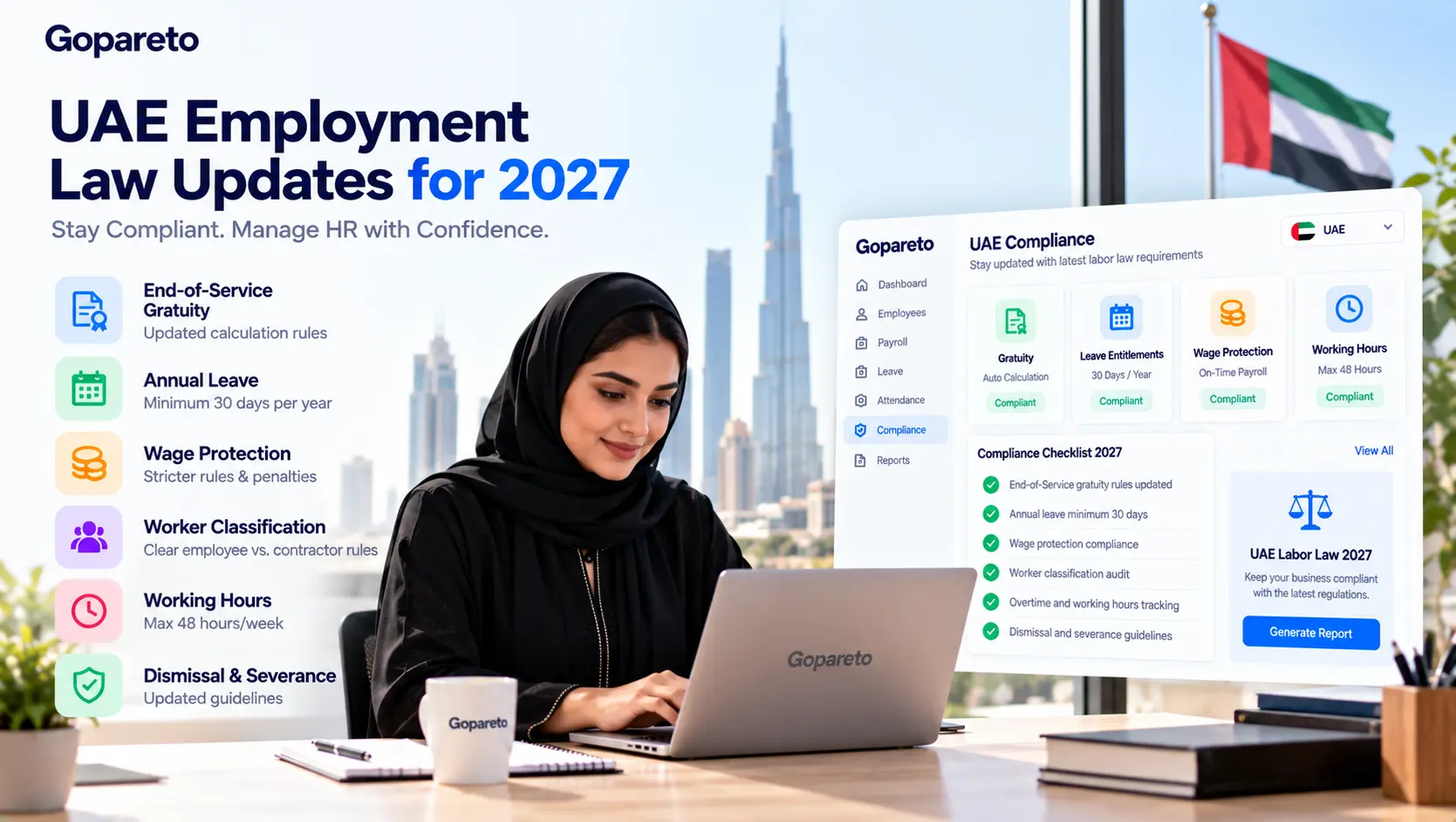
Every year HR teams in the UAE are told that “new labour laws” are coming. Some of it is real, much of it is rumour, and a surprising amount of what circulates online describes rules that have never existed in the UAE at all.
The reality for 2027 is more useful: the private-sector rules are already set out in Federal Decree-Law No. 33 of 2021 on the Regulation of Labour Relations and its Executive Regulations (Cabinet Resolution No. 1 of 2022), enforced by the Ministry of Human Resources and Emiratisation (MoHRE). The law has been amended since it took effect in February 2022, and more changes may follow, but most compliance failures come from misapplying the rules that already exist.
This guide sets out what applies going into 2027, corrects the most common misconceptions, and lists the developments worth watching—clearly separated from what is already law.
The short version
At the time of writing, no replacement labour law has been announced for 2027. Plan on the basis of Decree-Law 33 of 2021 as amended, watch MoHRE announcements for new resolutions, and confirm anything that sounds like a “2027 change” against an official MoHRE source before you act on it.
The Legal Framework Going Into 2027
UAE employment obligations come from a small number of instruments. Knowing which one a rule comes from tells you where to check for updates.
| Instrument | What it covers |
|---|---|
| Federal Decree-Law No. 33 of 2021 | The UAE Labour Law for the private sector: contracts, wages, working hours, leave, termination and end-of-service benefits. In force since 2 February 2022. |
| Cabinet Resolution No. 1 of 2022 | The Executive Regulations: the detail behind the law, including work models, leave, working hours and termination procedures |
| Later amending decree-laws (2023 and 2024) | Changes to contract terms, labour dispute procedures and penalties, including Federal Decree-Law No. 9 of 2024, which raised fines for serious violations |
| MoHRE ministerial resolutions | Operational rules such as the Wage Protection System (WPS), the midday break and Emiratisation targets |
| Unemployment insurance (ILOE) scheme | Mandatory job-loss insurance for most private-sector employees since 2023; the subscription obligation sits with the employee |
Free zones are different
- The Dubai International Financial Centre (DIFC) and Abu Dhabi Global Market (ADGM) have their own employment laws, which apply instead of the federal Labour Law for employees there.
- Most other free zones follow the federal Labour Law, with their own authority handling permits and registration.
- If you employ staff in more than one zone, configure their rules separately.
End-of-Service Gratuity: The Rules That Actually Apply
Gratuity is where most UAE payroll disputes start, and it is also where online guides go most wrong. There is no fixed “minimum gratuity amount”; it is a formula based on the employee’s last basic wage and length of service.
| Element | Rule for full-time employees |
|---|---|
| Eligibility | At least one year of continuous service |
| First five years | 21 days’ basic wage for each year of service |
| Each year after five | 30 days’ basic wage per year |
| Cap | Total gratuity cannot exceed two years’ wage |
| Wage used | Last basic wage, not gross pay with allowances |
| Partial years | Paid pro rata for the fraction of a year worked |
| Unpaid absences | Days of unpaid absence are excluded from the service period |
| Payment deadline | With all other end-of-service dues, within 14 days of the employment ending |
Worked example: an employee on a basic wage of AED 10,000 a month leaves after exactly seven years. Using a daily wage of AED 333.33 (basic ÷ 30, the convention commonly used in practice), gratuity is (5 × 21) + (2 × 30) = 165 days, or about AED 55,000. Check the method against your contracts and MoHRE’s own calculator.
The law also allows amounts the employee owes the employer to be deducted from end-of-service dues, so the claim you may see online that gratuity “can never be offset” is not accurate. Any deduction must be documented and lawful. A voluntary end-of-service savings scheme, approved by the Cabinet in 2023, lets employers invest gratuity contributions in approved funds instead of accruing the liability; it is optional.
Leave Entitlements
UAE annual leave has been 30 days for years. It did not “increase” for 2027, and it does not accrue in full from the first day of employment.
30 calendar days a year after one year of service. Between six months and one year, two days for each month worked. Part-time staff accrue in proportion to their hours.
Unused leave can be carried forward in line with company policy and the regulations, and the employee is entitled to payment for accrued unused leave when employment ends, calculated on basic wage.
Up to 90 days a year after probation: the first 15 days on full pay, the next 30 on half pay and the remaining 45 unpaid. It is not 10 days.
60 days: 45 days on full pay and 15 days on half pay, with additional unpaid leave available in specified circumstances.
5 working days for either parent, to be taken within six months of the child’s birth.
5 days on the death of a spouse; 3 days on the death of a parent, child, sibling, grandchild or grandparent.
10 working days a year for employees with at least two years’ service who are studying at an accredited UAE institution.
Public holidays sit on top of annual leave. Our UAE public holidays 2027 guide covers the expected dates and how to plan rosters around moon-sighting announcements.
Working Hours, Overtime and Rest
Overtime and rest-day rules are frequently misquoted, often by borrowing rules from other countries. The UAE rules are:
| Topic | Rule |
|---|---|
| Normal hours | Maximum 8 hours a day and 48 hours a week; can be varied for certain sectors and roles under the regulations |
| Overtime limit | Generally no more than 2 hours a day, and total hours must not exceed 144 over three weeks |
| Overtime pay | Normal wage plus at least 25% |
| Night overtime | Plus at least 50% for overtime between 10pm and 4am (shift workers excepted) |
| Rest day work | A substitute rest day, or the basic wage for that day plus at least 50% |
| Weekly rest | At least one paid rest day a week; the employer sets which day |
| Ramadan | Private-sector working hours reduced by 2 hours a day |
| Midday break | Outdoor work under direct sun is prohibited from 12:30 to 15:00 between 15 June and 15 September each year |
There is no general rule that Friday work is paid at double time. Ramadan 2027 is expected to begin in early February, subject to moon sighting; our Ramadan 2027 HR guide covers reduced hours and scheduling in detail.
Wages, Deductions and the Wage Protection System
Employers registered with MoHRE must pay salaries through the Wage Protection System (WPS), which gives the ministry visibility of whether and when each employee is paid.
- Pay on the due date: wages are paid on the date set in the contract. Under MoHRE’s WPS rules, a salary is treated as late if it is not paid within 15 days of that date.
- Consequences of late payment: MoHRE can apply escalating measures, including suspending the issue of new work permits, inspections and referral for further action. There is no “1% per day” statutory penalty.
- Deductions are permitted, but only on lawful grounds: for example recovering loans or overpaid wages, contributions required by law, and amounts under a court order. Total deductions are capped as a share of the wage, with lower limits for some categories.
- No unilateral changes: the employer cannot reduce pay or change the terms of the registered contract without the employee’s written agreement.
- Clear payslips: employees should be able to see how their pay was calculated, including any deductions and overtime.
Late payroll is usually a process problem rather than a cash problem: approvals stall, attendance data arrives late, or a WPS file is rejected. Our guide to tracking regulatory deadlines without missing them shows how to build a calendar that catches those slips early.
Contracts, Probation and Termination
Contracts
- Private-sector contracts are fixed-term and renewable
- Contracts must be registered with MoHRE and match the offer the employee accepted
- The law recognises several work models: full-time, part-time, temporary, flexible, remote and job sharing
Probation
- Maximum six months
- An employer ending employment during probation must give at least 14 days’ written notice
- Employees leaving during probation have their own notice requirements, longer if moving to another UAE employer
Notice and dismissal
- Notice must be set in the contract at between 30 and 90 days
- Termination needs a legitimate reason under the law
- Dismissal without notice is allowed only for the serious misconduct listed in the law, after a written investigation
Unlawful termination
- Dismissing an employee because they filed a complaint or claim against the employer is unlawful
- Courts can award compensation of up to three months’ wage, in addition to other dues
- There is no fixed “AED 30,000–60,000” severance scale
Whatever the reason for termination, the paper trail matters: warnings, investigation notes and the final settlement calculation. Our guide to employee records legal requirements covers what to keep for UAE staff.
Equality, Harassment and Work Permits
Discrimination and harassment
The Labour Law prohibits discrimination on grounds including race, colour, sex, religion, national or social origin and disability, and requires equal pay for women and men doing the same work. It also prohibits sexual harassment, bullying and verbal, physical or psychological violence against employees by the employer, managers or colleagues. A written policy, a confidential reporting channel and documented investigations are the practical way to show you meet these obligations.
Work permits rather than “contractor tests”
Online guides often import common-law tests for employees versus contractors. In the UAE the more pressing question is whether each person working for you holds the right permit for the work model they are on. Using someone without a valid permit, or on a permit for a different purpose, is a serious violation; the 2024 amendments raised fines for these offences substantially, up to AED 1,000,000 for the most serious cases.
What to Watch in 2027
The items below are not enacted changes. They are areas where announcements are plausible or where existing deadlines are reaching a natural review point. Track them, but wait for an official MoHRE or Cabinet publication before changing policy.
Emiratisation after 2026
Targets for private companies with 50 or more employees were set to reach 10% Emirati skilled staff by the end of 2026, with separate requirements for some companies of 20–49 employees. Watch for what MoHRE sets for 2027 onwards.
Personal data protection
The federal Personal Data Protection Law (Federal Decree-Law No. 45 of 2021) will shape how HR data is handled. Watch for its implementing regulations and any guidance specific to employee data.
WPS and inspection practice
MoHRE periodically updates WPS rules and inspection campaigns. Watch for resolutions that change late-payment thresholds or extend WPS coverage.
End-of-service savings scheme
The voluntary savings scheme is optional today. Watch whether participation rules or incentives change, as that would affect how you account for gratuity.
Free-zone employment rules
DIFC and ADGM update their own employment laws on their own timetable. If you employ there, follow their announcements separately.
Holiday and Ramadan announcements
Islamic holiday dates and Ramadan hours are confirmed close to the event. Build your 2027 plans on expected dates and adjust when the official announcement is made.
A 2027 UAE HR Compliance Calendar
Instead of invented “deadlines”, build your calendar around the obligations that genuinely recur.
| When | What to do |
|---|---|
| Every pay cycle | Run payroll through WPS on the contractual due date; reconcile rejected or failed payments immediately |
| Every exit | Calculate gratuity, leave payout and other dues; pay within 14 days of the employment ending |
| Early February (expected) | Ramadan begins, subject to moon sighting: reduce working hours by 2 hours a day |
| 15 June – 15 September | Midday break for outdoor work, 12:30–15:00 |
| Half-yearly | If you are covered by Emiratisation targets, check your position against MoHRE’s announced milestones |
| 2–3 December | UAE National Day (Eid Al Etihad) holiday |
| Annually | Review contracts, leave and deduction policies, and harassment training against the current law and any new resolutions |
When MoHRE asks for evidence, you need to produce it quickly. See how to create compliance reports for audits and regulators from the data you already hold.
Common UAE Compliance Mistakes
Payroll and gratuity
- Calculating gratuity on gross pay instead of basic wage
- Counting unpaid absences as service
- Paying final dues later than 14 days after exit
- Deducting for mistakes or damage without a lawful basis
Time and leave
- Overtime worked but not recorded or paid at the correct premium
- Ignoring Ramadan hours or the midday break
- Paying full sick pay beyond 15 days, or none at all
- No payout of accrued annual leave at termination
Contracts and records
- Terms in practice that differ from the MoHRE-registered contract
- Terminating without a documented reason or investigation
- People working on the wrong permit or work model
- Applying federal rules to DIFC or ADGM employees
UAE Compliance Checklist for 2027
Confirm before the new year
- Annual leave set to 30 days after one year, 2 days a month from six months to one year
- Sick leave tiers configured: 15 days full pay, 30 days half pay, 45 days unpaid
- Gratuity calculated on last basic wage at 21/30 days per year, capped at two years’ wage
- Overtime premiums of 25% and 50% applied, with hours recorded
- Payroll scheduled through WPS with a buffer before the due date
- Deductions reviewed against the permitted grounds and caps
- Contracts registered and matching current terms; notice periods between 30 and 90 days
- Anti-discrimination and anti-harassment policy published, with a reporting channel
- Every worker on the correct permit for their work model
- Emiratisation position checked if you are covered
- Free-zone employees mapped to the right law
Leave configuration is where errors compound quietly. GoPareto’s leave policy and compliance features let you set UAE rules once and apply them to every UAE employee.
Frequently Asked Questions
Not at the time of writing. Federal Decree-Law No. 33 of 2021, as amended, remains the governing law for the private sector. Check MoHRE for any new resolutions.
Yes, after one year of service. Employees with between six months and one year of service get two days for each month.
21 days’ basic wage per year for the first five years and 30 days per year after that, capped at two years’ wage, for employees with at least one year’s service.
Within 14 days of the end of employment, including gratuity and payment for unused leave.
Yes, but only on the grounds the law permits, such as loan recovery or court orders, and within the caps set in the regulations.
No. DIFC and ADGM have their own employment laws. Most other free zones follow the federal Labour Law.
Conclusion
For most UAE employers, 2027 compliance is less about reacting to dramatic new rules and more about applying the existing ones accurately: gratuity on basic wage, the right leave tiers, correctly paid overtime, on-time WPS payroll and documented terminations. Keep a short watch list for MoHRE announcements—Emiratisation, data protection and WPS practice above all—and verify every “new rule” against an official source before you change a policy. This article is general guidance, not legal advice; take advice from a UAE employment lawyer on specific cases.
Ready to stay UAE-compliant in 2027?
How GoPareto Helps
- UAE annual, sick and other leave rules configured once and applied to every UAE employee
- End-of-service gratuity calculated on basic wage at exit, ready for final settlement
- Attendance and overtime tracked so payroll and payslips reflect the hours actually worked
- An audit trail of approvals, records and changes, plus an employee self-service portal
Visit Us
GoPareto - Simple & Complete Business Management solution, Omkar Nandan Apartment, A1 201, near Navale Bridge, Kudale Baug, Narhe, Pune, Maharashtra 411041.
Related Blogs