India Labour Law Compliance 2026: Complete Guide for SMBs & HR Teams
September 15, 2026 | By Gopareto Marketing
Running a business in India means navigating complex, constantly changing labour laws. Different rules for different states. Different rules for different company sizes. Rules that change every year.
Get compliance wrong, and you face:
- Government fines of ₹10,000–5,00,000
- Back payments to employees
- Legal action
- Reputational damage
- Business licence suspension, in extreme cases
But there’s no need to fear it. India’s labour laws are simpler than they look once you break them down requirement by requirement.
Why India’s Labour Laws Matter for SMBs
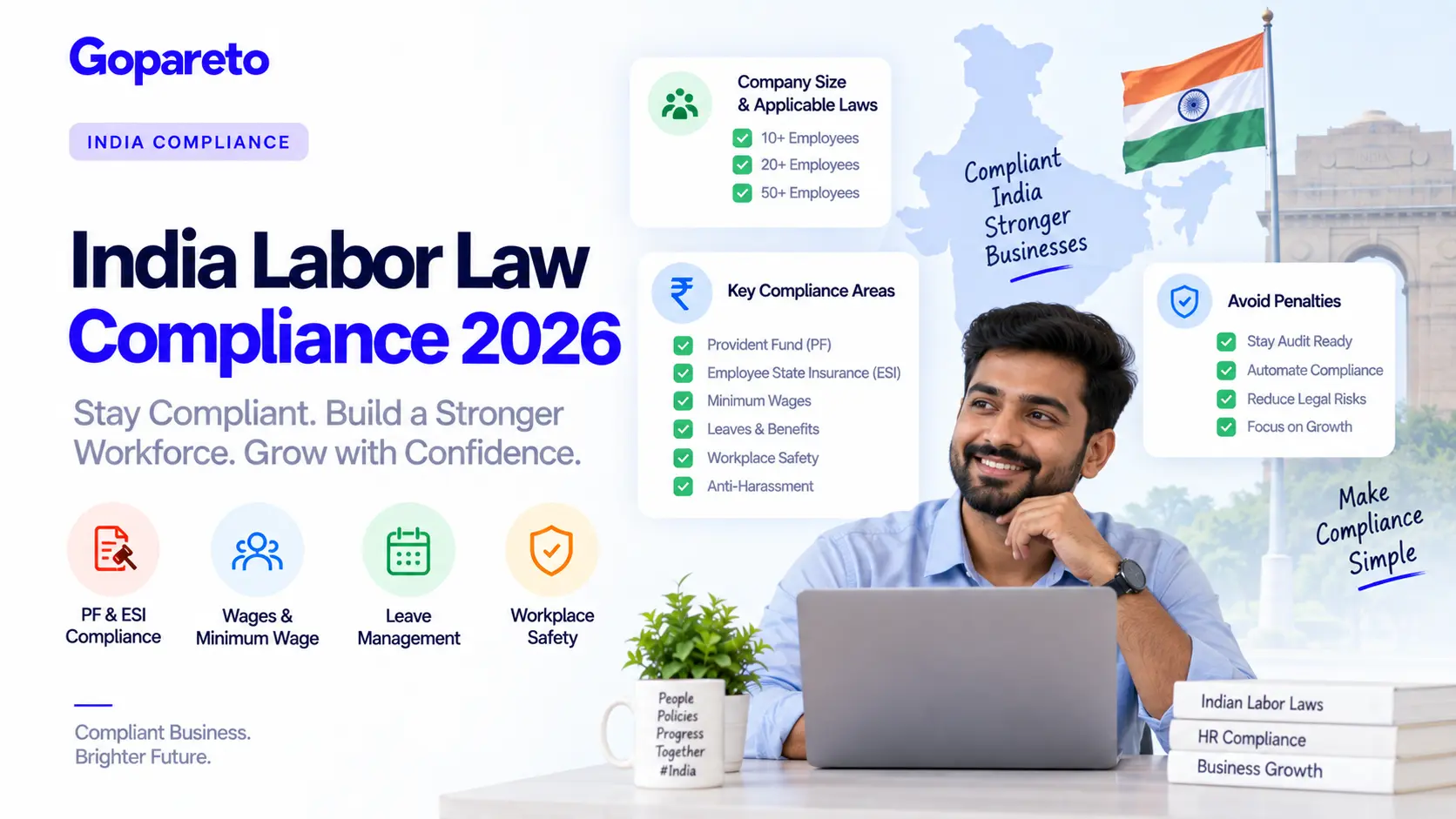
India has more than 50 labour laws covering wages, working hours, leave, social security, safety and health, child labour, discrimination and harassment, and gratuity. But not all of them apply to all companies. Size matters.
Applies to all companies
- Minimum wage, which sets the salary floor
- Timely wage payment
- Professional conduct standards
- No discrimination or harassment
- No child labour
Applies at 10+ employees
- Shop and Establishment Act, which varies by state
- Maternity Benefit Act
- Building and Other Construction Workers Act, where applicable
Applies at 20+ employees
- Provident Fund: employee plus employer contribution
- Workplace safety obligations
- Gratuity rules
Applies at 50+ employees
- Employee State Insurance (ESI)
- Works Committee
- Standing Orders, meaning clearly documented policies
Key Compliance Areas for SMBs
1. Provident Fund (PF)
A social security scheme: the employee contributes 12% of salary, the employer contributes 12%, the money accumulates in an account, and the employee receives it on leaving or retirement.
- Applies when the company has 20 or more employees
- Relevant on salaries of ₹15,000 and above
- Contributions go to the government fund
- Employees can withdraw for specific permitted reasons
If you have 20+ employees earning ₹15,000 or more, you must register with EPFO and deduct from payroll.
2. Employee State Insurance (ESI)
Health insurance for employees earning less than ₹21,000 a month, providing medical and disability benefits, funded by employer and employee contributions and managed by ESIC.
- Applies at 50 or more employees
- Mandatory where salary is below ₹21,000
- Covers employees and their dependants
- Includes disability and maternity benefits
If you’re approaching 50 employees, start planning ESI compliance now rather than after you cross the line. Our guide to PF and ESI compliance with HRMS covers the mechanics.
3. Wages and Minimum Wage
Minimum wage is the government-set salary floor, and it varies by state and often by region within a state.
| State | Indicative monthly minimum wage |
|---|---|
| Maharashtra | ₹6,800–8,600, varying by region |
| Karnataka | ₹5,500–7,000 |
| Tamil Nadu | ₹6,100–7,600 |
| Delhi | ₹7,750 |
| Uttar Pradesh | ₹5,307–5,619 |
Minimum wage includes basic plus allowances—it is not just the basic salary. Check your state’s current notified rate; every employee must earn at least that amount.
4. Leave Management
Mandatory leave types
- Casual leave: 5–8 days a year
- Sick leave: 5–7 days a year
- Earned leave: at least 1 day per 20 days worked
- Maternity leave: 6 months for women
- Paternity leave: 15 days, depending on state
- National holidays, as specified by the state
Rules that trip companies up
- Leave can be restricted but not denied entirely
- Unused earned leave is usually paid out on separation
- Casual and sick leave cannot be carried forward
- Earned leave cannot be refused without a valid reason
Maintain leave records, honour leave requests, and calculate payouts correctly at separation. A leave policy and compliance system makes this automatic.
5. Work Hours and Overtime
- Maximum 48 hours per week, though this can vary
- Overtime beyond 48 hours must be paid at twice the normal rate
- At least one weekly off day is mandatory
Track work hours accurately. If employees work overtime, compensate them properly.
6. Gratuity
A lump sum payment when an employee leaves, applicable after five or more years of service, calculated as 15 days’ salary multiplied by years of service, and paid on resignation, retirement or termination.
7. Professional Tax
A state-level deduction. Maharashtra, Karnataka and Tamil Nadu all run roughly ₹0–200 per month based on salary, while some states charge nothing at all. Check whether your state requires it and deduct from salary if so.
8. Sexual Harassment Prevention
- The company must have a written policy
- An internal complaints committee is required
- Every complaint must be investigated
- No retaliation against complainants is permitted
Create and communicate a clear anti-harassment policy. See our guide to preventing workplace discrimination and harassment.
How Rules Differ by State
| Aspect | Varies by state? | Example |
|---|---|---|
| Minimum wage | Yes | ₹5,300–8,600 per month |
| PF threshold | No | 20+ employees, nationally |
| ESI threshold | No | 50+ employees, nationally |
| Casual leave | Yes | 5–10 days per year |
| Professional tax | Yes | ₹0–200 per month |
| Holiday list | Yes | Different holidays in each state |
Critical point: if you have offices in multiple states, each state’s laws apply to the employees in that state. A company headquartered in Mumbai follows Maharashtra rules for Mumbai staff and Karnataka rules for Bengaluru staff.
Six Compliance Mistakes SMBs Keep Making
Watch for these
- Using an old minimum wage. The government notifies a new rate, the company pays the old one for three months, and owes a fine plus back payment.
- Incorrect PF calculation. Calculating on basic only when allowances should be included, resulting in underpayment.
- No records. No attendance, leave or salary records means you cannot prove compliance in an audit, and you are fined by default.
- Denying casual leave. A blanket denial is against the law and the employee can file a complaint.
- Not paying gratuity. An employee completes five years, leaves, and the calculation is forgotten—then litigated.
- Overtime underpayment. Paying 12 overtime hours at the normal rate instead of double violates the wages act.
How a Made-in-India HRMS Helps
An HRMS built for India automates the parts of compliance that people get wrong:
- Automatic wage calculation against your state’s minimum wage rules
- PF and ESI calculations verified by chartered accountants
- Leave tracking that enforces correct allocation
- Automatic updates when the law changes
- Compliance dashboards showing what needs attention
- Audit reports ready for government inspection
- Multi-state support for offices across India
Instead of your HR manager worrying about compliance, the system handles it.
Your SMB Compliance Checklist
This month
- Verify your company size by counting employees
- Check your state’s current minimum wage
- Determine whether you need PF or ESI registration
- Create a written leave policy
- Document your anti-harassment policy
Every month
- Maintain attendance records
- Calculate payroll according to state rules
- Track and approve leave properly
- Process salary correctly and on time
Every quarter
- Review PF contributions
- Verify ESI compliance where applicable
- Audit leave balances
- Check for new government notifications
Every year
- Reconcile taxes
- Calculate gratuity for eligible employees
- Review and update all policies
- Plan for next year’s minimum wage changes
Getting Compliance Right
Compliance doesn’t have to be stressful. With the right system and an understanding of the basic rules, you can avoid fines, maintain good employee relations, build a compliant workplace, and scale confidently.
Ready to make compliance automatic?
How GoPareto Helps
- PF, ESI, minimum wage, IT and PT handled for every state
- Leave entitlements enforced by policy, not memory
- Rules updated when the government changes them
- Audit-ready records and registers on demand
Read more in HRMS software compliant with Indian labour laws.
Request a DemoVisit Us
GoPareto - Simple & Complete Business Management solution, Omkar Nandan Apartment, A1 201, near Navale Bridge, Kudale Baug, Narhe, Pune, Maharashtra 411041.
Related Blogs