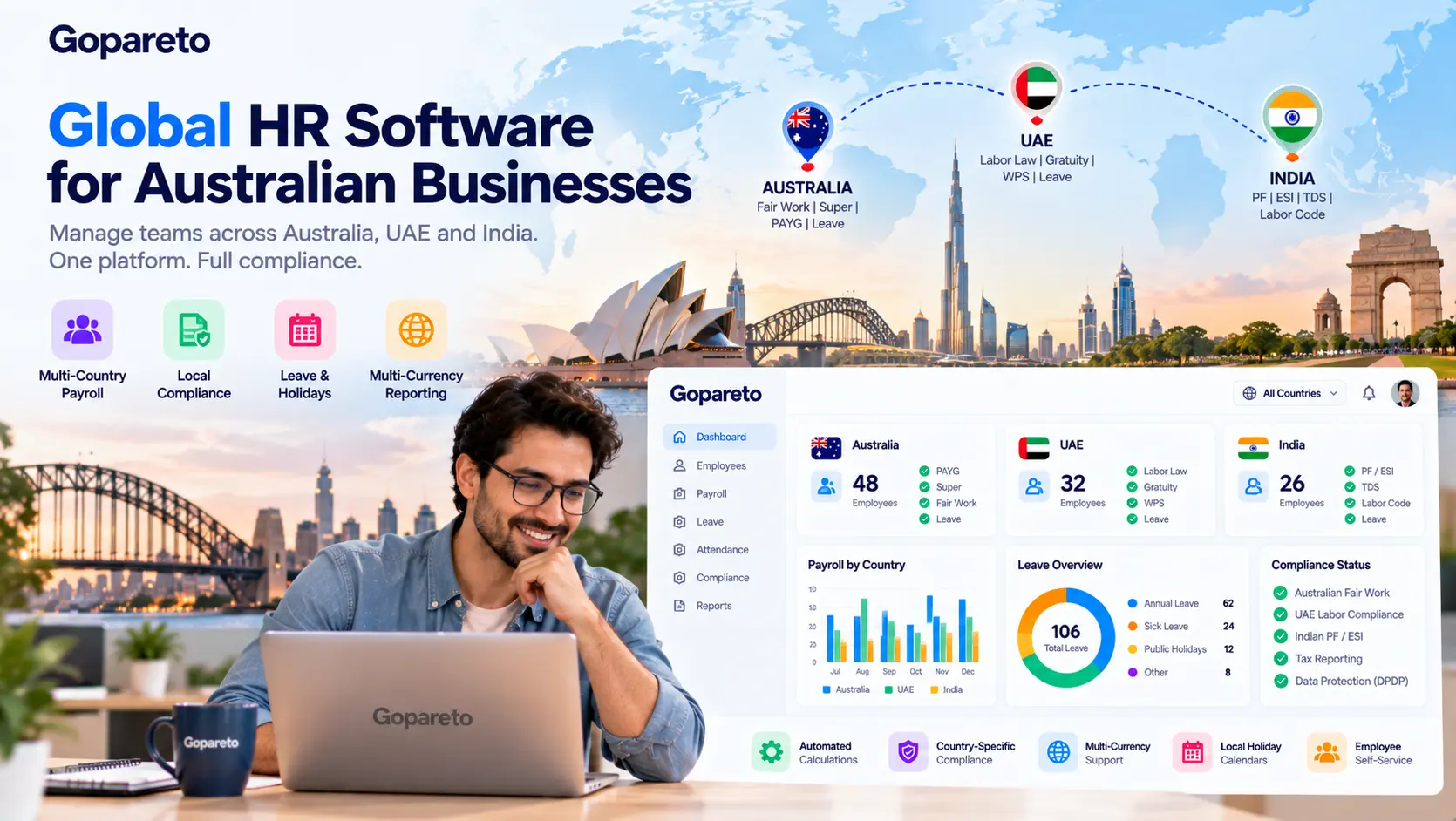
HR Software for Multi-State and Multi-Country Compliance: How It Works Across Australia, India and the UAE
October 12, 2026 | By Gopareto Marketing
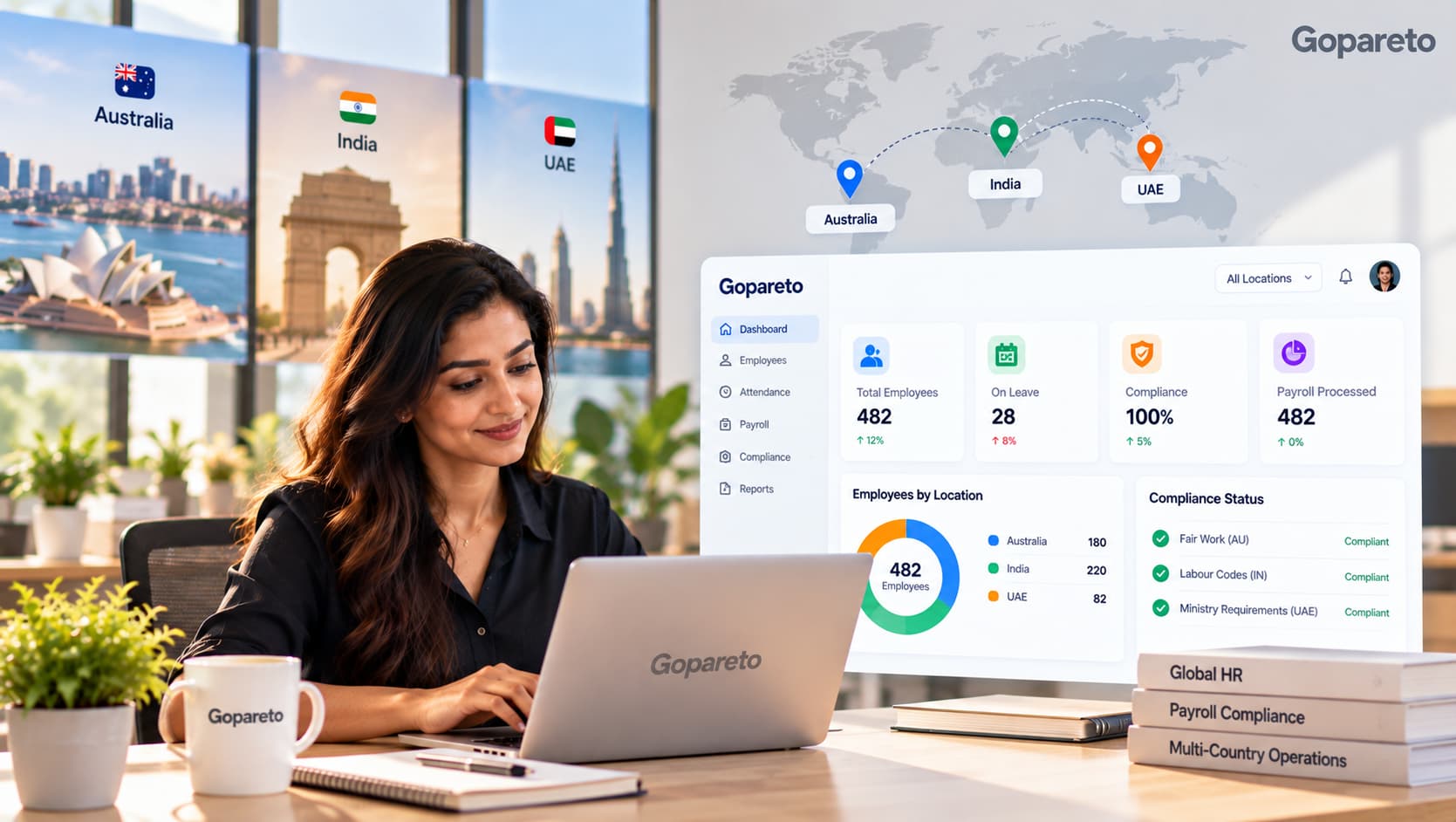
“Multi-country compliance” gets most of the attention, but plenty of compliance errors happen inside a single country. An Australian business with staff in Victoria and Queensland, or an Indian company with offices in Mumbai and Bengaluru, is already dealing with different rules for different employees.
Add a second or third country and the number of rule combinations multiplies. The question is not whether your HR software “supports” Australia, India and the UAE, but how it decides which rule applies to which employee, on which date, and how it proves that afterwards.
This guide looks at the mechanics: what varies by state or emirate in each country, how good HR software models those variations, and how to implement and measure it.
The Two Layers of Compliance
In each of the three countries, some obligations are national and some are set locally. Mixing up the two layers is the root of most configuration errors.
| Country | National layer | State or emirate layer |
|---|---|---|
| Australia | Fair Work Act and National Employment Standards, modern awards, PAYG withholding, STP, superannuation | Payroll tax, public holidays, long service leave, workers’ compensation |
| India | The Labour Codes, PF, ESI, TDS, gratuity | Professional tax, Shops and Establishments rules, Labour Welfare Fund, minimum wage rates, state holidays |
| UAE | Federal Decree-Law No. 33 of 2021, WPS, federal public holidays | Free-zone regimes (DIFC and ADGM have their own employment laws), emirate-level health insurance and visa processes |
Multi-State Compliance in Australia
Australia’s core employment framework is federal: the NES and modern awards apply nationally, and awards are not state-based. But several significant obligations are run by the states and territories.
Each state and territory sets its own tax-free threshold, rate and lodgement rules. Wages are generally taxed where the work is performed, and grouping rules can combine related businesses’ wages when testing thresholds.
National holidays are supplemented by state ones, and some shared holidays fall on different dates, such as Labour Day and the King’s Birthday.
Set by state and territory legislation, with different qualifying periods, accrual rates and cash-out rules, and portable schemes in some industries.
Each state runs its own scheme, with its own premiums, wage declarations and claims process.
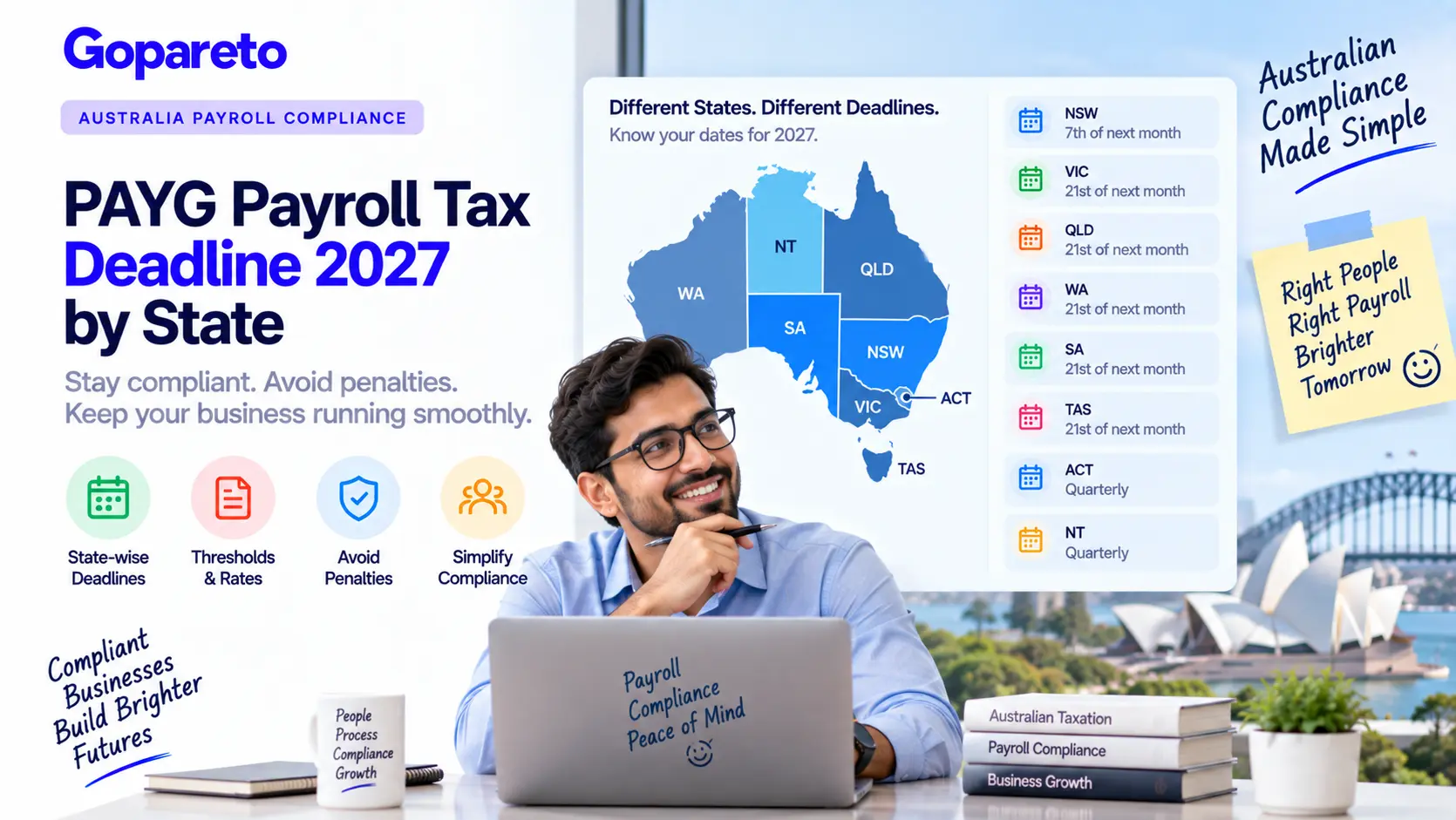
For payroll tax rates and lodgement dates by state, see our guide to PAYG and payroll tax deadlines in 2027 by state.
Multi-State Compliance in India
India’s Labour Codes, in effect from 21 November 2025, consolidate the central statutes, but states still make many of the rules that determine day-to-day payroll and HR.
Levied by some states, including Maharashtra, Karnataka and West Bengal, and not by others. Slabs differ by state, within a constitutional cap of ₹2,500 per employee per year.
State law governs registration, working hours, weekly offs, leave and holidays for shops and offices.
Small employee and employer contributions in states that operate a fund, with state-specific amounts and due dates.
States notify minimum wage rates by skill level and zone, and each state has its own festival and restricted holiday list alongside national holidays.
PF at 12% from employer and employee, ESI at 0.75% and 3.25% for employees earning up to ₹21,000 a month, and TDS are central, so they don’t change when an employee moves state. Our India labour law compliance guide covers both layers in detail.
Emirate and Free-Zone Differences in the UAE
The UAE Labour Law is federal, enforced by MoHRE, and applies on the mainland and in most free zones. The variations HR needs to model are:
- DIFC and ADGM: these financial free zones have their own employment laws, with different leave, end-of-service and termination rules.
- Health insurance: employer-provided health insurance has long been mandatory in Abu Dhabi and Dubai, and has since been extended to private-sector employees across the other emirates.
- Visas and permits: processes and authorities differ between emirates and free zones, so document tracking needs the issuing authority as well as the expiry date.
- Pensions for UAE nationals: contributions go to the federal pension authority, or to Abu Dhabi’s own fund for Emiratis employed there.
For the federal rules themselves—gratuity, leave, overtime and WPS—see our guide to UAE employment law for HR in 2027.
How HR Software Should Model These Rules
Behind any credible multi-jurisdiction HR system is the same basic design. Use these six points to test vendors.
Work location drives the rules
Every employee has a country, state or emirate, and entity. Leave policies, holiday calendars, statutory deductions and end-of-service rules are attached to that location, not typed in per person.
Rules are effective-dated
When a rate or threshold changes, the new rule applies from its start date and earlier pay periods keep the old one, so back-pay and audits stay correct.
Calendars are layered
National holidays plus the relevant state list, with UAE dates that can be confirmed after moon-sighting announcements.
Outputs are jurisdiction-specific
STP data for the ATO, PF and ESI contribution data for India, WPS salary data for the UAE—not one generic export.
Moves are events, not edits
A transfer between states or countries is recorded with a date, so the system switches rule sets cleanly and keeps the history.
Every override is logged
Manual exceptions are allowed but recorded with who, when and why, so you can explain any figure to a regulator.
Worked Examples: When an Employee Moves
Within India: Mumbai to Bengaluru
Professional tax switches from Maharashtra’s slabs to Karnataka’s from the transfer date, the Shops and Establishments rules and holiday list change, and any Labour Welfare Fund deduction follows the new state’s rules. PF, ESI and TDS carry on unchanged. A system that treats the move as a dated event handles all of this in the next pay run; a manual process usually misses at least one item.
Within Australia: Melbourne to Brisbane
The employee’s wages move to Queensland for payroll tax from when the work is performed there, the public holiday calendar changes, and you need to confirm how long service leave continuity is treated across the two states’ legislation. Award coverage, super and PAYG don’t change.
Across countries: Sydney to Bangalore
This is where advice is essential. Tax residency, the local employer (an entity or Employer of Record), Indian PF registration and permits all need settling first. Australia and India have a social security agreement that can prevent seconded employees contributing to both systems for a period; check eligibility and apply for a certificate of coverage before the move. For the broader picture of expanding from Australia, see our guide to global HR software for Australian businesses.
Implementing Multi-Jurisdiction HR Software
1. Assess
- List every country, state, emirate and entity you employ in
- Note the rules that vary in each, using the tables above
- Identify where current processes rely on manual work
2. Select
- Test vendors against the six design points
- Ask for a demonstration of a mid-year state transfer
- Confirm how statutory changes are updated and by whom
3. Configure
- Set up locations, entities, calendars and leave policies
- Load opening balances and service dates
- Document every local rule choice you make
4. Train
- HR and payroll by country
- Managers on approvals
- Employees on the self-service portal
5. Go live
- Run a parallel pay cycle in each country first
- Avoid a country’s year-end month for cut-over
- Monitor the first live cycles closely
6. Optimise
- Review exceptions and overrides monthly
- Update rules as laws change
- Retire leftover spreadsheets
Timelines depend on how many countries, entities and employees you bring across; a single-country team can move quickly, while a three-country rollout is best phased one country at a time.
Measuring Whether It Works
- Deadlines met: statutory filings and payments on time, by country
- Payroll corrections: off-cycle adjustments per pay run
- Rejected submissions: STP, PF or WPS files returned with errors
- Manual overrides: how often rules are bypassed, and why
- Time to close payroll: from cut-off to approval in each country
- Self-service adoption: employee queries answered without HR
These metrics are also the backbone of a regulator-ready file; see how to create compliance reports for audits and regulators.
Common Mistakes
Configuration
- One company-wide leave policy for all locations
- Treating Australian awards as state-based
- Applying federal UAE rules to DIFC or ADGM staff
- Deducting professional tax in states that don’t levy it
Process
- Transfers recorded by overwriting the employee’s location
- Rate changes applied retrospectively to closed pay periods
- No owner for monitoring legal changes in each jurisdiction
- Cross-border moves made before tax and permit advice
Frequently Asked Questions
No. Modern awards are federal and made by the Fair Work Commission. Payroll tax, long service leave, public holidays and workers’ compensation are the main state-level items.
No. Only some states levy it, and slabs differ, so it must be configured by state.
The federal law applies across the mainland and most free zones, but DIFC and ADGM have their own employment laws.
Recording each rule with a start date, so changes apply from the right pay period and history is preserved.
Conclusion
Multi-state and multi-country compliance comes down to the same mechanics: know which obligations are national and which are local, attach rules to each employee’s work location, date every change, and keep an audit trail of every exception. HR software built that way turns a transfer between Mumbai and Bengaluru, or a new office in Dubai, into a configuration task rather than a payroll risk. Take local advice on the law; let the system apply it consistently.
Ready to manage compliance across every location?
How GoPareto Helps
- Location-based leave policies for India, Australia and the UAE
- Multi-region holiday calendars applied to the right employees
- Attendance, leave and payroll in one system, with payslips for every location
- Audit trails of approvals and changes, plus an employee self-service portal
Visit Us
GoPareto - Simple & Complete Business Management solution, Omkar Nandan Apartment, A1 201, near Navale Bridge, Kudale Baug, Narhe, Pune, Maharashtra 411041.
Related Blogs