How to Prevent Workplace Discrimination and Harassment Issues
September 17, 2026 | By Gopareto Marketing
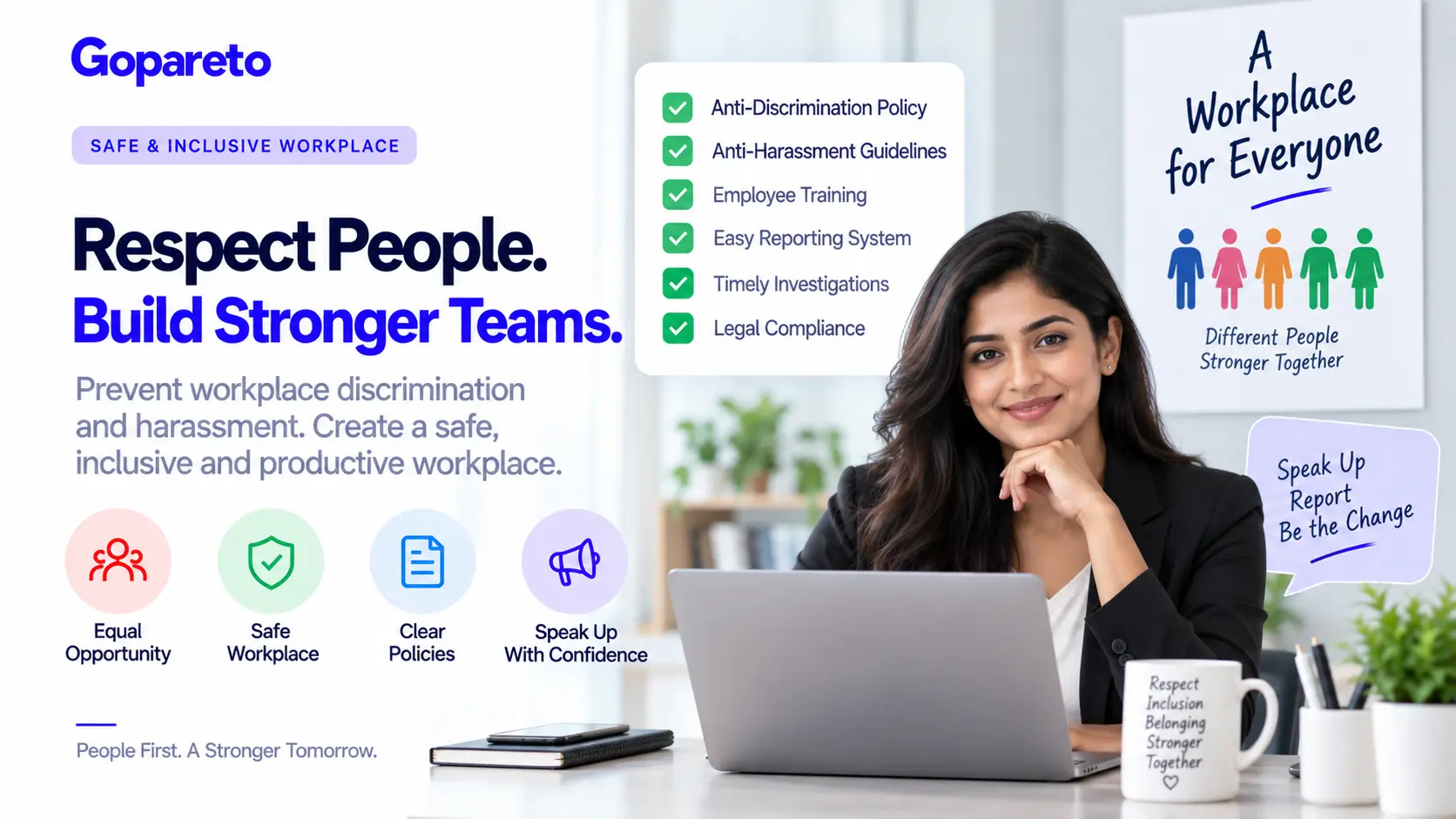
Workplace discrimination and harassment lawsuits are expensive, damaging to company culture, and entirely preventable. Yet most Indian companies approach prevention reactively, only addressing it after an incident occurs.
The cost of getting this wrong is massive: legal fees, settlement costs, lost productivity, damaged reputation, and the stress of investigations. The cost of preventing these issues is minimal—mostly time and attention.
This guide shows how to prevent workplace discrimination and harassment before it starts, with practical policies, training, reporting systems and investigation procedures.
Discrimination vs Harassment: The Legal Difference
Discrimination: unfair treatment
- Gender or sex, including pregnant women
- Caste, including scheduled castes and tribes
- Religion
- Disability, physical or mental, and chronic illness
- Age, whether “too old” or “too young”
- Marital or family status
- Sexual orientation
Harassment: unwanted conduct
- Sexual harassment: unwanted advances, comments or behaviour
- Caste harassment: slurs, name-calling or exclusion
- Religious harassment: mocking faith or forcing practices
- Gender-based harassment and bullying
- Disability harassment: mocking or excluding
- Age-based jokes and exclusion from opportunities
Key difference: discrimination is unfair treatment, often a single decision. Harassment is repeated unwanted conduct—a pattern that creates a hostile environment.
The Legal Framework in India
Applies to all workplaces. Mandates prevention policies, an internal complaints committee, and timelined investigation procedures.
Prohibit discrimination on grounds of religion, race, caste, sex and place of birth, for all employees.
Protects employees experiencing domestic violence; companies must accommodate employees fleeing abuse.
Prohibits discrimination against disabled employees and mandates reasonable accommodations.
Step 1: Write Clear Policies
Your first defence is a clear, written policy that all employees actually understand. It must cover five things.
Clear definitions
Don’t just cite laws. Explain in plain terms: not hiring someone because of their gender, paying someone less because of their caste, excluding someone from meetings because of their religion, not promoting someone because of their disability.
Prohibited conduct
- Slurs, name-calling, derogatory comments
- Jokes about appearance, body, gender, caste or religion
- Unwanted physical contact
- Threats or intimidation
- Exclusion from work or social activities
- Retaliation against anyone who reports
Consequences
- Verbal warning for a first minor offence
- Written warning for repeated offences
- Suspension for serious incidents
- Termination for severe or repeated violations
Reporting procedures
- Direct manager, where safe
- HR department
- Anonymous hotline, if available
- External agency, if internal reporting is risky
Investigation timeframe
- Acknowledge the complaint within 3 days
- Investigate within 10–15 days
- Share findings within 30 days
- Keep it confidential, on a need-to-know basis
Be specific about the hardest rule: retaliation against an employee who reports harassment in good faith results in immediate termination.
Do
- Distribute the policy during onboarding
- Have employees acknowledge they read and understood it
- Display it in common areas and on the employee portal
- Update it annually as incidents and laws change
Don’t
- Write a policy and file it away
- Assume employees read the handbook once
- Use generic policies that don’t reflect your culture
- Make exceptions for senior leaders
Step 2: Mandatory Training for Everyone
Policies only work if employees understand them.
| Audience | Cadence | What it covers |
|---|---|---|
| All employees | Annual, 60–90 minutes | What discrimination and harassment are, legal consequences, how to recognise subtle harassment, how to be an ally, how to report |
| Managers | Annual, 2–3 hours | All of the above, plus spotting signs in their team, responding to a report, building a supportive environment, and avoiding retaliation |
| HR staff | Annual, 4–6 hours | All of the above, plus investigation techniques, interviewing, evidence preservation and legal compliance specifics |
What works
- External trainers, for perceived neutrality
- Real scenarios from Indian workplaces
- Interactive elements, not just lectures
- Recorded sessions available to new hires
- Pre- and post-tests to verify learning
- Sign-off that training was completed
What doesn’t
- One-time training with no annual refresher
- Generic online modules watched passively
- No testing or verification of understanding
- Excusing senior leaders from attending
Step 3: Build Accessible Reporting Channels
Employees won’t report issues if they don’t believe it’s safe to do so. Offer more than one route.
- Direct manager: easiest, but risky if the manager is the harasser
- HR department: a dedicated email plus in-person availability
- Anonymous hotline: safest for serious issues, ideally run by a third party
- External bodies: State Labour Commissioner, District Magistrate, or police for criminal harassment
Confidentiality
- Only people who need to know are involved
- Investigation details aren’t shared with colleagues
- The reporter’s identity is protected where possible
No retaliation, and real support
- A written policy that good-faith reporting is never punished
- Named examples of retaliation: removal from projects, a negative review, a pay cut
- The reporter can bring a witness to meetings
- The reporter can request counselling, leave or a role change
Step 4: Establish an Internal Complaints Committee
For organisations with 10 or more employees, an ICC is legally mandatory under the Sexual Harassment Act.
Who sits on it
- Presiding officer: ideally a senior woman, or an external consultant if not possible
- Senior employee representative: typically HR or a senior manager
- External member: a retired judge, social worker or external HR consultant
- Employee representative: elected by staff
What it does
- Receives complaints
- Investigates impartially
- Interviews complainant, respondent and witnesses
- Preserves evidence: emails, messages, documentation
- Determines whether harassment occurred
- Recommends action
- Documents findings confidentially
- Monitors for retaliation after closure
The Investigation Timeline in Practice
| Days | What happens |
|---|---|
| 1–3 | Acknowledge receipt, inform both parties, outline the timeline |
| 4–7 | Preliminary investigation: gather documents, preserve emails, understand context |
| 8–14 | Interviews with complainant, respondent and witnesses, plus documentation review |
| 15–20 | Analysis: did the conduct occur, does it meet the legal definition, how severe is it |
| 21–30 | Report: findings, reasoning, recommendations and remedies |
Step 5: Remedies and Support for the Complainant
Immediate
- Separate the harasser from the complainant
- Ensure no further contact
- Apologise formally
- Offer counselling support
Longer term
- Transfer to another department, at the complainant’s choice
- Modified work schedule where needed
- Paid leave to recover, for medical or mental health reasons
- Promotion reconsideration if harassment delayed their progress
Financial and ongoing support
- Back pay where the harasser blocked work opportunities
- Compensation proportionate to severity
- Medical and counselling expenses
- An employee assistance programme, flexible arrangements, and regular HR check-ins
Step 6: Address the Harasser
| Severity | Action |
|---|---|
| Minor: an isolated inappropriate comment, quickly apologised for | Documented verbal warning, respectful-workplace training, signed acknowledgment |
| Moderate: a pattern of disrespectful comments, refused to change | Written warning, mandatory training, 60–90 day probation, loss of bonus or promotion eligibility |
| Serious: physical harassment, threats, repeated violations | Suspension of 7–30 days, formal warning, demotion, transfer away from the complainant |
| Most serious: assault, severe harassment, retaliation | Termination, police report where criminal, recovery of costs |
Weigh mitigating factors—a first offence, an immediate apology and changed behaviour, genuine remorse, a complainant requesting leniency—against aggravating ones: repeated violations, abuse of power by a senior person over a junior, threats, or retaliation after the complaint.
Step 7: Prevent Future Incidents
Review new reports and trends monthly, check ICC effectiveness and refresh training quarterly, and run a full policy review annually.
What builds a healthy culture
- Diverse hiring across gender, caste, religion and disability
- Inclusive language in all communication
- Visible leadership commitment
- Celebrating differences through inclusive policies
- Consistent zero-tolerance enforcement
Mistakes that backfire
- “We’ve never had a complaint”—usually means reporting is blocked
- All-male leadership, which signals women aren’t welcome
- Excusing senior leaders from policies
- Tolerating bad behaviour from high performers
- Focusing only on harassment of women and ignoring other forms
Responding to a Complaint: The First 24 Hours
What to do
- Listen without judgment; don’t argue or minimise
- Treat it as a potential legal matter
- Document what was said, when, and any witnesses
- Act immediately if safety is at risk
- Explain the ICC process and the timeline
- Be clear about who will know what
- Offer counselling, leave or workplace adjustments
What not to do
- Say “we’ll keep this quiet”—it signals a cover-up
- Tell the harasser before investigating
- Ask the complainant to work it out alone
- Question their credibility
- Suggest they might be overreacting
- Treat them differently after the complaint
FAQ: Preventing Discrimination and Harassment
No. Dress codes must be equally applied or offer equal options. A “professional appearance” standard is fine; different standards by gender are not.
No, that’s discrimination. You can adjust duties where there is a genuine health risk, but only with the employee’s consent.
Complete the investigation anyway and document the findings. If they reapply, you have a record of the conduct.
Only in limited circumstances. A hospital run by a religious body cannot discriminate against employees of other faiths in secular roles.
If it involves colleagues and affects the work environment, it is still workplace harassment. Report and investigate it.
Conclusion
Preventing workplace discrimination and harassment isn’t just the right thing—it’s legally required and good for business. Companies with genuine zero-tolerance policies attract better talent, have lower turnover, higher engagement and fewer lawsuits.
Start today: audit your policies, invest in training, and create safe reporting channels.
Ready to protect your workplace?
How GoPareto Helps
- Policy documents distributed and acknowledged inside the system
- Training records tracked per employee, with completion sign-off
- Employee records and documentation kept audit-ready
- Role-based access so sensitive case records stay confidential
See how this fits your wider obligations in our India labour law compliance guide.
Request a DemoVisit Us
GoPareto - Simple & Complete Business Management solution, Omkar Nandan Apartment, A1 201, near Navale Bridge, Kudale Baug, Narhe, Pune, Maharashtra 411041.
Related Blogs