How to Ensure Your HR Software is DPDP Compliant in India
September 15, 2026 | By Gopareto Marketing
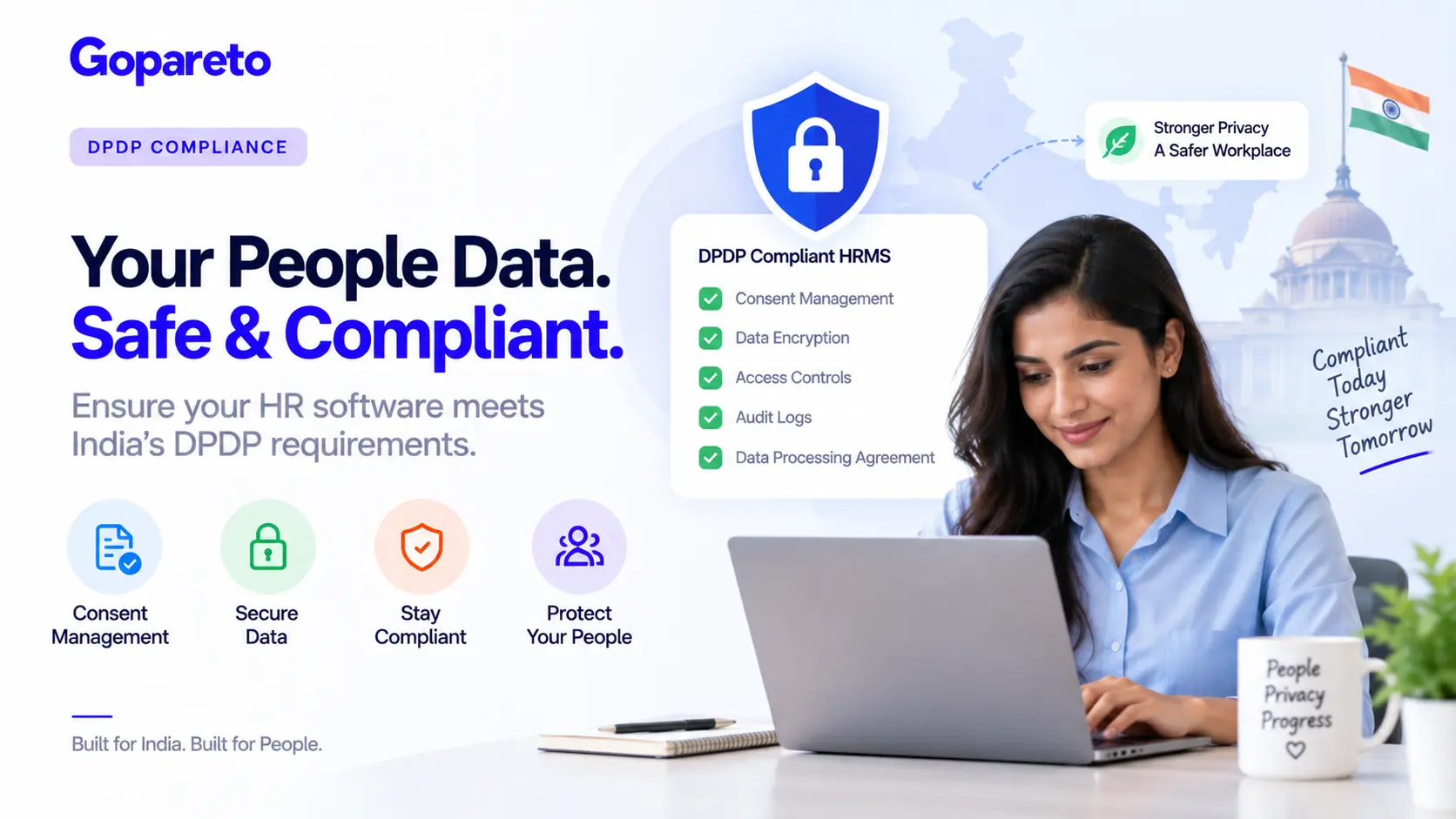
Most HR software companies don’t make it clear whether their platforms meet India’s DPDP requirements. Many are built for global markets and lack India-specific protections. As an Indian business owner or HR manager, you need to know exactly what to look for and how to verify compliance.
This guide walks through the DPDP Act requirements, shows what to audit in your HR software, and explains how a purpose-built India HRMS keeps your business legally protected.
What the DPDP Act Is and Why It Matters
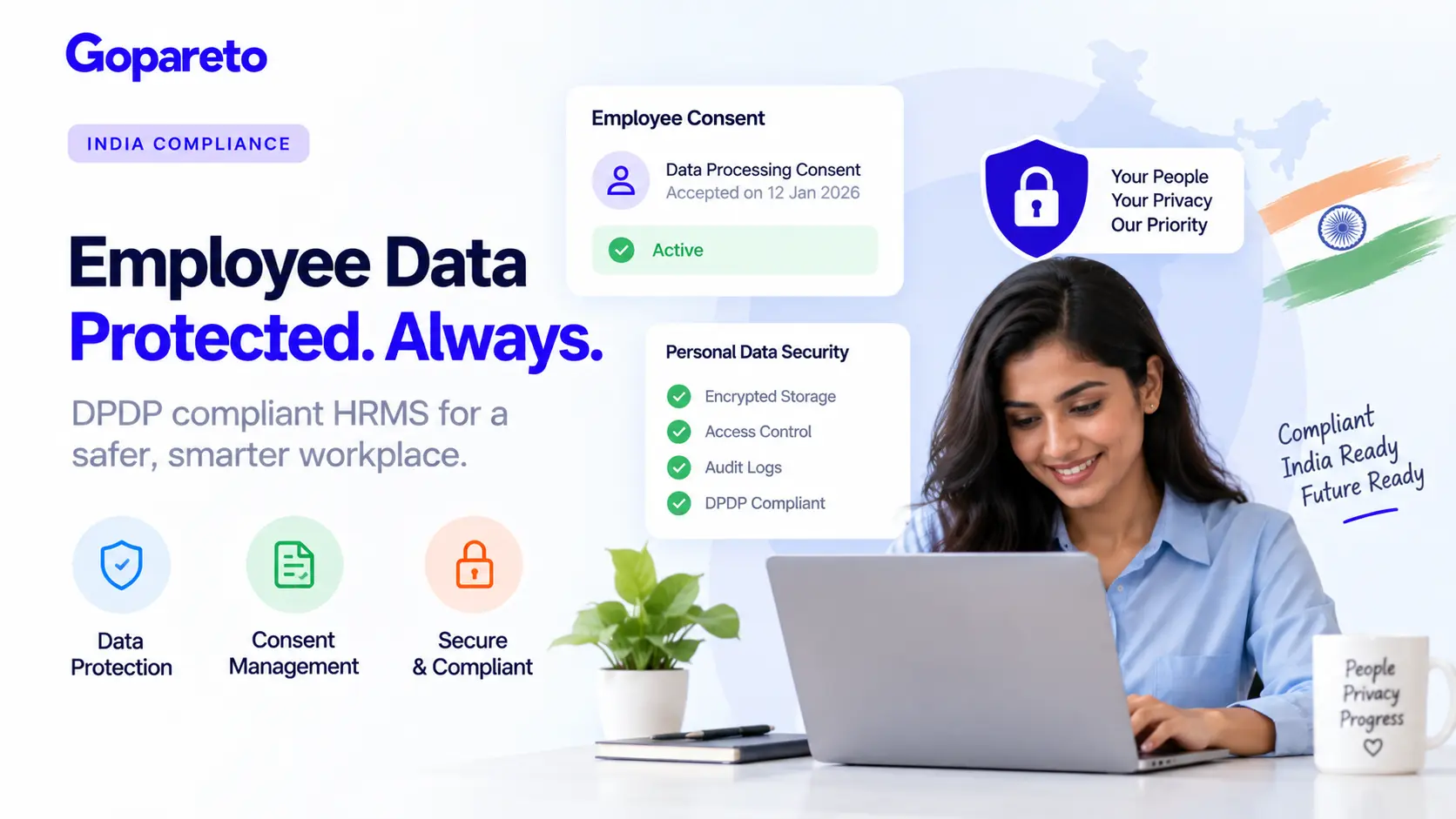
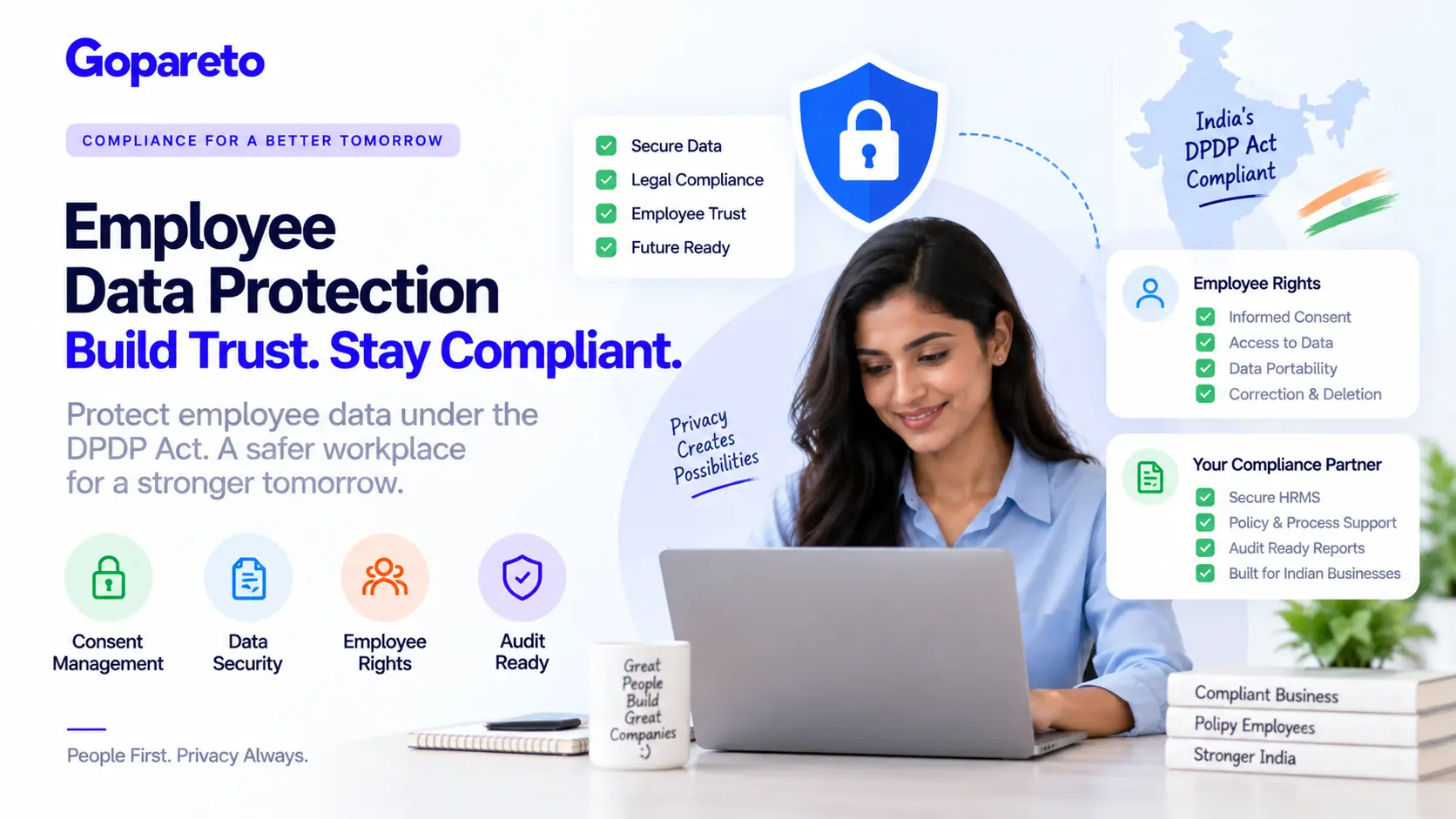
The Digital Personal Data Protection Act came into force in August 2024 and is India’s first comprehensive data protection law. It applies to every organisation that collects, processes or stores personal data about individuals—including your employees.
Scope
- Names and contact information
- Salary details and payroll records
- Attendance records
- Performance evaluations
- Health information
- Biometric data
Enforcement and timeline
- Penalties reach ₹20 crore for serious violations
- Administrative action against the organisation
- Effective since August 2024, with no grace period
- Applies to startups, SMBs, enterprises and non-profits alike
Why DPDP Is Not Just GDPR Again
Unlike GDPR, which focuses on EU residents, DPDP applies to all personal data of individuals in India regardless of where your company is based. It requires explicit consent management, mandatory data security standards, and clear data processing agreements—all documented.
The critical difference: DPDP requires a documented Data Processing Agreement with vendors, including your HR software provider. If your HRMS vendor doesn’t explicitly support DPDP compliance, your company remains liable.
Seven Things Your HR Software Needs for DPDP Compliance
1. Explicit Data Processing Agreements
Your vendor must provide a signed DPA outlining how they handle employee data on your behalf. Under DPDP you remain the employer and the software is your data processor; without a DPA you cannot legally claim compliance.
- Does your vendor offer a signed DPA?
- Does it specify data locations, India-based or international?
- Does it outline retention and deletion practices?
- Are there clauses covering their sub-processors?
Red flag
- If a vendor says “we don’t have formal DPAs,” they are not DPDP-ready. Walk away.
2. Consent Management System
DPDP requires explicit consent before processing certain data, such as health or biometric information, and you must be able to prove consent was obtained and documented.
- Can you create and track consent forms in the system?
- Does it maintain audit trails of when consent was obtained?
- Can employees withdraw consent, handled automatically?
- Are consent logs exportable for audits?
If your HRMS asks “do you consent to sharing your shift preferences with management?” and records a timestamp, that’s good consent management. If it just stores data without tracking consent, it isn’t compliant.
3. Data Encryption and Security Standards
Employee data must be encrypted both in transit and at rest using industry-standard encryption.
- Is data encrypted with AES-256 or equivalent?
- Are passwords hashed with bcrypt or Argon2, never plain text?
- Does the vendor use TLS 1.2 or higher in transit?
- Are multi-factor authentication options available?
- Is there regular security auditing and penetration testing?
Ask for security certifications such as ISO 27001 or SOC 2 Type II, and request the security whitepaper. Reputable vendors provide these openly.
4. Data Localisation
Sensitive personal data of Indian citizens should preferably sit on servers located in India. DPDP doesn’t absolutely mandate it for all data, but international transfers require additional safeguards.
- Where are the primary data servers located?
- Are attendance, payroll and performance data stored in India?
- What safeguards cover any international transfer?
- Does the vendor offer India-only data residency?
5. Data Retention and Deletion Policies
DPDP requires organisations to delete personal data once the purpose for processing is fulfilled. You cannot keep employee data indefinitely.
- Can you set custom retention periods per data type?
- Does the system auto-delete once a period expires?
- Can you trigger manual deletion for former employees?
- Is there an audit trail of what was deleted and when?
You might retain payroll data for seven years for tax compliance but delete detailed attendance logs after two. Your HRMS should support both timelines at once.
6. Employee Data Access and Portability
Employees have the right to access their personal data and receive a copy in a portable format.
- Can employees download their data as CSV, PDF or JSON?
- Is it self-service, or does it need admin approval?
- How quickly can exports be generated?
- Does the export include everything the system holds?
7. Audit Logs and Compliance Reporting
Your HRMS must log who accessed what data, when, and for what purpose. If you face a breach investigation, this is your evidence.
- Are audit logs generated automatically and immutable?
- Can you filter by user, data type and date range?
- Can you export compliance reports for regulators?
- How long are audit logs retained?
How to Audit Your Current HR Software
Request a DPDP compliance checklist
A serious vendor has a DPDP compliance whitepaper, a completed assessment checklist, and references from other Indian customers. If they can’t produce these, they aren’t serious about compliance.
Verify data processing agreements
- Do you have a signed DPA?
- Where is employee data physically stored?
- How often is data backed up, and where?
- Who can access employee data, and when?
Test consent and access features
Create a test employee account. Verify consent can be requested and tracked, download your own data from self-service, check deletion options, and see what withdrawing consent actually does.
Review audit logs
Confirm logs show who accessed which data and when, cannot be edited or deleted manually, can be exported, and are retained at least 12 months.
5. Document Your Findings
Keep a compliance checklist like this one. It protects you if authorities ask whether you made reasonable efforts.
| Requirement | Status | Evidence | Action needed |
|---|---|---|---|
| DPA in place | Yes | Signed on [date] | None |
| Consent management | No | System doesn’t track it | Vendor update needed |
| Data encryption | Yes | AES-256 confirmed | None |
| India data residency | Yes | Primary servers in Mumbai | None |
| Deletion capability | No | No self-service delete | Request feature |
| Audit logs | Yes | Accessible in admin panel | None |
Five Common DPDP Gaps in HR Software
Gap 1: no formal DPA
- Many vendors rely on generic Terms of Service, leaving you without legal protection. Require a DPDP-specific DPA before signing or renewing.
Gap 2: weak consent tracking
- Consent collected verbally or by email but never logged in the system doesn’t meet DPDP standards. Look for built-in consent workflows with audit trails.
Gap 3: international-only residency
- Global platforms default to US or European servers. Choose software offering India data residency, or negotiate it into the contract.
Gap 4: no deletion features
- Many platforms make full deletion of former employee data nearly impossible, violating data minimisation. Verify complete deletion is supported.
Gap 5: poor audit trails
- Incomplete or editable logs mean you cannot prove compliance during an audit. Test the audit log before purchasing, and confirm it captures all data access.
GoPareto’s DPDP Compliance for India
GoPareto was designed for Indian businesses, with DPDP compliance built into the foundation rather than bolted on afterwards.
- Signed DPDP Data Processing Agreements for all Indian customers
- India-first architecture, with employee data on Mumbai-based servers by default and backups in India
- Built-in consent workflows with full audit trails
- AES-256 encryption, bcrypt password hashing and TLS 1.2+ transfers
- Automated DPDP compliance reporting for audits
- Self-service employee data download in CSV and JSON
- Automated deletion of former employee data after retention periods
- Immutable, audit-ready logs of all data access
You’re not forcing a global tool to fit Indian requirements—you’re using a platform built for India’s legal landscape. See also our guide to employee data protection under the DPDP Act.
Next Steps
This week
- Request DPDP compliance documentation from your current vendor
- Build a compliance checklist using the table above
- Identify the gaps in your current system
Next two to four weeks
- Address critical gaps: DPA, consent management, encryption
- Document your compliance efforts
- Train your HR team on DPDP responsibilities
Ongoing
- Schedule quarterly compliance audits
- Monitor vendor updates for compliance improvements
- Archive audit logs and compliance reports for seven years
FAQ: DPDP Compliance for HR Software
Penalties up to ₹20 crore, regulatory action, potential liability for company officers, and reputational damage.
Yes. DPDP applies to all organisations collecting employee personal data, regardless of size.
That is a very large compliance risk. Spreadsheets have no security, no consent tracking and no audit logs, and DPDP requires reasonable security measures.
The Data Protection Board of India can audit any organisation. Frequency varies, but documentation prevents penalties if they do.
Not absolutely, but it is strongly recommended. Transfers abroad are allowed with safeguards; keeping data in India is the safest approach.
Moving to a compliant HRMS costs roughly ₹3,000–8,000 per employee annually. Non-compliance can cost crores in penalties.
Conclusion
DPDP compliance isn’t optional. It’s a legal requirement that protects your employees’ data and protects your business from devastating penalties.
The good news is that switching to a DPDP-compliant HRMS is straightforward and affordable. You get a better employee experience, automated compliance, and confidence that your business meets India’s highest data protection standards.
Ready to check your HR software?
How GoPareto Helps
- Signed DPAs and India-first data residency
- Consent workflows with complete audit trails
- Retention rules and automated deletion per data type
- Immutable access logs, exportable for regulators
See how it works in practice in our HRMS with built-in DPDP compliance guide.
Request a DemoVisit Us
GoPareto - Simple & Complete Business Management solution, Omkar Nandan Apartment, A1 201, near Navale Bridge, Kudale Baug, Narhe, Pune, Maharashtra 411041.
Related Blogs