BambooHR Doesn’t Run Your Payroll: Here’s What You Need
October 1, 2026 | By Gopareto Marketing
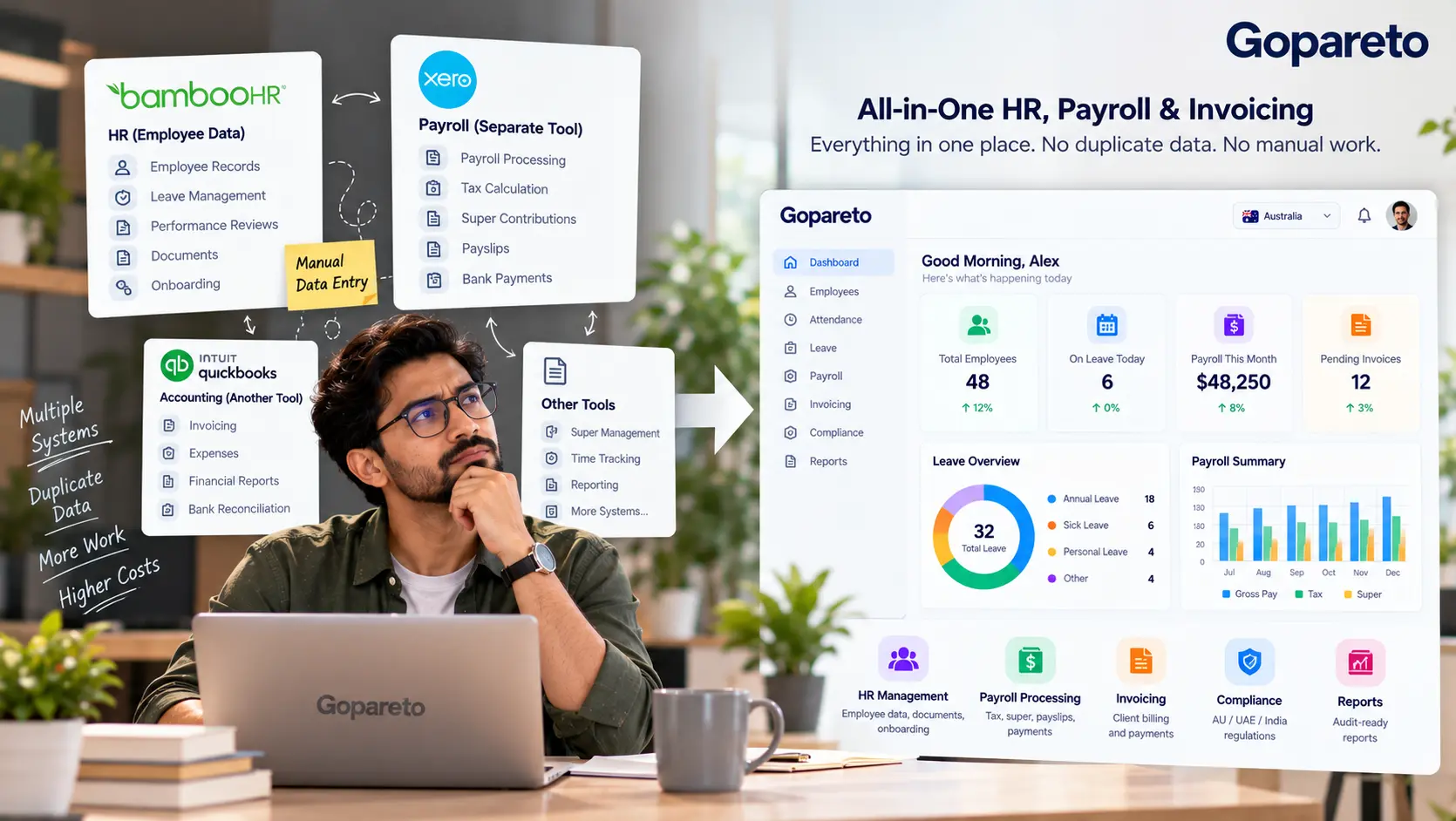
You’ve chosen BambooHR, or you’re close to it. The interface is clean, your managers actually approve leave in it, and employee records finally live in one place. Then someone asks the obvious question: where does payroll happen?
At the time of writing, BambooHR’s own payroll product is offered in the United States only. If you employ people in Australia, India or the UAE, BambooHR will hold your people data but it will not calculate PAYG withholding, superannuation, PF, ESI or end-of-service gratuity. That work has to happen somewhere else.
We have already covered whether to replace BambooHR with an all-in-one platform. This guide answers a more practical question: whatever you decide, what does the payroll side actually need to do, and how do you stop the gap between HR and pay from turning into errors?
What BambooHR Gives You, and Where It Stops
Being fair to the product matters, because the gap only makes sense once you see what sits on each side of it.
Covered well by BambooHR
- Employee records, documents and org chart
- Time-off requests, approvals and balances
- Onboarding checklists and e-signatures
- Performance reviews and goals
- Hiring and applicant tracking
- A pleasant employee self-service portal
Not covered outside the US
- Gross-to-net pay calculation
- Tax withholding and statutory deductions
- Superannuation, PF/ESI or gratuity calculations
- Payslips that employees can see alongside leave
- Government reporting such as STP or WPS files
- Leave paid out at termination
Check before you decide
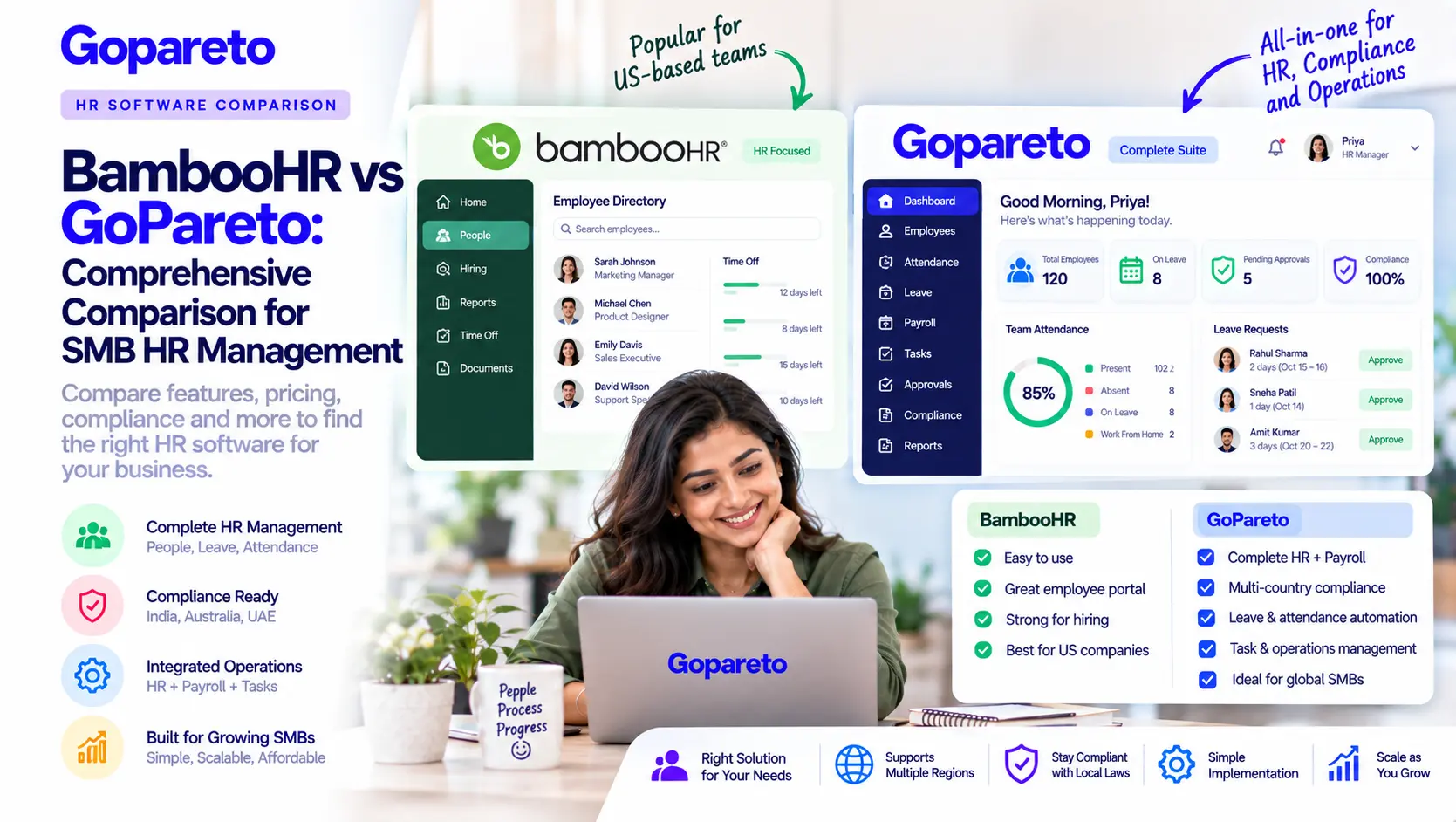
Vendor capabilities and regional availability change. Confirm current payroll coverage for your country directly with BambooHR and with any payroll partner it recommends. Our full BambooHR vs GoPareto comparison covers the HR features side by side.
The Real Problem Is the Handoff
Running two systems is not wrong in itself. Plenty of businesses pair an HR platform with a payroll platform and are perfectly happy. The risk sits in the handoff—the moment information that lives in BambooHR has to change what someone is paid.
Every pay run, these facts must cross the gap correctly:
| Event in BambooHR | What payroll must do | What goes wrong if it’s missed |
|---|---|---|
| New starter added | Create the employee with tax, bank and fund details before the first pay date | First pay is late or taxed at the wrong rate |
| Leave approved | Pay leave at the correct rate (including any loading) and reduce the balance | Balances disagree between systems; leave is paid twice or not at all |
| Unpaid leave approved | Deduct the right number of days or hours | Overpayment that must be recovered from the employee |
| Salary change | Apply the new rate from the correct effective date | Back-pay calculations and an unhappy employee |
| Address or bank change | Update payment and tax records | Payment fails or documents go to the wrong place |
| Termination | Pay final wages, notice and unused leave; process statutory amounts | Underpaid final settlement and a likely complaint |
Each of these is simple on its own. The trouble is that they happen every cycle, someone has to remember all of them, and the two systems will happily disagree without telling you. Our guide to preventing payroll errors in a small business shows how often these handoffs are the root cause.
What Your Payroll Layer Must Handle, by Country
Whichever tool fills the gap, it needs to cover the statutory work for every country you employ in. Use this as a requirements list when you talk to vendors.
Australia
Payroll requirements for Australian employees
- PAYG withholding using current ATO tax tables, including Medicare levy and study-loan adjustments
- Superannuation Guarantee at 12% of ordinary time earnings (the rate from 1 July 2025)
- Payday Super: from 1 July 2026, super must reach the employee’s fund within 7 days of payday rather than quarterly
- Single Touch Payroll Phase 2 reporting every pay event
- Modern award rates, penalty rates and leave loading (awards are federal, set by the Fair Work Commission)
- NES leave accruals and correct payout of unused annual leave on termination
Payday Super is the change most likely to expose a weak handoff: if leave and hours arrive late from your HR system, super is calculated late too. See how to calculate super contributions correctly for the detail.
India
Payroll requirements for Indian employees
- Provident Fund at 12% employee and 12% employer contributions on PF wages
- ESI at 0.75% employee and 3.25% employer for employees earning up to ₹21,000 a month
- TDS on salary, Form 16 and state professional tax where applicable
- Gratuity after five years’ continuous service (15 × last drawn salary × years ÷ 26)
- Loss of Pay deductions driven by attendance and approved unpaid leave
- Wage definitions aligned with the four Labour Codes, in force from 21 November 2025
UAE
Payroll requirements for UAE employees
- Salary paid through the Wage Protection System (WPS) on time
- End-of-service gratuity: 21 days’ basic pay per year for the first five years, 30 days per year after that, capped at two years’ total pay
- Annual leave and public holiday pay under Federal Decree-Law No. 33 of 2021, regulated by MoHRE
- Final settlement calculated and paid on exit
The test: if your payroll tool can’t show you, for one employee, the leave taken in BambooHR and the matching line on their payslip, the handoff is still manual.
Three Ways to Close the Gap
There is no single right answer. The right one depends on how much you value BambooHR’s HR features and how painful your pay run has become.
Keep BambooHR, add a local payroll tool
Best when hiring and onboarding are your priority and you employ in one country. Budget for an integration or a disciplined export routine, and assign one person to own the reconciliation every cycle.
Keep BambooHR, outsource payroll
An accountant or payroll bureau runs pay from the data you send. This removes the calculation burden but not the handoff—you still need clean, timely leave and change data every period.
Move HR and payroll into one platform
Leave, attendance and pay share one employee record, so there is nothing to sync. The trade-off is that dedicated applicant tracking is usually lighter than BambooHR’s.
Hybrid for heavy hiring
Use a specialist recruiting tool for hiring, and an all-in-one platform for everything after the offer is signed. One deliberate integration beats several accidental ones.
For very small teams the economics are different again; our BambooHR or GoPareto guide for small teams walks through the 5–50 employee range, and our guide to affordable HR software for small business shows how to price each option honestly.
Warning Signs Your Current Setup Isn’t Working
In the pay run
- Every pay run starts with an export from BambooHR
- Leave balances differ between the HR portal and the payslip
- Unpaid leave is caught after payment, not before
- Final pays are calculated in a spreadsheet
Around the business
- Employees ask HR for payslips because the portal doesn’t show them
- Your accountant queries leave liabilities each year
- New starters have been paid late at least once
- Only one person understands how the two systems connect
Two or more of these usually means the handoff is costing more than you think. A self-service portal that shows leave and pay together also takes a lot of routine questions off HR’s desk—see how self-service portals reduce HR questions.
If You Consolidate: A Practical Migration Plan
Moving from BambooHR plus a payroll tool to a single platform is mainly a data exercise. Plan it around a clean cut-over date, ideally the start of a pay period or quarter.
Export and clean employee data
Pull profiles, job and salary history from BambooHR, and tax, bank and fund details from payroll. Fix mismatches before import, not after.
Agree opening leave balances
Reconcile each employee’s balance between both systems and have it signed off. This becomes the opening balance in the new platform.
Bring year-to-date pay figures
Year-to-date earnings, tax and contributions are needed for correct year-end reporting. In Australia, plan the STP transition with your payroll provider.
Run a parallel pay
Process at least one pay run in both systems and compare every payslip line. Investigate differences until they are explained.
Switch and archive
Cut over, then keep read-only exports of historical records for your statutory retention period.
Brief employees
Tell staff where to request leave and find payslips from day one, so the old portal isn’t used by habit.
Frequently Asked Questions
It offers its own payroll in the United States. Elsewhere it relies on integrations with third-party payroll providers. Check current coverage with the vendor.
Yes, if the integration is reliable and someone owns the reconciliation. Problems start when the sync is partial or manual.
Approved leave (paid and unpaid), new starters, salary changes and terminations. These directly change what someone is paid.
Possibly. Most all-in-one HR and payroll platforms have lighter applicant tracking than BambooHR. Heavy hirers may prefer a hybrid.
It depends on headcount and data quality, but the critical path is usually reconciling leave balances and running at least one parallel pay. Choose a cut-over at the start of a pay period.
Conclusion
BambooHR is a good HR system. Outside the US, it is not a payroll system, and that is a deliberate choice rather than a flaw. What matters is how you fill the gap: a payroll layer that handles the statutory work in every country you employ in, and a handoff that doesn’t depend on someone remembering to copy leave into a spreadsheet.
If your handoff is stable, keep what you have. If it isn’t, putting leave, attendance and pay on one employee record is the most reliable way to make it disappear.
Ready to close the payroll gap?
How GoPareto Helps
- HR records, leave, attendance and payroll on one employee record, with no sync to manage
- Approved leave and unpaid leave flow straight into the pay calculation
- Payroll compliance for Australia, India and the UAE in one platform
- A self-service portal where employees see leave balances and payslips together
Visit Us
GoPareto - Simple & Complete Business Management solution, Omkar Nandan Apartment, A1 201, near Navale Bridge, Kudale Baug, Narhe, Pune, Maharashtra 411041.
Related Blogs