Extended Public Holiday Periods 2027: Planning for Peak Leave Seasons
September 25, 2026 | By Gopareto Marketing
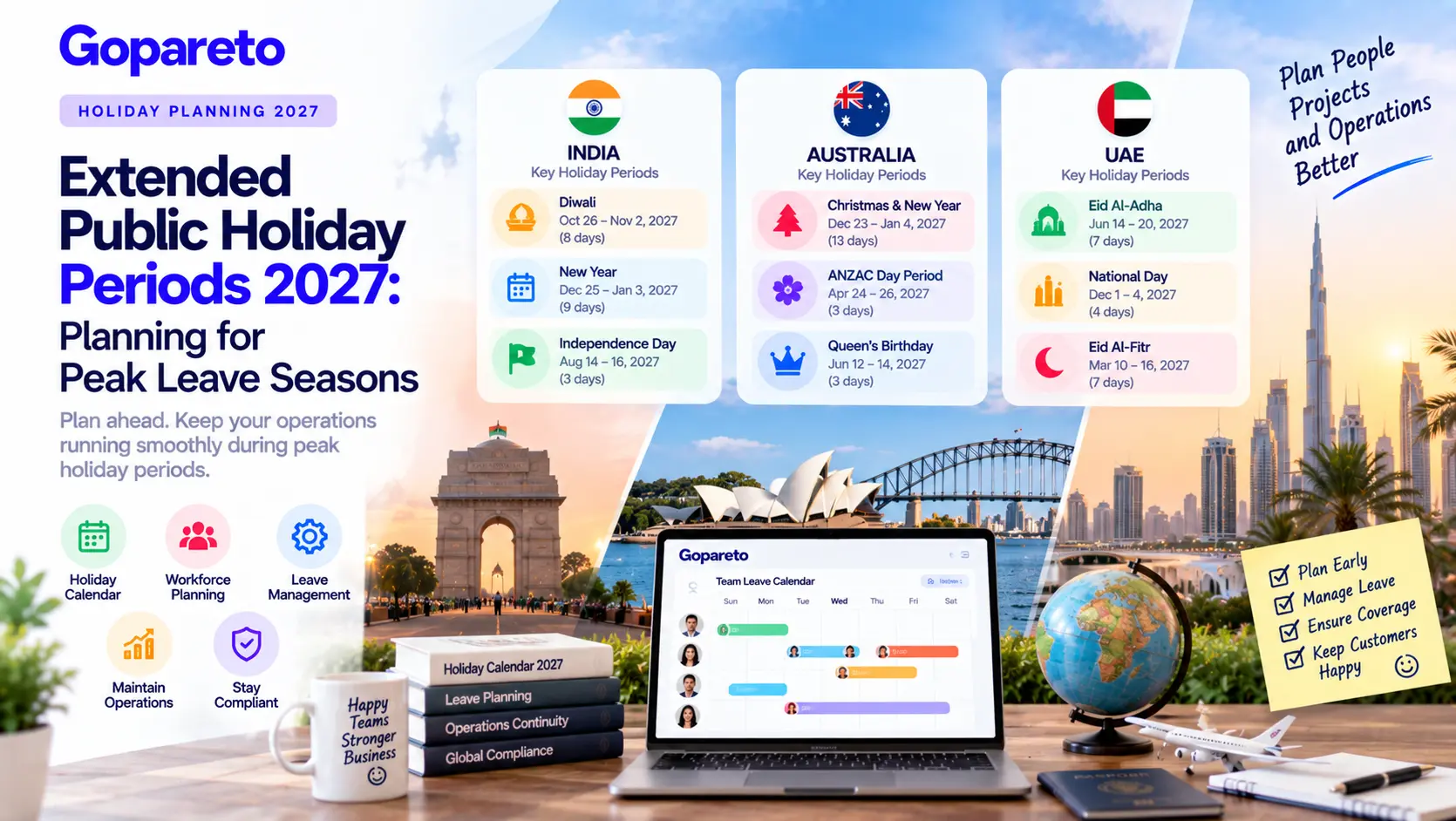
Public holidays cluster at specific times of year, creating “extended holiday periods” when organisations face serious workforce unavailability. In 2027, several regions hit these peaks close together—particularly around Diwali in India, Eid in the UAE, and Christmas and New Year everywhere.
For organisations operating across India, Australia and the UAE, managing extended holiday periods takes proactive planning: leave coverage, customer communications, project scheduling and payroll coordination. Organisations that plan these periods deliberately keep operations running and keep employees happy.
This guide maps the extended public holiday periods of 2027 and sets out an operational strategy for each.
A note on dates: every weekday in this guide has been checked against the 2027 calendar. Lunar-calendar holidays (Diwali, Holi, both Eids) are expected dates and can move by a day or more; Islamic holidays in the UAE are confirmed by official announcement only shortly before they fall. Always confirm against your state or government notification.
Extended Holiday Periods 2027: Regional Overview
India
- Diwali: Friday 29 October; extended period Tuesday 26 October to Tuesday 2 November (8 days including the weekend). Many employees use remaining Casual Leave or take LWP and travel home. Availability: 40–50%.
- Year-end: Christmas falls on Saturday 25 December; the extended period runs Thursday 23 December to Monday 3 January 2028. Heaviest annual leave usage of the year. Availability: 30–40%.
- Independence Day: Sunday 15 August, so the holiday itself lands on the weekend. Short, with lower leave usage. Availability: 60–70%.
Australia
- Christmas and New Year: Christmas Day and Boxing Day fall on a weekend, and so does New Year’s Day 2028, so substitute weekday holidays apply in most states. Many bridge Thursday 23 December to Tuesday 4 January 2028 (13 days) with annual leave. Availability: 20–30%, the lowest of the year during the summer holidays.
- Easter and ANZAC Day: Good Friday is 26 March and Easter Monday 29 March; ANZAC Day falls on Sunday 25 April, with some states adding a Monday substitute. School holidays sit around both. Availability: 50–60%.
- King’s Birthday: Monday 14 June in most states; Queensland and Western Australia hold it later in the year. A 3-day weekend that some extend with leave. Availability: 60–70%.
UAE
- Eid al-Fitr: expected around early to mid March 2027 at the end of Ramadan, subject to moon sighting.
- Eid al-Adha: expected mid-May 2027, subject to moon sighting. Arafat Day plus the Eid days typically give around four days off, often longer when combined with the weekend. Availability: 40–50% as many travel home.
- Commemoration Day and National Day: Wednesday 1 December to Friday 3 December, running straight into the Saturday–Sunday weekend for a 5-day break (1–5 December). Availability: 30–40% across the December peak.
- Summer: not an official holiday, but the peak vacation season once schools break for summer. Expect 50–60% availability.
For the full list of dates behind these periods, see our India national holidays 2027 HR calendar and the UAE public holidays 2027 guide.
Key Operational Challenges of Extended Holiday Periods
Extended holiday periods put pressure on five parts of the business at once. The figures below are typical ranges, not benchmarks—your own leave history is the best guide.
1. Leave request surge
The challenge
- Requests arrive weeks or months ahead and concentrate on the same dates
- Managers can receive 30–40% of annual leave requests in a 6–8 week window
- Without rules, approval becomes reactive: first-come, first-served or seniority
- Last-minute requests leave teams understaffed
The solution
- Open early request windows (e.g. “Diwali leave requests open 1–15 September”)
- Cap the share of each team on leave (e.g. a maximum of 40% during Diwali)
- Keep “core team” schedules so critical roles are always staffed
- Balance holiday access across seniority levels and departments
We cover request windows and caps in more depth in how to manage leave during peak business seasons.
2. Capacity and headcount planning
The challenge
- Projects and deadlines don’t pause for holidays
- Customers expect continuous service; support teams cannot fully close
- Payroll, compliance and security need year-round staffing
The solution
- Classify roles as essential, important or flexible
- Build holiday rosters weeks in advance
- Cross-train staff so coverage doesn’t fall on one person
- Agree reduced service levels with customers ahead of time
- Budget for overtime and shift premiums
Typical staffing floors: revenue-generating teams often need 70–80% staffed through extended periods, support teams 50–60%, while back-office functions such as HR and Finance can often run on 20–30%.
3. Leave carry-over and encashment
The challenge
- Some employees exhaust leave in the peaks; others hoard it
- Unused leave carries over or is paid out
- That creates a financial liability and leave “bloat” the following year
The solution
- Cap carry-over (for example 5–10 days), within what local law allows
- Encourage leave in non-peak periods
- Allow partial mid-year encashment where permitted
- Communicate carry-over rules clearly to prevent disputes
What it costs (India example): without active management, an employee can end the year with 5–8 unused days. At an encashment rate of ₹500–1,000 per day that is ₹2,500–8,000 per employee, or ₹2.5–8 lakh a year across a 100-person company.
4. Project scheduling and deadlines
The challenge
- December deadlines run straight into workforce gaps
- Client deliverables slip, with revenue impact
- Without holiday scheduling, December–January productivity can drop 40–50%
- Catch-up overtime drives burnout in January–February
The solution
- Put major milestones in quieter months (September, February–March outside Ramadan and Easter)
- Build a 15–20% buffer into timelines that cross peak periods
- Set “freeze periods” for new feature work
- Use peaks for maintenance and non-critical work
- Tell customers your shutdown schedule early
5. Payroll and compliance complexity
The challenge
- Holiday pay, shift premiums and bonuses all vary the payroll
- India requires accurate leave categorisation (Earned Leave vs LWP)
- PF and ESI contributions depend on wages actually paid, so leave status matters
- Leave encashment has its own tax treatment
The solution
- Pre-calculate holiday payroll scenarios
- Test payroll processing before each peak
- Tie PF/ESI calculations automatically to leave status
- Model leave encashment scenarios in advance
- Agree bonus and shift premium budgets with Finance
For the India statutory side—leave, PF and gratuity—see our HRMS India compliance guide.
Detailed Holiday Planning Calendar: 2027
| Date (2027) | Holiday | Region | Extended window | Availability |
|---|---|---|---|---|
| Fri 1 Jan | New Year’s Day | Australia, UAE; widely observed | Fri 25 Dec 2026 – Sun 3 Jan | 30–40% |
| Tue 26 Jan | Republic Day (India); Australia Day | India, Australia | Sat 23 – Tue 26 Jan (bridge Monday) | 60–70% |
| Mon 8 Mar | International Women’s Day (not a public holiday; some organisations observe) | Optional | Sat 6 – Mon 8 Mar | 70–80% |
| Early–mid Mar (expected) | Eid al-Fitr | UAE | Around 3 days plus weekend | UAE reduced |
| Mon 22 – Tue 23 Mar | Holi | India | Sat 20 – Tue 23 Mar | 50–60% |
| Fri 26 – Mon 29 Mar | Good Friday to Easter Monday | Australia (all states); India (Good Friday) | Fri 26 – Mon 29 Mar | Australia 60–70%; India 90%+ |
| Wed 14 Apr | Ambedkar Jayanti; Tamil New Year | India | Wed 14 – Thu 15 Apr | 80–90% |
| Sun 25 Apr | ANZAC Day (Monday substitute in some states) | Australia | Sat 24 – Mon 26 Apr | Australia 50–60% |
| Sat 1 May | May Day (observed in some Indian states) | India (regional) | Fri 30 Apr – Sun 2 May | 90%+ |
| Mid-May (expected) | Arafat Day and Eid al-Adha | UAE | Around 4 days plus weekend | UAE 40–50% |
| Mon 14 Jun | King’s Birthday (most states) | Australia | Sat 12 – Mon 14 Jun | Australia 60–70% |
| Sun 15 Aug | Independence Day | India | Falls on the weekend | 70–80% |
| Sat 2 Oct | Gandhi Jayanti | India | Falls on the weekend | 85–90% |
| Fri 29 Oct | Diwali | India | Tue 26 Oct – Tue 2 Nov | 40–50% |
| Wed 1 – Fri 3 Dec | Commemoration Day; National Day | UAE | Wed 1 – Sun 5 Dec | UAE 40–50% |
| Sat 25 Dec | Christmas (Australia; widely observed in India) | Australia, India | Thu 23 Dec – Mon 3 Jan 2028 | 30–40% |
Queensland and Western Australia celebrate the King’s Birthday later in the year (typically late September or early October), so check the state calendar for those teams. Weekend holidays in India do not usually get a substitute weekday; in Australia, substitute days depend on the state.
Diwali 2027: the India peak
Diwali falls on Friday 29 October, with Saturday 30 and Sunday 31 October on the weekend and post-Diwali observances (often restricted holidays) on Monday 1 and Tuesday 2 November. Many organisations also pay a Diwali bonus.
Diwali planning actions
- Open leave requests by early September
- Finalise team rosters by early October
- Brief customers on reduced service from 26 October to 2 November
- Prepare payroll for the Diwali bonus
Christmas and New Year 2027–28: the global peak
Christmas Day is Saturday 25 December, New Year’s Eve is Friday 31 December and New Year’s Day 2028 is Saturday 1 January. The practical shutdown runs from Thursday 23 December to Monday 3 January 2028—12 days, with summer holidays making it the lowest-availability period of the year in Australia.
Year-end planning actions
- Open leave requests by September
- Finalise year-end project schedules by 31 October
- Communicate shutdown dates by 1 November
- Plan critical cover for 1–3 January by November
- Consider closing offices from 24 December to 2 January
- Brief accounting teams: December close work should be complete by 20 December
- Prepare payroll for year-end bonuses
For the Australian rostering detail, including awards and shutdown notice, see Christmas break 2027: rostering and leave planning.
Country-Specific Holiday Planning Strategies
India
Critical periods
- Holi: 20–23 March (4 days)
- Diwali: 26 October – 2 November (8 days)
- Year-end: 23 December – 3 January 2028 (12 days)
Key planning actions
- Communicate the holiday schedule by 1 August
- Open Diwali leave requests by 1 September and year-end requests by 15 September
- Avoid new project launches from mid-September to end-October, and mid-November to mid-January
- Finalise critical rosters by 1 October (Diwali) and 1 November (year-end)
Payroll considerations
- Diwali bonus: typically 0.5–2 months’ salary; budget by August
- Year-end bonus: January payout; coordinate with Finance
- Leave encashment: high at year-end; coordinate with payroll
- PF/ESI: verify contributions across leave periods
- TDS: calculate correctly on leave encashment
Australia
Critical periods
- Easter: around 25 March – 5 April (with school holidays)
- ANZAC and autumn break: around 24 April – 5 May
- Christmas/New Year: 24 December – 4 January 2028 (12 days)
Key planning actions
- Open Easter leave requests by 1 January; finalise rosters by 1 February
- Open Christmas leave requests by 1 September; finalise rosters by 1 November
- Avoid major launches from 1 March to mid-May and mid-November to end-January
- Plan major milestones for February, June and July–August
Payroll considerations
- Superannuation: contributions continue on paid leave
- Awards and public holidays vary by state (Victoria, for example, has its own)
- Long service leave is often taken in extended periods; coordinate it
- Public holiday penalty rates apply in many industries
- Employees get at least 4 weeks’ annual leave, and many spend it here
Our Fair Work Australia compliance calendar 2027 covers the other dates Australian payroll needs to plan around.
UAE
Critical periods
- Eid al-Fitr: expected early–mid March (after Ramadan, which begins in February)
- Eid al-Adha: expected mid-May, around 4 days with Arafat Day
- Commemoration Day and National Day: 1–5 December, running into year-end leave for expatriate staff
Key planning actions
- Block provisional windows for both Eids now; confirm dates from the official announcement
- Avoid launches in the fortnight around each Eid and from mid-November to mid-January
- Finalise rosters a month before each Eid and by 1 November for year-end
- Plan major milestones for April, June–September and October–November
Payroll considerations
- End-of-service gratuity: keep calculations accurate as leave is taken
- Leave encashment: high at year-end
- End-of-service benefits are due on separation; plan exits around holidays
- Government processing (visas, Emirates ID) slows around public holidays
Cross-Regional Planning for Multi-Location Organisations
For organisations with teams in India, Australia and the UAE, the calendars don’t align:
- India’s year-end peak overlaps with the Australian summer
- UAE National Day leads straight into the December peak
- The Eids move roughly 11 days earlier every year
- Staggered holidays mean continuous but partial loss of global capacity
| Period (2027) | What happens | Capacity |
|---|---|---|
| January | Year-end recovery | Returning to 100% |
| February – March | Ramadan and Eid al-Fitr (UAE); Holi (India); Easter (Australia) | Partial reductions by region |
| April – May | ANZAC and school holidays (Australia); Eid al-Adha (UAE) | Australia or UAE around 50% |
| June – September | No major shared holidays; summer travel in the UAE | Largely 100% |
| Late October – early November | Diwali (India) | India around 40%, others 100% |
| December – early January | National Day (UAE), Christmas and New Year | All regions 30–50% |
Follow regional calendars
Each team follows its own country’s holidays, and global projects are scheduled around all of them.
Staggered global coverage
Rotate critical functions across regions: when India is on Diwali, UAE or Australia staff cover. Requires cross-training and clear handoffs.
Outsourced continuity
Use contractors for critical functions such as customer support and monitoring during peaks. Expect a 20–40% premium in exchange for continuity.
Tools and Systems for Holiday Planning
A modern HRMS such as GoPareto should give you:
- Holiday calendars by country, state and region
- Leave caps per department per period
- Capacity reporting by team, role and period
- Conflict alerts for under- or over-staffing
- Approval workflows that route peak requests
- Payroll integration for holiday pay, bonuses and encashment
- Project timeline sync against low-capacity periods
- Audit trails for every leave decision
Summary: 2027 Holiday Planning Checklist
Now to December 2026
- Communicate the 2027 holiday calendar to all staff
- Identify the extended holiday periods for your regions
- Set leave request windows and caps
- Plan major project milestones around the peaks
- Brief Finance on holiday payroll and bonus budgets
- Block provisional windows for Eid al-Fitr and Eid al-Adha
By September 2027
- Open leave requests for Diwali and the year-end period
- Draft rosters for critical functions
- Agree service expectations with customers and partners
By October 2027
- Finalise Diwali rosters
- Prepare payroll for Diwali bonuses
- Test payroll against holiday scenarios
By November 2027
- Finalise year-end project schedules and December–January rosters
- Plan the year-end financial close with reduced staff
- Communicate the year-end shutdown to customers and partners
December 2027
- Review payroll for holiday issues
- Finalise January 2028 payroll, including bonuses
- Plan the recovery phase: January workload and staffing return
Ready to simplify holiday planning?
How GoPareto Helps
- Multi-region holiday calendars for India, Australia and the UAE
- Leave windows and team caps enforced automatically during peak periods
- Capacity views that show who is available, by team and by date
- Holiday pay, bonuses and leave encashment flowing straight into payroll
Visit Us
GoPareto - Simple & Complete Business Management solution, Omkar Nandan Apartment, A1 201, near Navale Bridge, Kudale Baug, Narhe, Pune, Maharashtra 411041.
Related Blogs