Error-Free Payroll for Small Business: Complete System Guide
September 1, 2026 | By Gopareto Marketing

Payroll errors are among the most expensive mistakes a small business can make, and they rarely stay small. One salary calculated on the wrong number of working days, one tax withholding slightly off, one leave deduction applied against the wrong balance — multiply that across twenty or fifty employees and across twelve months, and the cost stops being trivial.
What a Payroll Error Actually Sets Off
- An employee who is paid incorrectly — and who will notice
- Rework: HR investigates, corrects, regenerates the payslip, adjusts the books
- Compliance exposure, because the statutory filing was built on the wrong figure
- Audit difficulty, since every correction has to be documented and reconciled
- Erosion of trust, which is the part that does not show up in any ledger
The underlying problem is almost never carelessness. It is that spreadsheets, calculators and email are not adequate tools for something this consequential. The fix is systemic, and it is achievable.
Why Payroll Errors Happen in Small Businesses
1. Attendance data does not match payroll
This is the single largest cause. Employees record hours one way, attendance is stored somewhere else, and a human retypes the result into payroll. Every retype is an opportunity for a typo, a missed entry or a misread figure.
A typical case: an employee works nine days in a month after one day of medical leave. The timesheet is correct. Payroll is entered as eight days. The employee is short several thousand rupees, raises it, and HR spends two to three hours investigating, correcting and reissuing. Repeat that across twenty employees a month and you have lost forty to sixty hours of HR capacity to transcription.
2. Manual statutory calculations are fragile
Indian payroll is genuinely complex. Income tax runs on slab rates that change. PF is calculated on basic plus DA, which requires agreeing what counts as basic. ESI varies by state and by salary threshold. Investment declarations affect withholding. Any of these can be applied using last year's rule without anyone noticing, and a ₹500 monthly error quietly becomes a ₹6,000 annual one.
3. Leave adjustments are complicated
Different leave types carry different rules: what is paid, what is encashable, what carries over, what is capped. When the balance lives in a spreadsheet that is updated after the fact, the balance is wrong more often than it is right. Our guide to streamlining employee leave management goes deeper on the policy side.
4. Compliance deadlines are missed
Monthly PF filing, state-varying ESI filing, TDS returns and Form 16, annual filings for contractors — each has a date, and none of them announce themselves. Missed deadlines and mismatched periods are a common source of notices.
5. Rework multiplies the original error
A single discovered error triggers a correction, a reissued payslip, possibly a reversal or adjustment if payment has already gone out, an accounting entry, and potentially an amended statutory filing. One mistake becomes five or six pieces of work.
What Payroll Errors Cost
| Impact | Where it lands | Indicative cost per incident |
|---|---|---|
| Investigation and correction | HR time, two to three hours | ₹1,000 – ₹1,500 |
| Incorrect statutory filing | Penalty exposure | ₹5,000 – ₹50,000 |
| Accounting adjustment | Finance time, reconciliation | ₹500 – ₹1,000 |
| Attrition risk | Replacement cost, apportioned | ₹2,000+ |
| Audit remediation | Reconstructing records | Variable, often the largest |
A fifty-person company averaging one meaningful payroll error a month is realistically carrying somewhere around ₹1 lakh a year in avoidable cost — before counting missed deadlines or an actual audit. These are illustrative ranges, but running the same arithmetic on your own error rate is a useful exercise.
The Solution: Five Layers of Automation
Error-free payroll is not about a better calculator. It is about removing every point where a human retypes a number.
Automated attendance integration
Employees clock in through an app; attendance flows into payroll without an export. Leave requests deduct automatically. No transfer means no transcription error.
Automated statutory calculation
The system holds current income tax slabs, PF rules and state-specific ESI rates, and applies them consistently. Rates are updated centrally when they change, not re-derived every month.
Automated leave management
Policy is configured once. Requests route through approval, balances update themselves, encashment and carryover follow the configured rule, and payroll reads the result.
Automated compliance workflow
Deadlines are tracked and flagged, statutory reports generate from the same data payroll used, and audit trails are complete because nothing was assembled by hand.
Automated payslip distribution
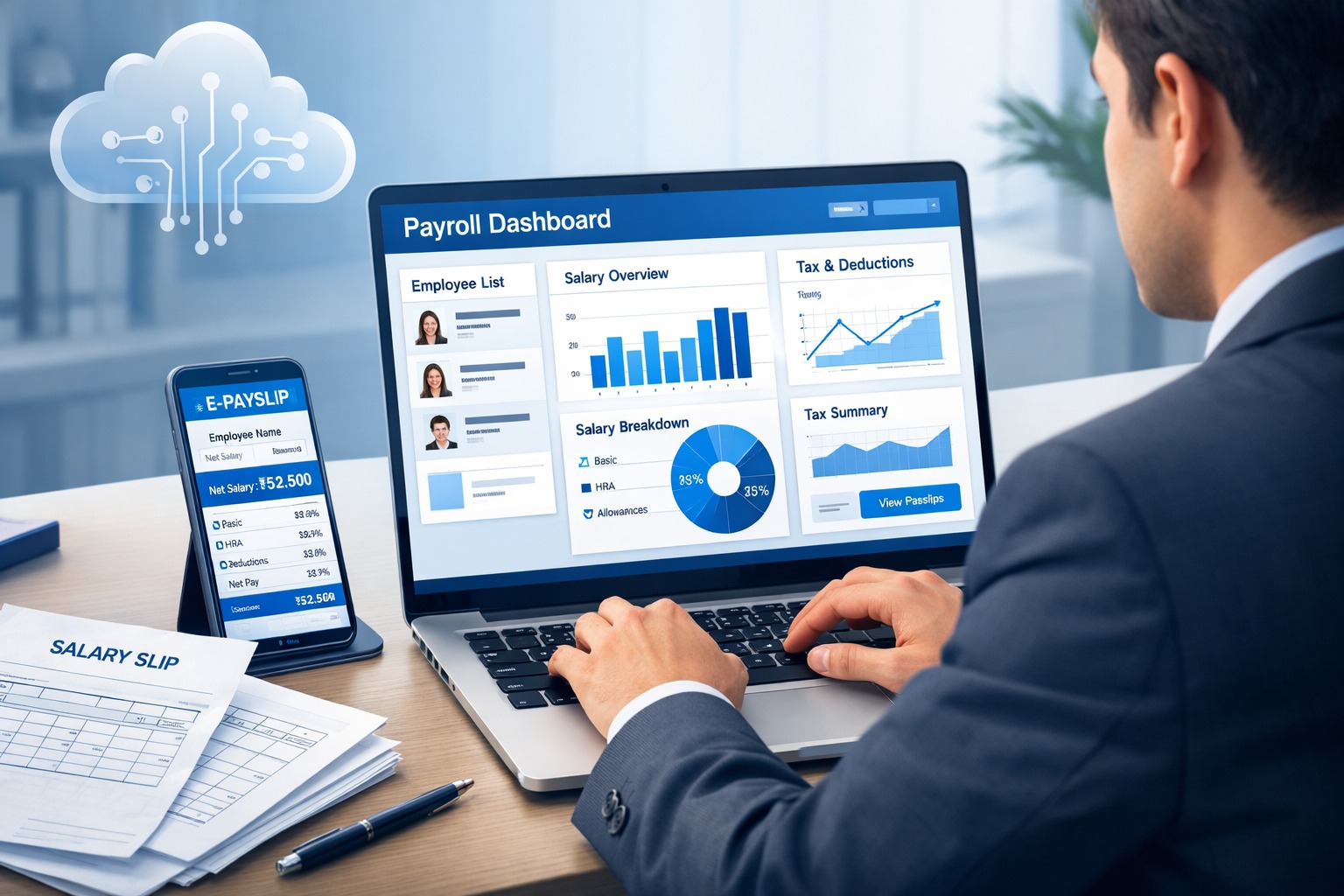
Payslips generate the moment payroll is finalised and are available to employees in the app. Nothing is printed, emailed individually, or lost.
A Five-Week Implementation Plan
| Phase | Timing | What happens |
|---|---|---|
| System selection | Weeks 1 – 2 | Shortlist against attendance integration, India-specific compliance, mobile apps and support quality. Trial with your own data. |
| Data migration | Weeks 2 – 3 | Move current payroll master data, historical records, leave balances and archived compliance filings. |
| Configuration | Week 3 | Set up salary components, leave policy, tax parameters, approval workflows and state-specific rules. |
| Training | Week 4 | HR on the full system, managers on attendance and leave approval, employees on the mobile app. |
| Go live | Week 5 | Run the first payroll in parallel with the old process, reconcile line by line, then cut over. |
Run the First Cycle in Parallel
Process month one in both the old and new systems and compare every employee line. It costs one extra cycle of effort and it is the single most effective way to catch a misconfigured salary component before it reaches a payslip.
GoPareto: Payroll That Reads Its Own Attendance Data
How GoPareto Prevents Errors
- Attendance management feeds payroll directly, with no manual entry step
- Leave policy and compliance holds balances, encashment and carryover rules centrally
- Automatic payslip generation the moment payroll is approved
- Statutory deductions for income tax, PF and ESI applied by configured rule
- Approval workflows that surface anomalies before payroll is committed
- Extensive reports and audit trails generated from a single dataset
If the root problem in your setup is that HR, attendance and payroll are three different products, the broader case for consolidation is in why bundled solutions beat multiple tools. For a deeper look at the calculation engine itself, see our complete guide to payroll calculation software.
Common Questions About Automated Payroll
Will employees trust an automated system?
Employees trust accurate payroll, whatever produced it. Consistency across a few cycles builds more confidence than any announcement.
Our payroll is complex — multiple allowances, variable deductions, project-based pay. Will it cope?
Complexity is a configuration question, not a blocker. What matters is whether the system lets you express your salary structure as rules rather than as a monthly spreadsheet edit.
How is payroll data protected?
Look for encryption in transit and at rest, role-based access so that only payroll staff see salary data, regular backups, and a clear position on data protection compliance.
Can salary transfers go straight to the bank?
Bulk transfer files for Indian banks are standard in a competent payroll system, along with reconciliation against the confirmations that come back.
What about state-specific rules?
Ask this explicitly during evaluation, naming your states. ESI thresholds, professional tax and leave entitlements all vary, and a system that treats India as uniform will be wrong somewhere.
Key takeaway: payroll accuracy is a property of the process, not of the person running it. Remove every manual hand-off between attendance, leave and payroll, and the error rate falls close to zero on its own.
Related Blogs